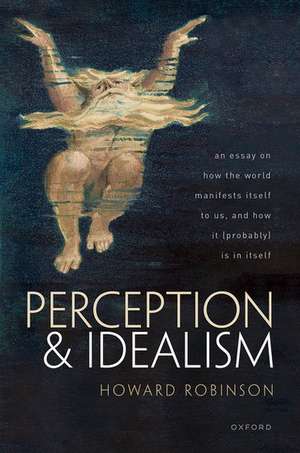
Perception and Idealism: An Essay on How the World Manifests Itself to Us, and How It (Probably) Is in Itself
Autor Howard Robinsonen Limba Engleză Hardback – 17 noi 2022
Preț: 565.63 lei
Preț vechi: 727.55 lei
-22%
Puncte Express: 848
Carte disponibilă
Livrare economică 27 noiembrie-08 decembrie
Livrare express 13-19 noiembrie pentru 74.63 lei
Livrare prin curier în România Termenul estimat este afișat lângă disponibilitate.
Transport gratuit pentru acest produs Plată online sau ramburs, în funcție de opțiunile comenzii.
Retur gratuit în 14 zile Comandă securizată și suport în română.
Specificații
ISBN-13: 9780192845566
ISBN-10: 019284556X
Pagini: 248
Dimensiuni: 162 x 242 x 20 mm
Greutate: 0.53 kg
Editura: OUP OXFORD
Colecția OUP Oxford
Locul publicării:Oxford, United Kingdom
ISBN-10: 019284556X
Pagini: 248
Dimensiuni: 162 x 242 x 20 mm
Greutate: 0.53 kg
Editura: OUP OXFORD
Colecția OUP Oxford
Locul publicării:Oxford, United Kingdom
Recenzii
Robinson's book is clearly and beautifully written, and argumentatively persuasive ... a refreshing blast of curative air breathed into the dank enclosures of Direct Realism, Disjunctivism and Reductive Representationalism.
Robinson argues for a kind of idealism, providing well-organized, well-documented discussions of both early modern and recent philosophers' views on the nature of perception and its relationship to the world.
Robinson argues for a kind of idealism, providing well-organized, well-documented discussions of both early modern and recent philosophers' views on the nature of perception and its relationship to the world.
Notă biografică
Howard Robinson is Professor Emeritus in Philosophy at Central European University, Vienna. He is also Research Fellow at Blackfriars Hall, Oxford, and Senior Fellow, Rutgers Center for Philosophy of Religion. He was educated at Manchester Grammar School and Corpus Christi College, Oxford. He previously held positions at the University of Nottingham, Oriel College, Oxford, University of Liverpool, and Eötvös Loránd University, Budapest.
Cuprins
- Introduction
- Part I: How the World Manifests Itself to Us
- 1: The Causal Argument for Sense-Data, 'Philosophers' Hallucinations', and the Disjunctive Response
- 2: Naïve Realism and the Argument from Illusion
- 3: Intentionality and Perception (I): The Fundamental irrelevance of Intentionality to Phenomenal Consciousness
- 4: Intentionality and Perception (II): Attempts to Articulate the 'Content' and 'Object' Distinction
- 5: Singular Reference and its Relation to Intentionality
- 6: Objectivity: How is It Possible?
- 7: Semantic Direct Realism, Critical Realism, and the Sense-Datum Theory
- 8: Building the Manifest World
- Part II: What the World Is, in Itself
- 9: The Problematic Nature of the Modern Conception of Matter
- 10: Two Suggestive Berkeleyan Arguments
- 11: Bishop Berkeley and John Foster on Problems with Physical Realism about Space
- 12: Mentalist Alternatives to Berkeleyan Theism, and their Failure
- General Conclusion