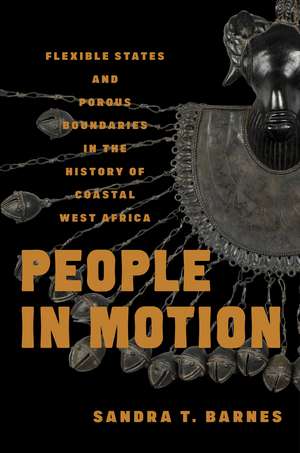
People in Motion: Flexible States and Porous Boundaries in the History of Coastal West Africa: Africa and the Diaspora: History, Politics, Culture
Autor Sandra T. Barnesen Limba Engleză Hardback – 9 iun 2026
In People in Motion, Sandra T. Barnes offers a history focused on the Benin Region’s patchwork of small states and ports that saw a constant movement of people and goods for centuries. As such, this book widens the lens of scholarship, formerly limited to kings and elite merchants, to include people of all social levels who provided the dynamism behind the political rivalries and changes that marked the period. Barnes concentrates on protective relationships and the violence people were forced to endure during a fast-moving, tumultuous period of history, examining how they organized their lives and why this mattered. The result is a refreshingly original work that challenges long-held assumptions about West Africa’s past, explaining what life was like for people on the coast during the transatlantic slave trade.
Din seria Africa and the Diaspora: History, Politics, Culture
- 19%
 Preț: 470.84 lei
 - 19%
 Preț: 420.41 lei
 -
 Preț: 158.50 lei
 -
 Preț: 489.45 lei
 -
 Preț: 166.70 lei
 -
 Preț: 227.28 lei
 -
 Preț: 304.13 lei
 -
 Preț: 409.31 lei
 -
 Preț: 231.93 lei
 -
 Preț: 144.01 lei
 - 23%
 Preț: 457.63 lei
 -
 Preț: 142.80 lei
 -
 Preț: 154.19 lei
 - 8%
 Preț: 429.83 lei
 -
 Preț: 170.56 lei
 -
 Preț: 253.19 lei
 - 23%
 Preț: 508.64 lei
 - 23%
 Preț: 456.80 lei
 - 23%
 Preț: 456.80 lei
 - 23%
 Preț: 449.66 lei
 - 23%
 Preț: 453.22 lei
 -
 Preț: 197.66 lei
 -
 Preț: 336.52 lei
 - nou
 Preț: 464.35 lei
Preț: 518.99 lei
Preț vechi: 640.74 lei
-19% Precomandă
Puncte Express: 778
Preț estimativ în valută:
91.77€ • 108.19$ • 79.21£
91.77€ • 108.19$ • 79.21£
Carte nepublicată încă
Doresc să fiu notificat când acest titlu va fi disponibil:
Se trimite...
Specificații
ISBN-13: 9780299356903
ISBN-10: 0299356906
Pagini: 256
Ilustrații: 3 b-w illus., 2 maps
Dimensiuni: 152 x 229 mm
Greutate: 0.45 kg
Editura: University of Wisconsin Press
Colecția University of Wisconsin Press
Seria Africa and the Diaspora: History, Politics, Culture
ISBN-10: 0299356906
Pagini: 256
Ilustrații: 3 b-w illus., 2 maps
Dimensiuni: 152 x 229 mm
Greutate: 0.45 kg
Editura: University of Wisconsin Press
Colecția University of Wisconsin Press
Seria Africa and the Diaspora: History, Politics, Culture
Notă biografică
Sandra T. Barnes is a professor emeritus of anthropology and the founding director of the African Studies Center at the University of Pennsylvania. She is the author of Patrons and Power: Creating a Political Community in Metropolitan Lagos and Ogun: An Old God for a New Age and the editor of Africa’s Ogun: Old World and New.
Cuprins
List of Illustrations
Acknowledgments
Introduction
1 Performing the Past
2 Politics, Environment, and the Making of a Region
3 Trade as a Social Field
4 Living with Violence
5 Regional Politics and Blurred Boundaries
6 The Locus of Survival
Conclusion
Appendix A: Coastal Settlements Linked to the Kingdom of Benin
Appendix B: Wars, Raids, Rebellions, Attacks, 1760–1860
Appendix C: Women and Political Exile
References
Index
Acknowledgments
Introduction
1 Performing the Past
2 Politics, Environment, and the Making of a Region
3 Trade as a Social Field
4 Living with Violence
5 Regional Politics and Blurred Boundaries
6 The Locus of Survival
Conclusion
Appendix A: Coastal Settlements Linked to the Kingdom of Benin
Appendix B: Wars, Raids, Rebellions, Attacks, 1760–1860
Appendix C: Women and Political Exile
References
Index
Recenzii
“By emphasizing inland kingdoms where those enslaved were grounded rather than the broader implications of the transatlantic slave trade writ large, Barnes offers a uniquely refreshing perspective that changes how we think about the history of West Africa.”
“Well-conceived and brilliantly executed, this volume advances scholarship on Africa in significant ways, underscoring the importance of local history and processes in the making of regional experiences. With its fresh take on histories of coastal cities, indigenous framing of power, and global processes, People in Motion clearly represents a new chapter in the long history of academic writing about Africa.”