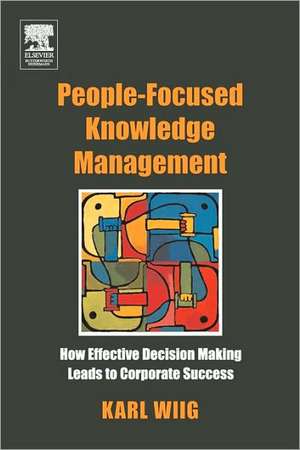
People-Focused Knowledge Management
Autor Karl Wiigen Limba Engleză Paperback – 15 iun 2004
Preț: 425.86 lei
Preț vechi: 501.01 lei
-15%
Puncte Express: 639
Carte tipărită la comandă
Livrare economică 18 noiembrie-02 decembrie
Livrare prin curier în România Termenul estimat este afișat lângă disponibilitate.
Transport gratuit pentru acest produs Plată online sau ramburs, în funcție de opțiunile comenzii.
Retur gratuit în 14 zile Comandă securizată și suport în română.
Specificații
ISBN-13: 9780750677776
ISBN-10: 0750677775
Pagini: 392
Ilustrații: Illustrated
Dimensiuni: 152 x 229 x 42 mm
Greutate: 0.53 kg
Ediția:UK edition
Editura: Taylor & Francis
Colecția Routledge
Locul publicării:Oxford, United Kingdom
ISBN-10: 0750677775
Pagini: 392
Ilustrații: Illustrated
Dimensiuni: 152 x 229 x 42 mm
Greutate: 0.53 kg
Ediția:UK edition
Editura: Taylor & Francis
Colecția Routledge
Locul publicării:Oxford, United Kingdom
V-ar putea interesa
-
 MetadataJeffrey Pomerantz-17%Preț: 99.71 lei120.75 lei
 -
 Knowledge ManagementPasherPreț: 318.61 lei
 -
 -40%Preț: 327.41 lei543.11 lei
 -
 How to Become a Successful IT ConsultantDan RemenyiPreț: 392.52 lei
 -
 Information FirstElaine Evernden-50%Preț: 232.06 lei466.31 lei
 -
 Rise of the Knowledge WorkerJames Cortada-48%Preț: 240.65 lei466.67 lei
 -
 Manage IT as a BusinessBennet Lientz-41%Preț: 351.45 lei593.98 lei
 -
 Stealth KMNiall Sinclair-53%Preț: 207.59 lei440.67 lei
 -
 Knowledge CitiesFrancisco Carrillo-45%Preț: 364.86 lei668.80 lei
 -
 Actionable IntelligenceCarterPreț: 320.89 lei
 -
 Tableau Your Data!Daniel G Murray-20%Preț: 313.20 lei391.50 lei
 -
 Big Data for Small Business for DummiesBernard MarrPreț: 131.65 lei
 -
 The End of the Performance ReviewT. Baker-15%Preț: 540.70 lei636.12 lei
 -
 Myth-Busting China's NumbersMatthew CrabbePreț: 201.05 lei
Public țintă
Professional Practice & DevelopmentCuprins
CHAPTER 1 - COMPETING IN THE GLOBAL ECONOMY REQUIRES EFFECTIVE ENTERPRISES; CHAPTER 2 - THE EFFECTIVE ENTERPRISE; CHAPTER 3 - ACTIONS ARE INITIATED BY KNOWLEDGEABLE PEOPLE:PEOPLE MAKE DECISIONS AND ACT USING DIFFERENT KINDS OF KNOWLEDGE; CHAPTER 4 - MENTAL AND STRUCTURAL REFERENCE MODELS; CHAPTER 5 - A KNOWLEDGE MODEL FOR PERSONAL SITUATION-HANDLING; CHAPTER 6 - ENTERPRISE SITUATION-HANDLING; CHAPTER 7 - PEOPLE-FOCUSED KNOWLEDGE MANAGEMENT IN DAILY OPERATIONS; CHAPTER 8 - PEOPLE-FOCUSED KNOWLEDGE MANAGEMENT EXPECTATIONS; APPENDIX A - EXAMPLES OF KNOWLEDGE MANAGEMENT ANALYSIS TOOLS; APPENDIX B - EXAMPLES OF KNOWLEDGE MANAGEMENT PRACTICES AND INITIATIVES; APPENDIX C - KNOWLEDGE CATEGORIZATIONS; GLOSSARY; REFERENCES AND RECOMMENDED READINGS; INDEX
Descriere
The business environment has changed. Sharper competition requires organizations to exhibit greater effectiveness in their operations and services and faster creation of new products and services—all hallmarks of the knowledge economy. Up until now, most of the knowledge management literature has focused on technology, systems, or culture. This book moves to the next stage, to focus on the people—the knowledge workers themselves. Noted expert Karl Wiig synthesizes recent research findings in cognitive science and related fields to describe how people actually work. He focuses on how people learn, remember, make decisions, solve problems and act—in general, how knowledge relates to work behavior. By understanding how people work, managers can improve effectiveness to gain competitive advantage.