Cantitate/Preț
Produs

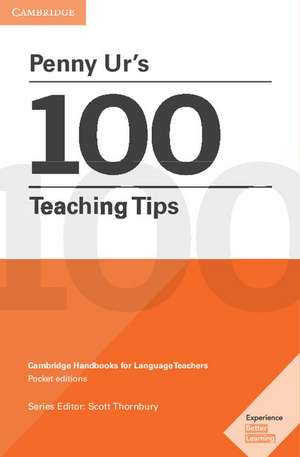
Penny Ur's 100 Teaching Tips

Autor Penny Ur
en Limba Engleză Paperback – 18 feb 2016

Observăm în Penny Ur's 100 Teaching Tips o rafinare a metodelor practice de predare a limbilor străine, oferind o resursă imediat aplicabilă ce prioritizează eficiența în clasă. Față de literatura metodologică densă, această lucrare se remarcă prin concizie și pragmatism, fiind organizată în 100 de unități de învățare rapidă care acoperă 19 domenii critice, de la gestionarea disciplinei până la evaluare. Abordarea este structurată pentru a ghida profesorul prin momentele cheie ale unei lecții. De pildă, în secțiunea dedicată începutului și sfârșitului de oră, Penny Ur recomandă claritatea obiectivelor și evitarea temelor pentru acasă în ultimele minute, pentru a menține un ton pozitiv. În ceea ce privește managementul clasei, textul oferă soluții pentru evitarea confruntărilor și recunoașterea comportamentului adecvat, elemente esențiale pentru un mediu de învățare productiv. Comparativ cu Tips for Teachers: 400+ ideas to improve your teaching de Craig Barton, care oferă un volum vast de idei din surse multiple, lucrarea de față este mult mai focalizată pe specificul predării limbilor străine, păstrând linia metodologică riguroasă a editurii Cambridge University Press. Această carte completează portofoliul autoarei, situându-se între introducerea teoretică solidă din A Course in English Language Teaching și resursele de activități precum 100 Great Activities. Dacă lucrările anterioare puneau accent pe planificarea de durată, Penny Ur's 100 Teaching Tips este un instrument de intervenție rapidă. Structura sa, care include sfaturi despre utilizarea selectivă a manualului și simplificarea jocurilor didactice, o face indispensabilă pentru profesorii care doresc să își rafineze tehnica fără a parcurge tratate extinse de pedagogie.

Citește tot Restrânge

Preț: 7900 lei

Puncte Express: 119

Carte în stoc

Livrare din stoc 05 septembrie

Livrare prin curier în România Termenul estimat este afișat lângă disponibilitate.
Transport gratuit de la 40000 lei Plată online sau ramburs, în funcție de opțiunile comenzii.
Retur gratuit în 14 zile Comandă securizată și suport în română.

Specificații

ISBN-13: 9781316507285
ISBN-10: 1316507289
Pagini: 130
Dimensiuni: 133 x 203 x 8 mm
Greutate: 0.15 kg
Editura: Cambridge University Press
Locul publicării:Cambridge, United Kingdom

De ce să citești această carte

Recomandăm această carte oricărui profesor de limbi străine care caută soluții concrete pentru provocările cotidiene din clasă. Veți câștiga strategii testate pentru gestionarea disciplinei, corectarea eficientă a erorilor și predarea gramaticii fără jargon excesiv. Este un ghid esențial pentru stagiari și o sursă excelentă de împrospătare a metodelor pentru profesorii cu experiență, totul într-un format ușor de consultat în pauze.


Descriere scurtă

Tried and tested teaching tips for language teachers. This practical book, with its clear and accessible style, will be useful to many teachers, whether trainee, novice or experienced, in a variety of contexts. It provides a set of 100 hands-on tips on 19 different areas of classroom teaching, including using a coursebook, giving and checking homework, classroom discipline, testing and assessment. The clear and concise advice is accompanied by brief explanatory notes based on the author's extensive teaching experience.

Cuprins

Why I wrote this book Beginning and ending the lesson 1. Start with a smile 2. Begin and end clearly 3. Give an advance overview 4. Teach new material first 5. Don't give homework at the end 6. End with something nice The Coursebook 7. Use the coursebook- selectively 8. Vary the way you use exercises 9. Allow lots of right answers 10. Recycle tasks Discipline 11. Learn students' names 12. Keep it moving 13. Make the lesson interesting 14. Catch problems as they start 15. Avoid confrontations 16. Compliment good behaviour Error correction 17. Do correct mistakes 18. Correct (sometimes) during speech 19. Get students to self-correct 20. Draw attention to correct answers Games 21. Make sure games are fun 22. Check games are learning-rich 23. Keep games simple 24. Involve all, or most, students 25. Have more than one winner Grammar 26. Keep explanations short 27. Use mother tongue to explain 28. Avoid grammatical terms 29. Get students to learn by heart 30. Get students to make meanings Group work 31. Have a good reason to use group work 32. Make collaborating worthwhile 33. Do group work in the middle of the lesson 34. Use pair work a lot 35. Instruct before making groups 36. Organize groups quickly 37. Arrange endings in advance Heterogeneous (mixed-level) classes 38. Let students choose 39. Attend to the weaker students 40. Invite different answers 41. Limit tasks by time, not amount 42. Give basic tasks plus options Homework 43. Clarify requirements in advance 44. Make homework success-oriented 45. Include homework in the final grade 46. Plan homework-giving in advance 47. Check homework has been done 48. Keep class checking to a minimum 49. Check written homework Interest 50. Don't worry about the topic 51. Keep activities short and varied 52. Tell students what the goals are 53. Use higher-order thinking skills 54. Personalize 55. Use visual materials Listening 56. Give topic and task in advance 57. Don't always pre-teach vocabulary 58. Don't use written texts 59. Let students see the speaker 60. Divide the text into short bits 61. Use dictations Pronunciation 62. Teach pronunciation (a little) 63. Drill isolated sounds 64. Contrast with mother-tongue sounds 65. Teach 'international' pronunciation Reading comprehension 66. Read aloud while students follow 67. Minimize guessing from context 68. Don't make students read aloud 69. Read and re-read 70. Use readers' theatre 71. Vary comprehension tasks Speaking activities 72. Use language practice for fluency 73. Use group work 74. Let students use memorized text 75. Give tasks rather than topics 76. Make sure the language is easy Teacher talk 77. Talk a lot 78. Keep eye contact 79. Tell stories 80. Teach common classroom phrases 81. Use mother tongue occasionally 82. Invite short responses Testing and assessment 83. Assess not only through tests 84. Use (also) student self-assessment 85. Use tests as a teaching tool 86. Add optional sections to tests 87. Prepare students for the test 88. Assess yourself Vocabulary teaching 89. Teach a lot of vocabulary