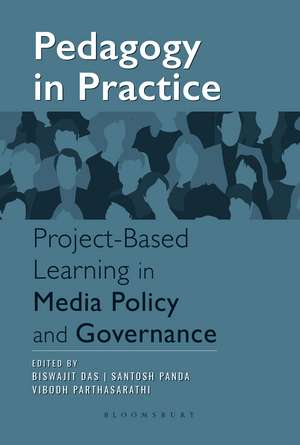
Pedagogy in Practice: Project-Based Learning in Media Policy and Governance
Biswajit Das, Santosh Panda, Vibodh Parthasarathien Limba Engleză Hardback – 30 aug 2022
Preț: 554.37 lei
Preț vechi: 821.32 lei
-33%
Puncte Express: 832
Carte disponibilă
Livrare economică 13-27 noiembrie
Livrare prin curier în România Termenul estimat este afișat lângă disponibilitate.
Transport gratuit pentru acest produs Plată online sau ramburs, în funcție de opțiunile comenzii.
Retur gratuit în 14 zile Comandă securizată și suport în română.
Specificații
ISBN-13: 9789354359675
ISBN-10: 9354359671
Pagini: 320
Dimensiuni: 160 x 240 x 22 mm
Greutate: 0.66 kg
Editura: Bloomsbury Publishing
Colecția Bloomsbury Academic India
Locul publicării:New Delhi, India
ISBN-10: 9354359671
Pagini: 320
Dimensiuni: 160 x 240 x 22 mm
Greutate: 0.66 kg
Editura: Bloomsbury Publishing
Colecția Bloomsbury Academic India
Locul publicării:New Delhi, India
Cuprins
Foreword by Sir John Daniel
Section 1: Media Education and Media Pedagogy
1. Introduction: Designing Media Policy and Governance
Santosh Panda, Biswajit Das and Vibodh Parthasarathi
2. Pedagogy and Teaching-Learning Strategies
Santosh Panda
3. Media Education and Media Pedagogy in India
Biswajit Das
Section 2: Pedagogic Practices: Project-Based Learning
4. Enumerating Media Diversity
Athikho Kaisii, Nabeela Inayati and Vibodh Parthasarathi
5. Market Structure, Ownership and Industry
Pradosh Nath, Prashant Kumar and Vibodh Parthasarathi
6. Document Analysis for Media Policy Research
Vibodh Parthasarathi and Ritu Sinha
7. Mapping Shifts in Media Regulation
Vibodh Parthasarathi and Aradhana Sharma
Section 3: Professional Development and the Future
8. Professional Development of Media Educators
Santosh Panda
9. The Future of Pedagogy and Technology in Media Education
Biswajit Das
Glossary by Jesna Jayachandran
Section 1: Media Education and Media Pedagogy
1. Introduction: Designing Media Policy and Governance
Santosh Panda, Biswajit Das and Vibodh Parthasarathi
2. Pedagogy and Teaching-Learning Strategies
Santosh Panda
3. Media Education and Media Pedagogy in India
Biswajit Das
Section 2: Pedagogic Practices: Project-Based Learning
4. Enumerating Media Diversity
Athikho Kaisii, Nabeela Inayati and Vibodh Parthasarathi
5. Market Structure, Ownership and Industry
Pradosh Nath, Prashant Kumar and Vibodh Parthasarathi
6. Document Analysis for Media Policy Research
Vibodh Parthasarathi and Ritu Sinha
7. Mapping Shifts in Media Regulation
Vibodh Parthasarathi and Aradhana Sharma
Section 3: Professional Development and the Future
8. Professional Development of Media Educators
Santosh Panda
9. The Future of Pedagogy and Technology in Media Education
Biswajit Das
Glossary by Jesna Jayachandran
Recenzii
Pedagogy in Practice is quite a masterful guidepost to more active and engaging media studies/governance courses, programmes and activities that will sharpen your project-based learning competencies, confidences and communications. If you're a media studies educator, simply immerse yourself in any page and walk away with a whole new vision of what transformative learning in the twenty-first century can really look like.
Pedagogy in Practice fills an important gap in the current pedagogical literature. Media literacy, together with media policy and governance, has emerged as one of the most salient issues of our time, critical to understanding the formation of public opinion and to the survival of democracy itself. Meanwhile, project-based learning is recognised as one of the best pedagogical tools available for engaging students. These are combined effectively in this book, which provides the perfect tool for teachers to understand and educate others about media-related issues. I would like to offer my congratulations to the authors on the creation of this practical, clear and helpful guide.
Pedagogy in Practice is a smartly edited and indispensable volume for those studying Indian media analysis, news mapping, market structure of cultural industries, regulatory policy shifts and media governance. The different chapters have a wealth of hands-on pedagogic advice for teaching at the MA and PhD levels. Faculty will find it innovative, practical, comprehensive and stimulating. For serious students, the world of contemporary mass media is a place for big ideas and controversies about citizen activism, diversity and individual rights. The authors have done a first-rate job in providing a roadmap to this complex policy universe and the latest in innovative teaching methods. One of its best features is that it provides the tools for students and policy experts to acquire a critical view of the far-ranging impact of media studies in contemporary times.
This is an interesting and timely publication and provides valuable insights on evidence-based teaching and active learning strategies. It will help strengthen, standardise and innovate pedagogical practices in media studies and can be used and adapted in any classroom setting including higher education and professional studies. I see this book as being of great value to educational leaders and pedagogues across the world.
Rarely one finds a book that combines the best of pedagogy in a disciplinary context. Pedagogy in Practice is one such publication that presents reflective practitioners' documentation of adopting project-based learning in media education. Set in the context of media policy and governance in India, and a larger project on developing conceptual framework and pedagogic analysis on the subject, the book provides lived-in experiences of the authors supported with sound theoretical perspectives on designing and implementing hands-on projects and workshops to prepare media professionals and researchers. The editors of the book bring together their extensive experiences of teaching and research on education and media to provide a balanced contribution on theory and practice of teaching and learning in media education.
Timely, comprehensive, rigorous and practically engaged, this volume should be read by students, educators and media policy analysts, both in classrooms and beyond, across Asia and the Global South.
Pedagogy in Practice fills an important gap in the current pedagogical literature. Media literacy, together with media policy and governance, has emerged as one of the most salient issues of our time, critical to understanding the formation of public opinion and to the survival of democracy itself. Meanwhile, project-based learning is recognised as one of the best pedagogical tools available for engaging students. These are combined effectively in this book, which provides the perfect tool for teachers to understand and educate others about media-related issues. I would like to offer my congratulations to the authors on the creation of this practical, clear and helpful guide.
Pedagogy in Practice is a smartly edited and indispensable volume for those studying Indian media analysis, news mapping, market structure of cultural industries, regulatory policy shifts and media governance. The different chapters have a wealth of hands-on pedagogic advice for teaching at the MA and PhD levels. Faculty will find it innovative, practical, comprehensive and stimulating. For serious students, the world of contemporary mass media is a place for big ideas and controversies about citizen activism, diversity and individual rights. The authors have done a first-rate job in providing a roadmap to this complex policy universe and the latest in innovative teaching methods. One of its best features is that it provides the tools for students and policy experts to acquire a critical view of the far-ranging impact of media studies in contemporary times.
This is an interesting and timely publication and provides valuable insights on evidence-based teaching and active learning strategies. It will help strengthen, standardise and innovate pedagogical practices in media studies and can be used and adapted in any classroom setting including higher education and professional studies. I see this book as being of great value to educational leaders and pedagogues across the world.
Rarely one finds a book that combines the best of pedagogy in a disciplinary context. Pedagogy in Practice is one such publication that presents reflective practitioners' documentation of adopting project-based learning in media education. Set in the context of media policy and governance in India, and a larger project on developing conceptual framework and pedagogic analysis on the subject, the book provides lived-in experiences of the authors supported with sound theoretical perspectives on designing and implementing hands-on projects and workshops to prepare media professionals and researchers. The editors of the book bring together their extensive experiences of teaching and research on education and media to provide a balanced contribution on theory and practice of teaching and learning in media education.
Timely, comprehensive, rigorous and practically engaged, this volume should be read by students, educators and media policy analysts, both in classrooms and beyond, across Asia and the Global South.