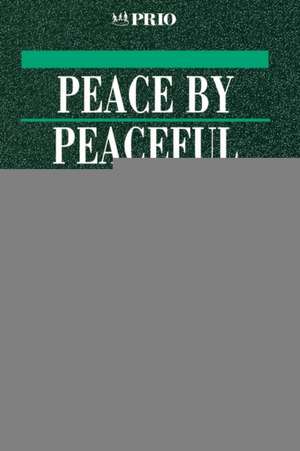
Peace by Peaceful Means: International Peace Research Institute, Oslo (PRIO)
Autor Johan Galtungen Limba Engleză Paperback – 8 noi 2001
Subliniem rolul fundamental al lucrării Peace by Peaceful Means în cadrul curriculumului modern de studii de securitate și sociologie politică. Johan Galtung organizează materialul pe o metodologie riguroasă, divizată în patru piloni teoretici care oferă o viziune holistică asupra păcii. Începând cu bazele epistemologice, volumul progresează logic spre analiza ciclurilor de viață ale conflictelor, examinarea violenței structurale în economie și, în final, către studiul cosmologiilor culturale care pot genera violență simbolică. Reținem că această structură nu este doar descriptivă, ci și prescriptivă, culminând cu strategii concrete pentru acțiunea de pace. În contextul operei autorului, Peace by Peaceful Means reprezintă sinteza teoretică a deceniilor de cercetare inițiate prin lucrări precum The European Community sau Essays in Peace Research. Dacă în scrierile sale timpurii Galtung se concentra pe analize externe sau metodologii specifice, aici el reușește să unifice conceptele de violență directă, structurală și culturală într-un cadru unitar. Credem că această abordare completează perspectiva oferită de Peace and Conflict Studies de Charles Webel, care funcționează mai degrabă ca un cititor de texte clasice. Spre deosebire de volumul lui Webel, lucrarea lui Galtung adaugă o profunzime teoretică originală, legând direct dezvoltarea economică și identitatea civilizațională de stabilitatea politică. Această ediție publicată de SAGE Publications rămâne un text de referință pentru mediul academic, fiind marcată de un ton analitic și precis. De la analiza raportului dintre democrație și război până la propunerea unor „terapii” pentru cosmologiile patologice, Galtung oferă un instrumentar intelectual indispensabil pentru înțelegerea mecanismelor de transformare nonviolentă a conflictelor în secolul XXI.



Preț: 466.43 lei
Carte disponibilă
Livrare economică 27 octombrie-10 noiembrie
Livrare express 10-16 octombrie pentru 33.07 lei
Specificații
ISBN-10: 0803975112
Pagini: 292
Ilustrații: black & white illustrations
Dimensiuni: 156 x 234 x 16 mm
Greutate: 0.41 kg
Ediția:1
Editura: SAGE Publications
Colecția International Peace Research Institute, Oslo (PRIO)
Seria International Peace Research Institute, Oslo (PRIO)
Locul publicării:London, United Kingdom
V-ar putea interesa
-
 The Better Angels of Our NatureSteven Pinker-20%Preț: 115.76 lei145.49 lei
 -
 Peace: A Very Short IntroductionOliver P. Richmond-20%Preț: 56.02 lei70.29 lei
 -
 -20%Preț: 193.30 lei241.17 lei
 -
 Advancing PeaceDevone BogganPreț: 325.91 lei
 -
 Violence in War and PeaceNancy Scheper-HughesPreț: 350.86 lei
 -
 Peace and Conflict: Citizens EditionJames R. Adams-24%Preț: 132.73 lei175.35 lei
 -
 Preț: 347.39 lei
 -
 The Handbook of Conflict Resolution - Theory and Practice 3eEric C. Marcus-23%Preț: 612.40 lei795.33 lei
 -
 Preț: 283.42 lei
 -
 Preț: 137.81 lei
 -
 -27%Preț: 114.20 lei155.64 lei
 -
 The Art of War and PeaceDavid KilcullenPreț: 189.16 lei
 -
 PacificationMark NeocleousPreț: 194.51 lei
 -
 Is Peace Possible?Kathleen LonsdalePreț: 92.95 lei
 -
 ViolenceSlavoj Zizek-20%Preț: 68.05 lei85.23 lei
 -
 Speak Peace in a World of Conflict: What You Say Next Will Change Your WorldMarshall B. RosenbergPreț: 91.81 lei
 -
 The World After GazaPankaj MishraPreț: 141.71 lei
 -
 Peace and Conflict in a Changing WorldDong Jin Kim-15%Preț: 589.58 lei693.62 lei
 -
 War and Peace in Ukraine and in GazaRobin LuckhamPreț: 346.39 lei
 -
 -20%Preț: 249.12 lei312.02 lei
De ce să citești această carte
Această carte este esențială pentru studenții și specialiștii în relații internaționale care doresc să înțeleagă pacea nu doar ca absență a războiului, ci ca un sistem complex de echilibru social și cultural. Cititorul câștigă acces la conceptele fundamentale dezvoltate de Johan Galtung, învățând să identifice și să combată violența structurală prin metode creative și nonviolente.
Despre autor
Johan Galtung este recunoscut la nivel mondial drept fondatorul disciplinei academice a studiilor păcii. Profesor la universități de prestigiu precum Hawaii și Tromsø, el a pus bazele Institutului Internațional de Cercetare a Păcii din Oslo (PRIO) în 1959 și a lansat Journal of Peace Research. Cu o carieră de peste jumătate de secol și peste 50 de volume publicate, Galtung a modelat gândirea contemporană despre transformarea conflictelor, introducând termeni cheie în științele sociale precum „violența structurală” și „pacea pozitivă”.
Descriere scurtă
Recenzii
`Galtung's book is one of the best guides for getting to know the world we live in. It contains astonishing insights, not only about war and peace, but about one's own cultural roots and ideological predispositions. It is a courageous and highly ethical work, full of unpalatable truths but lit up by sparks of truth' - Media Development
`This is an important volume by one of the most important scholars of modern peace studies.... It is both an overview and an elaboration of his ideas regarding the conceptual and material implications of peace.... This is not an easy book to read in the sense that the prose is dense and the arguments are spread over the main text and within the detailed footnotes. However, it is worth reading carefully precisely because it is concerned with locating peace studies within a broader social and intellectual context than other parts of the discipline of international relations or political science. Galtung concludes his latest contribution with a plea for perseverance: peace is something that has to be worked at and, moreover, peace workers have to expect resistance from those inculcated within reactionary state structures' - International Affairs
Cuprins
PART ONE: PEACE THEORY
Peace Studies
An Epistemological Basis
Peace Studies
Some Basic Paradigms
Woman:Man = Peace:Violence?
Democracy:Dictatorship = Peace:War?
The State System
Dissociative, Associative, Confederal, Federal, Unitary - or a Lost Case?
PART TWO: CONFLICT THEORY
Conflict Formations
Conflict Life Cycles
Conflict Transformations
Conflict Interventions
Nonviolent Conflict Transformation
PART THREE: DEVELOPMENT THEORY
Fifteen Theses on Development Theory and Practice
Six Economic Schools
The Externalities
Ten Theses on Eclectic Development Theory
Development Theory
An Approach across Spaces
PART FOUR: CIVILIZATION THEORY
Cultural Violence
Six Cosmologies
An Impressionistic Presentation
Implications
Peace, War, Conflict, Development
Specifications
Hitlerism, Stalinism, Reaganism
Explorations
Any Therapies for Pathological Cosmologies?
Conclusion
Peace and Conflict, Development and Civilization