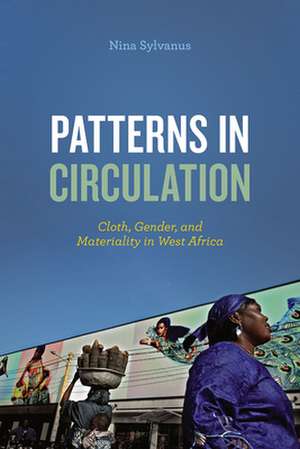
Patterns in Circulation: Cloth, Gender, and Materiality in West Africa
Autor Nina Sylvanusen Limba Engleză Hardback – 7 dec 2016
In this book, Nina Sylvanus tells a captivating story of global trade and cross-cultural aesthetics in West Africa, showing how a group of Togolese women—through the making and circulation of wax cloth—became influential agents of taste and history. Traveling deep into the shifting terrain of textile manufacture, design, and trade, she follows wax cloth around the world and through time to unveil its critical role in colonial and postcolonial patterns of exchange and value production.
Sylvanus brings wax cloth’s unique and complex history to light: born as a nineteenth-century Dutch colonial effort to copy Javanese batik cloth for Southeast Asian markets, it was reborn as a status marker that has dominated the visual economy of West African markets. Although most wax cloth is produced in China today, it continues to be central to the expression of West African women’s identity and power. As Sylvanus shows, wax cloth expresses more than this global motion of goods, capital, aesthetics, and labor—it is a form of archive where intimate and national memories are stored, always ready to be reanimated by human touch. By uncovering this crucial aspect of West African material culture, she enriches our understanding of global trade, the mutual negotiations that drive it, and the how these create different forms of agency and subjectivity.
Sylvanus brings wax cloth’s unique and complex history to light: born as a nineteenth-century Dutch colonial effort to copy Javanese batik cloth for Southeast Asian markets, it was reborn as a status marker that has dominated the visual economy of West African markets. Although most wax cloth is produced in China today, it continues to be central to the expression of West African women’s identity and power. As Sylvanus shows, wax cloth expresses more than this global motion of goods, capital, aesthetics, and labor—it is a form of archive where intimate and national memories are stored, always ready to be reanimated by human touch. By uncovering this crucial aspect of West African material culture, she enriches our understanding of global trade, the mutual negotiations that drive it, and the how these create different forms of agency and subjectivity.
Preț: 493.17 lei
Preț vechi: 663.29 lei
-26%
Puncte Express: 740
Carte indisponibilă temporar
Doresc să fiu notificat când acest titlu va fi disponibil:
Se trimite...
Specificații
ISBN-13: 9780226397191
ISBN-10: 022639719X
Pagini: 224
Ilustrații: 10 color plates, 18 halftones
Dimensiuni: 152 x 229 x 20 mm
Greutate: 0.45 kg
Ediția:1
Editura: University of Chicago Press
Colecția University of Chicago Press
ISBN-10: 022639719X
Pagini: 224
Ilustrații: 10 color plates, 18 halftones
Dimensiuni: 152 x 229 x 20 mm
Greutate: 0.45 kg
Ediția:1
Editura: University of Chicago Press
Colecția University of Chicago Press
Notă biografică
Nina Sylvanus is assistant professor of anthropology at Northeastern University.
Cuprins
Preface
Acknowledgments
Introduction: Patterns in Circulation
1 Fashioning the Body: Dressing the Public Self
2 Archival Prints: Alternate Histories of Taste and Circulation
3 Branding Cloth, Branding Nation: The Nana Benz and the Materiality of Power
4 Flexible Patterns: The Nanettes Remake the Market and Cloth in China
5 Dangerous Copies: Old Value Systems in a New Economy
Conclusion: Assigamé Burning
Notes
Bibliography
Index
Acknowledgments
Introduction: Patterns in Circulation
1 Fashioning the Body: Dressing the Public Self
2 Archival Prints: Alternate Histories of Taste and Circulation
3 Branding Cloth, Branding Nation: The Nana Benz and the Materiality of Power
4 Flexible Patterns: The Nanettes Remake the Market and Cloth in China
5 Dangerous Copies: Old Value Systems in a New Economy
Conclusion: Assigamé Burning
Notes
Bibliography
Index
Recenzii
"Sylvanus illuminates the cloth’s centrality to ever-shifting conceptions of social status, authenticity, personal style, and political power. . . . Patterns in Circulation reveals wax print as a stand-in for capitalist modernity in the twenty-first century built on multinational production and financing, invested with local, highly personal meanings, and always teetering on the edge of unruly transformation."
"By providing a detailed history of this company and the intersecting histories of colonialism and printing techniques, Sylvanus shows how the company’s recent brand publicity as both authentic African heritage and the latest new fashion reflects the company’s attempts to manage the fast-paced competition for consumers of West African cloth, who have a range of manufactured wax and fancy print cloth from which to choose....The author also presents an excellent discussion of intellectual property rights, with the company, Vlisco, claiming legal and technical rights to its wax print textiles while Togolese women claim their own measures of value and ownership."
"Sylvanus's excellent multi-layered trans-historical study of Togolese wax-print fabric (or pagne) interweaves the role of African women in postcolonial developments, on the one hand, with a timely intervention in the ‘China-in-Africa’ debates on the other. . . . Provides essential reading not only for those interested in wax cloth, but also for those interested in its long-standing role in patterning relations between women, market and nation."
"Presents an ethnography of West African wax cloth, exploring the history, manufacture, and marketing of wax cloth and using data collected between 2000 and 2010 to illustrate political, economic, and gender relations in global capitalism."