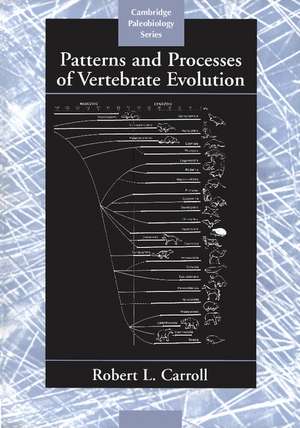
Patterns and Processes of Vertebrate Evolution
Autor Robert Lynn Carrollen Limba Engleză Paperback – 17 iul 1997
În cadrul programelor de studiu avansate dedicate biologiei evoluționiste și paleontologiei, Patterns and Processes of Vertebrate Evolution se poziționează ca o sinteză fundamentală care conectează genetica populațiilor actuale cu datele macroevoluționiste extrase din registrul fosil. Găsim în această lucrare, publicată de Cambridge University Press, o tentativă rară de a unifica forțele care guvernează ratele de evoluție, de la nivel de specie până la originea marilor grupuri de vertebrate. Subliniem faptul că Robert Lynn Carroll nu se limitează la mecanismele clasice de variație și selecție naturală, ci extinde cadrul analitic prin includerea factorilor geologici și ontogenetici, precum deriva continentală și biologia dezvoltării. Reținem structura riguroasă a celor 464 de pagini, unde cele 173 de ilustrații documentează vizual tranziții critice: evoluția tetrapodelor din pești sau adaptarea secundară a mamiferelor la mediul acvatic. Această abordare integrată extinde cadrul propus de Major Patterns in Vertebrate Evolution de Max Hecht cu date noi din paleontologia modernă și analize comparative ale ratelor de supraviețuire în timpul extincțiilor în masă. Dacă volumul lui Hecht se concentra pe prezentarea statusului cunoașterii la nivelul anilor '70, lucrarea de față, integrată în Cambridge Paleobiology Series, rafinează modelele teoretice prin prisma noilor descoperiri de fosile și a tehnicilor de analiză filogenetică. Este prima lucrare de anvergură care, după decenii de la studiile de referință ale lui Simpson, reușește să ofere o viziune panoramică asupra mecanismelor care determină succesul sau declinul liniilor de vertebrate pe parcursul sutelor de milioane de ani.
Preț: 680.79 lei
Preț vechi: 840.47 lei
-19%
Carte tipărită la comandă
Livrare economică 26 noiembrie-10 decembrie
Specificații
ISBN-10: 052147809X
Pagini: 466
Ilustrații: 173 b/w illus. 14 tables
Dimensiuni: 178 x 254 x 25 mm
Greutate: 0.87 kg
Ediția:New.
Editura: Cambridge University Press
Locul publicării:Cambridge, United Kingdom
V-ar putea interesa
-
 Primate Adaptation and EvolutionJohn G. Fleagle-23%Preț: 388.79 lei504.30 lei
 -
 Principles of GeologyCharles Lyell-19%Preț: 88.07 lei108.10 lei
 -
 Evolution: A Very Short IntroductionBrian Charlesworth-20%Preț: 57.12 lei71.12 lei
 -
 Why Evolution is TrueJerry A. Coyne-19%Preț: 75.26 lei93.24 lei
 -
 EvolutionStephen Stearns-21%Preț: 475.67 lei603.00 lei
 -
 Preț: 236.22 lei
 -
 The Bare BonesMatthew F Bonnan-15%Preț: 436.84 lei513.93 lei
 -
 Vertebrate Evolution: From Origins to Dinosaurs and BeyondDonald R. Prothero-8%Preț: 563.05 lei612.01 lei
 -
 A History of Dinosaurs in 50 FossilsPaul M. Barrett-16%Preț: 111.11 lei132.94 lei
 -
 EvolutionDouglas FutuymaPreț: 373.32 lei
 -
 EvolutionNicholas H BartonPreț: 202.76 lei
 -
 Evolutionary Analysis, Global EditionScott Freeman-11%Preț: 672.78 lei755.93 lei
 -
 Vertebrate PalaeontologyMichael J. Benton-19%Preț: 463.49 lei572.21 lei
 -
 Metamorphosis: A Natural and Human HistoryOren Harman-30%Preț: 133.14 lei191.14 lei
 -
 Evolution 3eMark Ridley-19%Preț: 461.33 lei569.54 lei
 -
 Fossils at a Glance 2eClare MilsomPreț: 382.65 lei
 -
 50 Biology Ideas You Really Need to KnowJV Chamary-27%Preț: 51.88 lei71.22 lei
 -
 Preț: 72.09 lei
 -
 Relativity of EvolutionMarkus KnoflacherPreț: 399.90 lei
De ce să citești această carte
Această carte este esențială pentru studenții de la facultățile de biologie și specialiștii în paleontologie care caută o înțelegere sistemică a macroevoluției. Cititorul câștigă o perspectivă clară asupra modului în care evenimentele geologice și biologice interacționează pentru a modela diversitatea vertebratelor. Este un instrument de studiu solid, susținut de o iconografie bogată, care explică nu doar 'ce' s-a schimbat în istoria vieții, ci mai ales 'cum' s-au produs aceste transformări majore.
Descriere scurtă
Cuprins
Recenzii
'Robert Carroll has broken new ground. He views the fossil record with the eyes of a biologist and a geologist … Not since 1953, when George Gaylord Simpson published Major Features of Evolution, has there been such a well-founded overview of vertebrate fossils, their distribution in time and space, relationships with other organisms and with the environment.' Douglas Palmer New Scientist
'This book is a milestone and is highly recommended. General readers: undergraduate through faculty.' F. S. Szaley, Choice
'… an intellectual tour de force … Carroll's overview is welcome, well organised, affordable in paperback format and will prove a very useful backdrop to undergraduate courses on general evolution of vertebrate history.' David Norman, University of Cambridge
'Carroll's overview is welcome, well organised, affordable in paperback format and will prove a very useful backdrop to undergraduate courses on general evolution or vertebrate history.' David Norman, The Times Higher Education Supplement