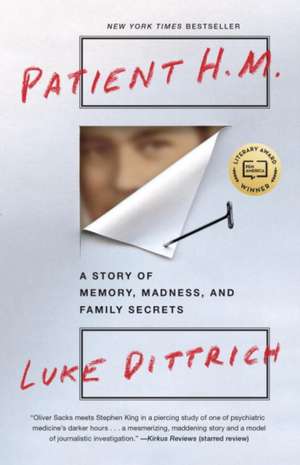
Patient H.M.
Autor Luke Dittrichen Limba Engleză Paperback
Analizând istoria neuroștiinței prin prisma cazului lui Henry Molaison, considerăm că Patient H.M. reprezintă o incursiune tulburătoare în etica medicală a secolului XX. Punctul central al lucrării este intervenția chirurgicală din 1953, o lobotomie experimentală menită să vindece epilepsia, care l-a lăsat pe pacient într-un prezent continuu, incapabil să mai formeze amintiri pe termen lung. Ceea ce distinge acest volum de alte lucrări despre amnezie este perspectiva personală a autorului: Luke Dittrich investighează propria moștenire familială, bunicul său fiind chirurgul care a realizat operația.
Textul este structurat ca o călătorie caleidoscopică, împletind biografia cu jurnalismul științific și memoriile. Autorul nu se limitează la descrierea clinică a cazului, ci explorează azilurile vechi, teatrele de operații și miza proprietății asupra creierului lui Molaison după moartea sa. Ritmul este alert, amintind de structura unui roman de suspans, dar ancorat riguros în date istorice. Această ediție în limba engleză de la Vintage Publishing oferă un context vast, de la practicile din Egiptul antic până la bătăliile legale moderne din jurul cercetării științifice.
Acoperă aceeași arie tematică precum Permanent Present Tense de Suzanne Corkin, însă Patient H.M. adoptă o abordare mult mai critică și investigativă. În timp ce Suzanne Corkin se concentrează pe observația științifică a cercetătorului care a lucrat cu Henry, Luke Dittrich analizează procesul de investigație în sine, expunând hubrisul și ambițiile profesionale care au alimentat experimentele umane. Rezultatul este o analiză a modului în care progresul științific este adesea clădit pe tragedii personale și dileme morale nerezolvate.
Preț: 124.02 lei
Preț vechi: 130.55 lei
-5%
Carte disponibilă
Livrare economică 02-16 noiembrie
Specificații
ISBN-10: 0812982525
Pagini: 496
Greutate: 0.32 kg
V-ar putea interesa
-
 A Smell of BurningColin Grant-20%Preț: 61.94 lei77.83 lei
 -
 Moonwalking with EinsteinJoshua Foer-18%Preț: 64.77 lei79.37 lei
 -
 Permanent Present TenseSuzanne Corkin-19%Preț: 76.46 lei93.95 lei
 -
 Memory: A Very Short IntroductionJonathan K. FosterPreț: 68.08 lei
 -
 Preț: 133.34 lei
 -
 When the Air Hits Your BrainFrank Vertosick-5%Preț: 89.02 lei93.71 lei
 -
 OutcastOliver BascianoPreț: 143.00 lei
 -
 Gray MattersTheodore SchwartzPreț: 163.29 lei
 -
 -26%Preț: 52.50 lei71.21 lei
 -
 -26%Preț: 89.85 lei122.07 lei
 -
 -25%Preț: 54.65 lei72.86 lei
 -
 LettersOliver SacksPreț: 98.99 lei
 -
 RememberingDonald G. MacKayPreț: 147.76 lei
 -
 The Memory ThiefLauren Aguirre-22%Preț: 71.67 lei91.91 lei
 -
 Brain and Heart: The Triumphs and Struggles of a Pediatric NeurosurgeonDavid I. Sandberg M.D.-19%Preț: 114.93 lei142.69 lei
 -
 Adventures in MemoryHilde ØstbyPreț: 101.71 lei
 -
 -5%Preț: 47.33 lei49.82 lei
 -
 -29%Preț: 67.04 lei94.63 lei
 -
 Our Brains, Our SelvesMasud HusainPreț: 142.66 lei
 -
 Brain (Edition, Revised)Ammar Al-ChalabiPreț: 87.61 lei
De ce să citești această carte
Recomandăm această carte cititorilor interesați de istoria medicinei și de mecanismele memoriei umane. Este o lectură esențială pentru a înțelege cum un singur pacient a revoluționat neuroștiința modernă. Veți câștiga o perspectivă unică asupra eticii medicale, descoperind povestea din spatele celui mai studiat subiect de cercetare din istorie, scrisă cu onestitatea cuiva care își confruntă propriul trecut familial.
Descriere scurtă
Finalist for the PEN/E.O. Wilson Literary Science Writing Award
NAMED ONE OF THE BEST BOOKS OF THE YEAR BY
The Washington Post - New York Post - NPR - The Economist - New York - Wired - Kirkus Reviews - BookPage
In 1953, a twenty-seven-year-old factory worker named Henry Molaison--who suffered from severe epilepsy--received a radical new version of the then-common lobotomy, targeting the most mysterious structures in the brain. The operation failed to eliminate Henry's seizures, but it did have an unintended effect: Henry was left profoundly amnesic, unable to create long-term memories. Over the next sixty years, Patient H.M., as Henry was known, became the most studied individual in the history of neuroscience, a human guinea pig who would teach us much of what we know about memory today.
Patient H.M. is, at times, a deeply personal journey. Dittrich's grandfather was the brilliant, morally complex surgeon who operated on Molaison--and thousands of other patients. The author's investigation into the dark roots of modern memory science ultimately forces him to confront unsettling secrets in his own family history, and to reveal the tragedy that fueled his grandfather's relentless experimentation--experimentation that would revolutionize our understanding of ourselves.
Dittrich uses the case of Patient H.M. as a starting point for a kaleidoscopic journey, one that moves from the first recorded brain surgeries in ancient Egypt to the cutting-edge laboratories of MIT. He takes readers inside the old asylums and operating theaters where psychosurgeons, as they called themselves, conducted their human experiments, and behind the scenes of a bitter custody battle over the ownership of the most important brain in the world.
Patient H.M. combines the best of biography, memoir, and science journalism to create a haunting, endlessly fascinating story, one that reveals the wondrous and devastating things that can happen when hubris, ambition, and human imperfection collide.
Praise for Patient H.M.
"An exciting, artful blend of family and medical history."--The New York Times
"In prose both elegant and intimate, and often thrilling, Patient H.M. is an important book about the wages not of sin but of science."--The Washington Post
"Spellbinding . . . The fact that Dittrich looks critically at the actual process of scientific investigation is just one of the things to admire about Patient H.M."--The New York Times Book Review
"Patient H.M. tells one of the most fascinating and disturbing stories in the annals of medicine, weaving in ethics, philosophy, a personal saga, the history of neurosurgery, the mysteries of human memory, and an exploration of human ego."--Sheri Fink, M.D., Pulitzer Prize winner and author of Five Days at Memorial
"This is classic reporting and myth-making at the same time."--Colum McCann, author of Let the Great World Spin
*Kirkus Reviews (starred review)
Descriere
In the summer of 1953, maverick neurosurgeon William Beecher Scoville performed a groundbreaking operation on an epileptic patient named Henry Molaison. But it was a catastrophic failure, leaving Henry unable to create long-term memories. Scoville's grandson, Luke Dittrich, takes us on an astonishing journey through the history of neuroscience, from the first brain surgeries in ancient Egypt to the New England asylum where his grandfather developed a taste for human experimentation.
Dittrich's investigation confronts unsettling family secrets and reveals the dark roots of modern neuroscience, raising troubling questions that echo into the present day.