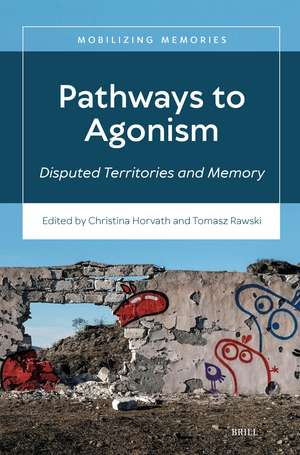
Pathways to Agonism: Disputed Territories and Memory: Mobilizing Memories, cartea 6
Christina Horvath, Tomasz Rawskien Limba Engleză Paperback – 7 aug 2025




Preț: 419.50 lei
Preț vechi: 493.53 lei
-15%
Puncte Express: 629
Carte disponibilă
Livrare economică 06-11 noiembrie
Livrare prin curier în România Termenul estimat este afișat lângă disponibilitate.
Transport gratuit pentru acest produs Plată online sau ramburs, în funcție de opțiunile comenzii.
Retur gratuit în 14 zile Comandă securizată și suport în română.
Specificații
ISBN-13: 9789004736825
ISBN-10: 9004736824
Pagini: 384
Dimensiuni: 155 x 235 mm
Greutate: 0.65 kg
Editura: Brill
Colecția Brill
Seria Mobilizing Memories
ISBN-10: 9004736824
Pagini: 384
Dimensiuni: 155 x 235 mm
Greutate: 0.65 kg
Editura: Brill
Colecția Brill
Seria Mobilizing Memories
Notă biografică
Christina Horvath, Ph.D. (2003), is a Reader of French Politics at the University of Bath. She has widely published on cities, urban marginality and memory, including Breaking the Dead Silence: Engaging with the Legacies of Slave Ownership in Bath and Bristol (2024).
Tomasz Rawski, Ph.D. (2018), is an Assistant Professor at the Faculty of Sociology, University of Warsaw. He is a political and cultural sociologist. He has published on memory politics, nationalism, war and state socialism in contemporary Eastern Europe and beyond.
Tomasz Rawski, Ph.D. (2018), is an Assistant Professor at the Faculty of Sociology, University of Warsaw. He is a political and cultural sociologist. He has published on memory politics, nationalism, war and state socialism in contemporary Eastern Europe and beyond.
Cuprins
Acknowledgements
List of Figures and Tables
Abbreviations and Acronyms
Notes on Contributors
Pathways to Agonism: Memory Practices in Disputed Territories
Christina Horvath and Tomasz Rawski
1 Performance and Peacebuilding, between Consensus and Agonism: The Sejny Chronicles and Moush, Sweet Moush
David Clarke, Weronika Czyżewska-Poncyljusz and Nina Parish
2 Participatory Walking as an Alternative Heritage Practice in Two UNESCO World Heritage Cities: Bath and Lahore
Christina Horvath and Mudassir Farooqi
3 Reinforcers and Challengers: War-Related Street Art in Contemporary Poland and Armenia
Tomasz Rawski and Nelly Manucharyan
4 Liminal Spaces of Memory and Remembrance: Realignment of Agonistic Interpretations at Sites of Complex Histories in Sarajevo
Selma Ćatović Hughes and Sabina Tanović
5 Culture of Remembrance and the Use of the Repertory Grid Technique (RGT): Preparing for a Design Approach
Thomas Duschlbauer
6 Curating Mnemonic Security: Museum Responses to War in Armenia and Poland
Joanna Wawrzyniak and Ruzanna Tsaturyan
7 Military Museums in Postcolonial Countries: Vytautas the Great War Museum in Kaunas and the Army Museum in Lahore
Agnieszka Nowakowska and Umber bin Ibad
8 Commemorative Practices and Memorial Sites: The Armenian Genocide Memorial
Harutyun Marutyan
9 The Second Nagorno-Karabakh War: from War to Postwar Memory Politics
Arsen Hakobyan
10 The Memory of Neighbours: Lithuania and Poland in School Textbooks of Both Countries
Tomasz Błaszczak, Małgorzata Głowacka-Grajper, Rūstis Kamuntavičius and Agnieszka Nowakowska
11 Burgenland: Agonistic Memory in an Acknowledged Multicultural Borderland?
Melinda Harlov-Csortán
12 Translating the International to the Local: the Case of the Women, Peace and Security Agenda in Poland and Armenia
Sophie Whiting and Ruzanna Tsaturyan
Index
List of Figures and Tables
Abbreviations and Acronyms
Notes on Contributors
Pathways to Agonism: Memory Practices in Disputed Territories
Christina Horvath and Tomasz Rawski
part 1: Pathways to Agonism
1 Performance and Peacebuilding, between Consensus and Agonism: The Sejny Chronicles and Moush, Sweet Moush
David Clarke, Weronika Czyżewska-Poncyljusz and Nina Parish
2 Participatory Walking as an Alternative Heritage Practice in Two UNESCO World Heritage Cities: Bath and Lahore
Christina Horvath and Mudassir Farooqi
3 Reinforcers and Challengers: War-Related Street Art in Contemporary Poland and Armenia
Tomasz Rawski and Nelly Manucharyan
4 Liminal Spaces of Memory and Remembrance: Realignment of Agonistic Interpretations at Sites of Complex Histories in Sarajevo
Selma Ćatović Hughes and Sabina Tanović
5 Culture of Remembrance and the Use of the Repertory Grid Technique (RGT): Preparing for a Design Approach
Thomas Duschlbauer
part 2: Mnemonic Responses to Wars
6 Curating Mnemonic Security: Museum Responses to War in Armenia and Poland
Joanna Wawrzyniak and Ruzanna Tsaturyan
7 Military Museums in Postcolonial Countries: Vytautas the Great War Museum in Kaunas and the Army Museum in Lahore
Agnieszka Nowakowska and Umber bin Ibad
8 Commemorative Practices and Memorial Sites: The Armenian Genocide Memorial
Harutyun Marutyan
9 The Second Nagorno-Karabakh War: from War to Postwar Memory Politics
Arsen Hakobyan
part 3: International Pressures and Local Memoryscapes
10 The Memory of Neighbours: Lithuania and Poland in School Textbooks of Both Countries
Tomasz Błaszczak, Małgorzata Głowacka-Grajper, Rūstis Kamuntavičius and Agnieszka Nowakowska
11 Burgenland: Agonistic Memory in an Acknowledged Multicultural Borderland?
Melinda Harlov-Csortán
12 Translating the International to the Local: the Case of the Women, Peace and Security Agenda in Poland and Armenia
Sophie Whiting and Ruzanna Tsaturyan
Index