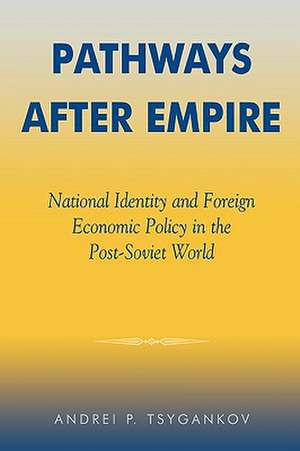
Pathways after Empire: National Identity and Foreign Economic Policy in the Post-Soviet World: The New International Relations of Europe
Autor Andrei P. Tsygankoven Limba Engleză Paperback – 4 dec 2001

Preț: 366.49 lei
Preț vechi: 483.42 lei
-24%
Puncte Express: 550
Carte tipărită la comandă
Livrare economică 28 noiembrie-12 decembrie
Livrare prin curier în România Termenul estimat este afișat lângă disponibilitate.
Transport gratuit de la 400.00 lei Plată online sau ramburs, în funcție de opțiunile comenzii.
Retur gratuit în 14 zile Comandă securizată și suport în română.
Specificații
ISBN-13: 9780742516731
ISBN-10: 0742516733
Pagini: 254
Dimensiuni: 152 x 228 x 20 mm
Greutate: 0.38 kg
Editura: Bloomsbury Publishing
Colecția Rowman & Littlefield
Seria The New International Relations of Europe
Locul publicării:New York, United States
ISBN-10: 0742516733
Pagini: 254
Dimensiuni: 152 x 228 x 20 mm
Greutate: 0.38 kg
Editura: Bloomsbury Publishing
Colecția Rowman & Littlefield
Seria The New International Relations of Europe
Locul publicării:New York, United States
V-ar putea interesa
-
 Bitter BrewWilliam KnoedelsederPreț: 118.04 lei
 -
 How to Work a Room, 25th Anniversary EditionSusan RoAnePreț: 114.15 lei
 -
 Class Clowns – How the Smartest Investors Lost Billions in EducationJonathan A. KneePreț: 268.46 lei
 -
 Business AgilityHeisterbergPreț: 344.50 lei
 -
 Smartstorming (R)Mitchell RigiePreț: 141.68 lei
 -
 QuestN. AnandPreț: 139.56 lei
 -
 Preț: 377.30 lei
Descriere
This book explores how culture shapes foreign economic policy in post-Soviet states. After the Soviet empire fragmented, some of the newly emerged nations directed their economic activities primarily toward Russia and other former republics, while others turned sharply away from the Soviet bloc. Taking a constructivist approach, Andrei P. Tsygankov explains the striking variation by making the original argument that a new state's strength of national identity shapes its foreign economic policy. The stronger the identity, the more likely the new state was to shift away from the empire. Drawing on detailed case studies of Latvia, Ukraine, and Belarus, the author demonstrates how the Baltic nations, with a strong sense of identity, chose to deal with Russia and other ex-Soviet nations on a strictly bilateral basis and entered preferential arrangements with European countries. Ukraine, with moderate identity strength, pursued active economic relations with both Russia and Europe. Finally, Belarus, with a relatively weak identity, pursued an effort to reintegrate with Russia at the expense of developing ties with Europe. Employing a range of both qualitative and quantitative analysis, this study brings a national identity perspective into the forefront of international political economy theory.
Cuprins
Chapter 1: Introduction
Chapter 2: National Identity, Domestic Structures, and Foreign Economic Policy
Chapter 3: Latvia
Chapter 4: Ukraine
Chapter 5: Belarus
Chapter 6: Evidence from Other Ex-Soviet Republics
Chapter 7: Conclusions and Implications
Bibliography
Chapter 2: National Identity, Domestic Structures, and Foreign Economic Policy
Chapter 3: Latvia
Chapter 4: Ukraine
Chapter 5: Belarus
Chapter 6: Evidence from Other Ex-Soviet Republics
Chapter 7: Conclusions and Implications
Bibliography
Recenzii
The book provides an insightful, comparative analysis of the foreign economic courses of the three post-Soviet republics. Recommended for upper-division undergraduates and above.
Andrei Tsygankov is a member of an exciting new generation of scholars who have been trained in both Russian and Western academic traditions. His analysis of the significance of national identity illustrates the differential success of the former Soviet republics in the attainment of relative economic independence from Russia. The study is original, insightful, and persuasive.
Tsygankov's fine book is one of the few to link the politics of identity with economic policy, and to powerful effect. His treatment of east European national identity shines with careful empirical research as well as unusual nuggets of wisdom. Pathways after Empire offers valuable lessons from the post-Soviet world with great relevance for other post-imperial transitions.
The analysis is well organized and rigorous. For political scientists eager to see 'the constructivist turn' take hold in the field of international political economy, this book offers a good example of how identity studies might be applied to strategic foreign economic choice.
The book offers some interesting insights into the politics of post-Soviet economic reform. It adds a new and promising line of analysis to the ongoing debate on the political economy of transition and in this sense is a commendable contribution.
Perhaps the most interesting consequence of the breakup of the Soviet Union in 1991 was the behavior of the successor states, which did not fit the pattern predicted by the experts. Looking for an answer to this puzzle, Andrei Tsygankov concluded that it was the new states' strength of national identity that determined their policy. His masterful analysis of foreign economic policies of Latvia, Ukraine, and Belarus makes his study required reading for all those interested in post-Communist transition.
Tsygankov makes a strong case for a moderate constructivist approach to understanding foreign policy and, by implication, foreign policy more generally. His judicious tone throughout Pathways after Empire, the care of his research, and the generosity with which he treats alternative explanations all contribute to a convincing account.
Andrei Tsygankov is a member of an exciting new generation of scholars who have been trained in both Russian and Western academic traditions. His analysis of the significance of national identity illustrates the differential success of the former Soviet republics in the attainment of relative economic independence from Russia. The study is original, insightful, and persuasive.
Tsygankov's fine book is one of the few to link the politics of identity with economic policy, and to powerful effect. His treatment of east European national identity shines with careful empirical research as well as unusual nuggets of wisdom. Pathways after Empire offers valuable lessons from the post-Soviet world with great relevance for other post-imperial transitions.
The analysis is well organized and rigorous. For political scientists eager to see 'the constructivist turn' take hold in the field of international political economy, this book offers a good example of how identity studies might be applied to strategic foreign economic choice.
The book offers some interesting insights into the politics of post-Soviet economic reform. It adds a new and promising line of analysis to the ongoing debate on the political economy of transition and in this sense is a commendable contribution.
Perhaps the most interesting consequence of the breakup of the Soviet Union in 1991 was the behavior of the successor states, which did not fit the pattern predicted by the experts. Looking for an answer to this puzzle, Andrei Tsygankov concluded that it was the new states' strength of national identity that determined their policy. His masterful analysis of foreign economic policies of Latvia, Ukraine, and Belarus makes his study required reading for all those interested in post-Communist transition.
Tsygankov makes a strong case for a moderate constructivist approach to understanding foreign policy and, by implication, foreign policy more generally. His judicious tone throughout Pathways after Empire, the care of his research, and the generosity with which he treats alternative explanations all contribute to a convincing account.