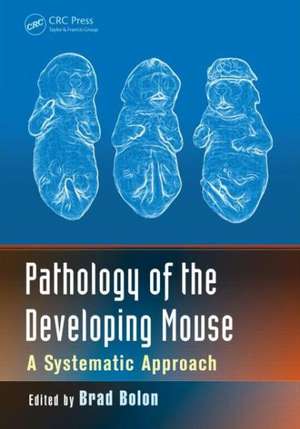
Pathology of the Developing Mouse: A Systematic Approach
Editat de Brad Bolonen Limba Engleză Hardback – 24 apr 2015
The topics covered in this volume include a full range of subjects encountered when building and wielding a developmental pathology tool kit:
- baseline anatomic and physiologic traits of developing mice
- principles of good experimental design and statistical analysis for mouse developmental pathology studies
- procedures for anatomic pathology examinations, to evaluate structural changes at the macroscopic (gross), microscopic (cells and tissues), and ultrastructural (subcellular) levels, suing conventional autopsy-based or novel non-invasive imaging techniques;
- methods for clinical pathology testing, to assess the biochemical and cellular composition of tissues and fluids;
- options and protocols for in situ molecular pathology analysis, to undertake site-specific explorations of the various mechanisms responsible for producing adverse findings (i.e., "lesions") during development; and
- well-referenced and illustrated guides to the interpretation of anatomic pathology and clinical pathology changes in the animal (embryos, fetuses, neonates, and juveniles) and its support system (placenta).
Preț: 1636.67 lei
Preț vechi: 1798.54 lei
-9%
Puncte Express: 2455
Carte disponibilă
Livrare economică 10-24 noiembrie
Livrare express 24-30 octombrie pentru 98.96 lei
Livrare prin curier în România Termenul estimat este afișat lângă disponibilitate.
Transport gratuit pentru acest produs Plată online sau ramburs, în funcție de opțiunile comenzii.
Retur gratuit în 14 zile Comandă securizată și suport în română.
Specificații
ISBN-13: 9781420070088
ISBN-10: 1420070088
Pagini: 446
Ilustrații: 29 black & white illustrations, 159 colour illustrations, 54 black & white tables
Dimensiuni: 178 x 254 x 25 mm
Greutate: 2.15 kg
Ediția:1
Editura: CRC Press
Colecția CRC Press
ISBN-10: 1420070088
Pagini: 446
Ilustrații: 29 black & white illustrations, 159 colour illustrations, 54 black & white tables
Dimensiuni: 178 x 254 x 25 mm
Greutate: 2.15 kg
Ediția:1
Editura: CRC Press
Colecția CRC Press
V-ar putea interesa
-
 Fundamentals of Toxicologic PathologyMatthew A. Wallig-26%Preț: 1228.17 lei1659.65 lei
 -
 Practical Statistics for Medical ResearchDouglas G. Altman-18%Preț: 966.50 lei1178.65 lei
 -
 Comparative Effectiveness and Safety of Radiotherapy Treatments for Head and Neck CancerU. S. Department of Heal Human Services-5%Preț: 237.15 lei249.63 lei
 -
 Comparative Effectiveness of Angiotensin Converting Enzyme Inhibitors or Angiotensin II Receptor Blockers Added to Standard Medical Therapy for TreatiU. S. Department of Heal Human Services-5%Preț: 183.11 lei192.74 lei
 -
 Values of Older Adults Related to Primary and Secondary PreventionU. S. Department of Heal Human Services-5%Preț: 111.23 lei117.08 lei
 -
 Screening for OsteoporosisU. S. Department of Heal Human Services-5%Preț: 152.01 lei160.02 lei
 -
 Screening for Intermediate Risk Factors for Coronary Heart DiseaseU. S. Department of Heal Human Services-5%Preț: 151.79 lei159.78 lei
 -
 Screening for Hearing Loss in Adults Ages 50 Years and OlderU. S. Department of Heal Human Services-5%Preț: 117.23 lei123.40 lei
 -
 Screening for Breast CancerU. S. Department of Heal Human Services-5%Preț: 118.35 lei124.58 lei
 -
 Second-Generation Antidepressants in the Pharmacologic Treatment of Adult DepressionU. S. Department of Heal Human Services-5%Preț: 155.74 lei163.94 lei
 -
 A Systematic Evidence Review of Interventions for Non-Professional Caregivers of Individuals with DementiaU. S. Department of Veterans Affairs-5%Preț: 111.23 lei117.08 lei
 -
 A Systematic Evidence Review of the Signs and Symptoms of Dementia and Brief Cognitive Tests Available in VaU. S. Department of Veterans Affairs-5%Preț: 98.92 lei104.13 lei
 -
 Efficacy of Complementary and Alternative Medicine Therapies for Posttraumatic Stress DisorderU. S. Department of Veterans Affairs-5%Preț: 106.03 lei111.61 lei
 -
 Brief Psychotherapy for Depression in Primary CareU. S. Department of Veterans Affairs-5%Preț: 105.08 lei110.61 lei
 -
 -5%Preț: 104.71 lei110.21 lei
 -
 Comparative Effectiveness of Smoking Cessation Treatments for Patients with DepressionU. S. Department of Veterans Affairs-5%Preț: 117.23 lei123.40 lei
 -
 Preventing Alzheimer's Disease and Cognitive DeclineU. S. Department of Heal Human Services-5%Preț: 349.04 lei367.41 lei
 -
 Safety of Probiotics to Reduce Risk and Prevent or Treat DiseaseU. S. Department of Heal Human Services-5%Preț: 313.58 lei330.08 lei
 -
 Biological ClocksSusan Binkley-18%Preț: 949.28 lei1157.66 lei
Public țintă
Professional and Professional Practice & DevelopmentCuprins
INTRODUCTION. The Case for Developmental Pathology and Developmental Pathologists. FUNDAMENTALS OF MOUSE DEVELOPMENTAL BIOLOGY. Essentials of Mouse Genetics and Nomenclature. Essential Terminology for Mouse Developmental Pathology Studies. Anatomy and Physiology of the Developing Mouse and Placenta. Teratogens and Teratogenic Mechanisms in Mouse Developmental Pathology. EXPERIMENTAL METHODS IN MOUSE DEVELOPMENTAL PATHOLOGY. Principles of Experimental Design for Mouse Developmental Pathology Studies. Necropsy Sampling and Data Collection for Studying the Anatomy, Histology, and Pathology of Mouse Development. Clinical Pathology Analysis in Developing Mice. Histotechnological Processing of Developing Mice. Localization of Gene Expression in Developing Mice. Protein Localization in Developing Mice. Quantitative Morphological Assessment in Mouse Developmental Pathology Studies. Ultrastructural Evaluation of Developing Mice. Three-Dimensional Imaging in Mouse Developmental Pathology Studies. ANALYTICAL PRACTICES FOR MOUSE DEVELOPMENTAL PATHOLOGY. Pathology of the Developing Mouse from Conception to Weaning. Pathology of the Placenta. Mouse Developmental Pathology Assessments in High-Throughput Phenogenomic Facilities. A Statistical Analysis Primer for Mouse Developmental Pathology Studies. COMMON ABBREVIATIONS IN MOUSE DEVELOPMENTAL PATHOLOGY STUDIES. INDEX.
Notă biografică
Brad Bolon, DVM, MS, PhD, is a Diplomate of both the American College of Veterinary Pathologists (DACVP) and the American Board of Toxicology (DABT) as well as a Fellow of both the Academy of Toxicological Sciences (FATS) and the International Academy of Toxicologic Pathology (FIATP). He is currently an associate professor in the Department of Veterinary Biosciences, College of Veterinary Medicine and also the associate director of the Comparative Pathology and Mouse Phenotyping Shared Resource, Comprehensive Cancer Center at the Columbus campus of The Ohio State University (OSU). His main professional interests are the pathology of genetically engineered mice (especially embryos, fetuses, neonates, and placentas) and toxicologic neuropathology.
Recenzii
"Pathology of the Developing Mouse: A Systematic Approach is a much anticipated addition to the veterinary pathology reference literature. It is a fairly inexpensive textbook that will be useful for anyone who uses mice in developmental research.
Detailed, easy-to-follow experimental protocols are described throughout the text. In many cases, there are multiple options for procedures with pros and cons discussed for each. Each chapter contains excellent tables, diagrams, and photographs and ends with a complete reference list.
Although there is a growing volume of information on mouse developmental biology in the literature and on the Internet, the authors of this book have done a great job of creating a synopsis of this information that can be easily used by anyone working or training in mouse pathology or developmental biology."
—Stephen M. Griffey, DVM, PhD, University of California–Davis, in JAVMA
Detailed, easy-to-follow experimental protocols are described throughout the text. In many cases, there are multiple options for procedures with pros and cons discussed for each. Each chapter contains excellent tables, diagrams, and photographs and ends with a complete reference list.
Although there is a growing volume of information on mouse developmental biology in the literature and on the Internet, the authors of this book have done a great job of creating a synopsis of this information that can be easily used by anyone working or training in mouse pathology or developmental biology."
—Stephen M. Griffey, DVM, PhD, University of California–Davis, in JAVMA
Descriere
This book is the first publication to provide comprehensive guidance regarding the identification, characterization, and interpretation of mouse developmental defects. It emphasizes the interpretation of abnormal phenotypes and provides detailed protocols for appropriately processing mouse embryos, fetuses, neonates, juveniles, and placentas. A complete reference on the design, analysis, and interpretation of abnormal findings, the book is enhanced with numerous full-color illustrations, enabling readers to comprehend both normal development and the major categories of defects that may be seen in malformed developing mice (and placentas) of all ages. The extensive literature citations provide a starting point for additional reading to begin building true expertise in the field.