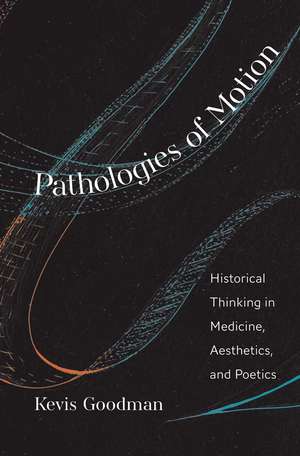
Pathologies of Motion: Historical Thinking in Medicine, Aesthetics, and Poetics: The Lewis Walpole Series in Eighteenth-Century Culture and History
Autor Kevis Goodmanen Limba Engleză Hardback – 17 ian 2023
Ne-a atras atenția modul în care Pathologies of Motion reîncadrează estetica și poetica Iluminismului târziu nu doar ca forme de artă, ci ca sisteme de cunoaștere suprapuse peste medicina de mediu. Punctul central al lucrării este analiza „patologiei mișcării”, în special a nostalgiei medicale, privită ca o reacție fiziologică la strămutarea geografică și la dislocările istorice. Putem afirma că abordarea lui Kevis Goodman transformă înțelegerea noastră despre cum corpul uman „înregistrează” istoria prin sistemul nervos și mișcările interioare.
Spre deosebire de narativele clasice despre armonia dintre medicină și artă, acest volum explorează „patologia filosofică” ca pe o metodă sofisticată de interpretare a semnelor corporale. Kevis Goodman demonstrează cum nostalgia a supraviețuit în teoria estetică nu ca diagnostic, ci sub forma unor practici formale care perturbă ideea de „joc liber” al minții. Comparabil cu A Cultural History of Medicine in the Age of Enlightenment de Lisa Smith în rigurozitatea documentării tensiunilor dintre minte și corp, acest volum este actualizat pentru o perspectivă mai profundă asupra modului în care mobilitatea modernă a modelat patologiile epocii. De asemenea, lucrarea intră în dialog cu City of Health, Fields of Disease de Martin Wallen, însă Goodman se concentrează mai specific pe mecanismele estetice prin care medicina de mediu devine o formă de gândire istorică.
În contextul operei sale, Pathologies of Motion reprezintă o evoluție firească de la Georgic Modernity and British Romanticism. Dacă în lucrarea anterioară autoarea urmărea medierea percepției prin instrumente științifice și sentimente, aici ea plonjează în „anatomia” suferinței provocate de mișcare și timp. Este un studiu dens, de 320 de pagini, care reunește istoria medicinei, antropologia și critica literară sub egida prestigioasei edituri Yale University Press.
Din seria The Lewis Walpole Series in Eighteenth-Century Culture and History
-
 Preț: 230.84 lei
 - 8%
 Preț: 442.11 lei
 -
 Preț: 245.91 lei
 -
 Preț: 254.70 lei
 -
 Preț: 252.87 lei
 - 8%
 Preț: 425.41 lei
 -
 Preț: 192.91 lei
 -
 Preț: 296.91 lei
 -
 Preț: 420.61 lei
 -
 Preț: 419.65 lei
 -
 Preț: 338.72 lei
 -
 Preț: 234.74 lei
 -
 Preț: 430.88 lei
 -
 Preț: 420.22 lei
 - 23%
 Preț: 490.18 lei
 - 23%
 Preț: 450.12 lei
 - 23%
 Preț: 414.36 lei
 -
 Preț: 115.40 lei
 - 23%
 Preț: 423.70 lei
 - 23%
 Preț: 449.52 lei
 - 23%
 Preț: 483.02 lei
 - 23%
 Preț: 419.28 lei
 - 23%
 Preț: 431.67 lei
 - 17%
 Preț: 299.00 lei
 - 24%
 Preț: 158.95 lei
 - 22%
 Preț: 90.96 lei
 -
 Preț: 255.91 lei
 - 16%
 Preț: 235.51 lei
Preț: 278.80 lei
Carte disponibilă
Livrare economică 13-27 mai
Livrare express 28 aprilie-02 mai pentru 44.65 lei
Specificații
ISBN-10: 0300243960
Pagini: 320
Ilustrații: 2 b-w illus.
Dimensiuni: 156 x 235 x 30 mm
Greutate: 0.61 kg
Editura: Yale University Press
Colecția Yale University Press
Seria The Lewis Walpole Series in Eighteenth-Century Culture and History
De ce să citești această carte
Această carte este esențială pentru cercetătorii interesați de intersecția dintre literatură și istoria medicinei. Cititorul va câștiga o înțelegere nuanțată a modului în care concepte medicale vechi, precum nostalgia, au modelat structura poeziei și esteticii romantice. Este o recomandare solidă pentru cei care doresc să exploreze cum dislocările sociale și geografice ale secolului al XVIII-lea au fost „traduse” în limbaj medical și artistic.
Despre autor
Kevis Goodman este conferențiar de literatură engleză la University of California, Berkeley, fiind o voce autoritară în studiul Romantismului și al culturii secolului al XVIII-lea. Cu o activitate publicistică bogată în jurnale de prestigiu precum „Studies in Romanticism” și „ELH”, Goodman s-a remarcat prin capacitatea de a conecta discipline aparent divergente. Lucrarea sa anterioară, Georgic Modernity and British Romanticism, a stabilit direcția cercetărilor sale actuale, investigând modul în care transformările istorice și științifice sunt mediate de formele literare, temă pe care o rafinează în prezentul volum prin prisma patologiei medicale.
Descriere scurtă
This book studies later eighteenth-century medicine, aesthetics, and poetics as overlapping forms of knowledge increasingly concerned about the relationship between the geographical movements of persons displaced from home and the physiological or nervous “motions” within their bodies and minds. Looking beyond familiar narratives about medicine and art’s shared therapeutic and harmonizing ideals, this book explores Enlightenment and Romantic-era aesthetics and poetics in relation to a central but less well known area of eighteenth-century environmental medicine: pathology.
No mere system of diagnosis or classification, philosophical pathology was an art of interpretation, offering sophisticated ways of reading the multiple conditions and causes of disease, however absent from perception, in their palpable, embodied effects. For medical, anthropological, environmental, and literary authors alike, it helped to locate the dislocations of modern mobility when a full view of their causes and conditions remained imperfectly understood or still unfolding. Goodman traces the surprising afterlife of the period’s exemplary but unexplained pathology of motion, medical nostalgia, within aesthetic theory and poetics, arguing that nostalgia persisted there not as a named condition but as a set of formal principles and practices, perturbing claims about the harmony, freedom, and free play of the mind.
Recenzii
“Pathologies of Motion is a splendid book, knitting together discoveries unexpectedly congruent with one another, and strewn so bountifully before readers they will be inspired to make more.”—Jonathan Lamb, Eighteenth-Century Studies
“Wonderfully written and engaging.”—European Romantic Review
“Goodman’s engagement with figures such as Friedrich Schiller . . . offers a vision of moral and aesthetic development structured by sensation and emotion. . . . Goodman proposes a model for Romantic reading as well as a kind of criticism attuned to recursive, symptomatic patterns.”—Laura Miller, Studies in English Literature 1500–1900
Winner of the 2022 Jean-Pierre Barricelli Prize, sponsored by the International Conference on Romanticism
Shortlisted for the Marilyn Gaull Award from The Wordsworth Circle
Honorable Mention from the Michelle Kendrick Memorial Book Prize, sponsored by The Society for Literature, Science, and the Arts
Shortlisted for the Kenshur Prize, sponsored by The Indiana U Center for Eighteenth-Century Studies
“In tracing how eighteenth-century pathology and aesthetics registered causal forces beyond our immediate ken, Kevis Goodman offers an electrifying account of the way poetics made abstract historical processes visible at a pivotal moment in global modernity.”—Lynn Festa, author of Fiction Without Humanity
“Goodman provides a new way of thinking about human freedom, the imagination, volition, and mobility. This is a richly erudite and theoretically lucid book that anyone working in this period will want to read and reread.”—Alan Bewell, University of Toronto
“By bringing together aesthetics and medicine, Goodman offers a new and enthralling description of modernity. Pathologies of Motion also brilliantly vindicates, as it demonstrates, the practice of symptomatic reading.”—Deidre Lynch, Harvard University
“Goodman’s elegant, learned work is the entering wedge in a radical rethinking of Romanticism and its predecessors. It reveals a pathological counter-current in tension with the age’s dominant aesthetic quest for harmony.”—Marjorie Levinson, author of Thinking through Poetry
“Goodman rediscovers eighteenth-century pathology as a synoptic discipline projecting the material body and the imagination as mutually involved and evolving agents of human behavior and consciousness. Her book thereby offers exciting new readings of reading itself—of the physiological functions of organized sound—as well as of Schiller and the Scottish doctors, of the newly privileged phenomenon of nostalgia, and of some of the best-known Romantic poems.”—David Simpson, author of Engaging Violence