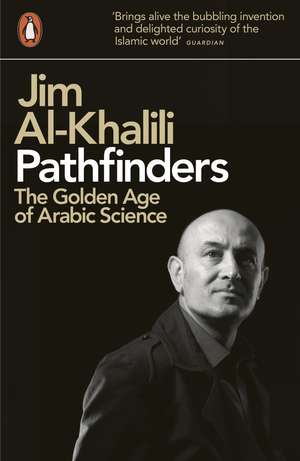
Pathfinders
Autor Jim Al–khalilien Limba Engleză Paperback – 26 ian 2012
Observăm în literatura academică occidentală o lacună persistentă în ceea ce privește tranziția cunoașterii de la antichitatea clasică la Renașterea europeană, o perioadă adesea expediată sub eticheta „Evului Mediu întunecat”. Pathfinders vine să corecteze această omisiune, demonstrând că, timp de șapte secole, araba a fost limba universală a cercetării științifice. Jim Al-Khalili nu se limitează la o simplă cronologie, ci analizează riguros modul în care figuri precum Ibn al-Haytham au prefigurat metoda științifică modernă cu mult înaintea lui Francis Bacon. Subliniem precizia cu care autorul, el însuși profesor de fizică, explică moștenirea lui al-Khwarizmi în matematică sau a lui Abu Rayhan al-Biruni în polimație. Volumul este comparabil cu Encyclopedia of the History of Arabic Science de Roshdi Rashed în ceea ce privește rigoarea documentării, dar este actualizat pentru un public mai larg, oferind o cursivitate narativă care lipsește enciclopediilor tehnice. Spre deosebire de The House of Wisdom de Jonathan Lyons, care se concentrează pe transferul de cunoștințe către Vest, Pathfinders pune accentul pe contextul intelectual intern al lumii musulmane și pe inovațiile originale ale acestor savanți. În contextul operei sale, această carte reprezintă o ancoră istorică necesară. Dacă în The World According to Physics sau The Physics Book autorul explorează frontierele moderne și legile fundamentale ale universului, în Pathfinders el investighează însăși geneza gândirii raționale. Stilul este cel consacrat al lui Jim Al-Khalili: autoritar prin prisma expertizei sale în fizică matematică, dar accesibil, fiind susținut de hărți și ilustrații care ajută la vizualizarea fluxului de idei între marile centre de învățare ale vremii.
Preț: 87.23 lei
Preț vechi: 107.60 lei
-19%
Carte disponibilă
Livrare economică 06-18 noiembrie
Livrare express 22-28 octombrie pentru 43.24 lei
Specificații
ISBN-10: 0141038365
Pagini: 352
Ilustrații: Illustrations (some col.), maps, ports.
Dimensiuni: 131 x 203 x 23 mm
Greutate: 0.28 kg
Editura: Penguin Books
Locul publicării:London, United Kingdom
V-ar putea interesa
-
 Sapiens: A Brief History of Human KindYuval Noah Harari-17%Preț: 80.04 lei95.89 lei
 -
 To Explain the WorldSteven Weinberg-29%Preț: 66.53 lei94.31 lei
 -
 The Light AgesSeb Falk-18%Preț: 77.30 lei94.26 lei
 -
 The House of WisdomJim Al–khaliliPreț: 108.23 lei
 -
 The Genius of their Age: Ibn Sina, Biruni, and the Lost EnlightenmentS. Frederick Starr-23%Preț: 150.33 lei194.38 lei
 -
 Preț: 213.45 lei
 -
 Amazing Muslims Who Changed the WorldBurhana Islam-14%Preț: 110.46 lei128.82 lei
 -
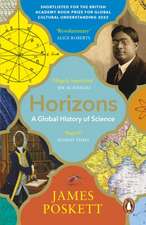 HorizonsJames Poskett-18%Preț: 77.34 lei94.48 lei
 -
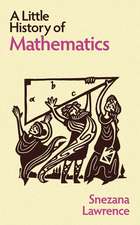 A Little History of MathematicsSnezana LawrencePreț: 155.08 lei
 -
 Preț: 270.05 lei
 -
 -14%Preț: 58.70 lei68.49 lei
 -
 A Brief History of the Universe (and our place in it)Sarah Alam Malik-19%Preț: 99.18 lei122.10 lei
 -
 The 50 Greatest ScientistsJon BalchinPreț: 153.78 lei
 -
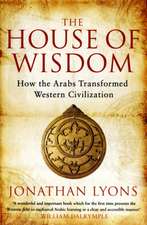 -27%Preț: 68.42 lei93.17 lei
 -
 Preț: 29.73 lei
 -
 -33%Preț: 79.92 lei119.99 lei
 -
 Homo Deus: A Brief History of TomorrowYuval Noah Harari-16%Preț: 80.40 lei96.07 lei
 -
 Science and IslamEhsan MasoodPreț: 79.49 lei
 -
 SapiensYuval Noah Harari-37%Preț: 119.84 lei189.48 lei
 -
 -18%Preț: 1371.95 lei1673.11 lei
De ce să citești această carte
Recomandăm această carte oricărui cititor pasionat de istoria ideilor care dorește să înțeleagă rădăcinile globale ale științei. Veți descoperi că algoritmii, optica modernă și bazele medicinei nu au apărut în vid, ci sunt rezultatul unei epoci de aur a raționalismului arab. Este un instrument esențial pentru a completa o viziune eurocentrică asupra progresului uman, oferind o perspectivă documentată asupra datoriei intelectuale pe care modernitatea o are față de savanții din Baghdad sau Cairo.
Despre autor
Jim Al-Khalili OBE este profesor de fizică la Universitatea din Surrey, unde deține prima catedră de implicare publică în știință. Renumit comunicator de știință, a fost distins cu Premiul Michael Faraday al Royal Society în 2007. Născut în Baghdad și educat în Irak până la vârsta de 16 ani, autorul îmbină rigoarea academică a fizicianului teoretician cu o înțelegere profundă a culturii și limbii arabe. Această dublă identitate îi permite să navigheze cu autoritate prin manuscrisele istorice, oferind o perspectivă unică asupra modului în care știința a traversat frontierele geografice și lingvistice.
Notă biografică
His many popular science books have been translated into twenty-six languages. He is a recipient of the Royal Michael Faraday medal and the Institute of Physics Kelvin Medal.
In 2016 he received the inaugural Stephen Hawking Medal for Science Communication. He lives in Southsea, Hampshire, with his wife Julie.
Recenzii
A fascinating and user-friendly guide to this whole scientific movement
Jim Al-Khalili has a passion for bringing to a wider audience not just the facts of science but its history ... Just as the legacy of Copernicus and Darwin belongs to all of us, so does that of Ibn Sina and Ibn al-Haytham. To think otherwise, as this book so powerfully reveals, is to do disservice to the tradition to which they belong
Spry, informative and timely ... Al-Khalili takes the reader through a brisk survey of the highlights of the period
A fascinating introduction to a neglected area. His approachable style and ability to distil extensive knowledge into simple narrative makes Pathfinders an absorbing read
Enjoyable and informative ... provides ample evidence for the compatibility of Islam and science
He has brought a great story out of the shadows
This captivating book is a timely reminder of the debt owed by the West to the intellectual achievements of Arab, Persian and Muslim scholars
Descriere scurtă
For over 700 years the international language of science was Arabic. Surveying the golden age of Arabic science, Jim Al-Khalili reintroduces such figures as the Iraqi physicist Ibn al-Haytham, who practised the modern scientific method over half a century before Bacon; al-Khwarizmi, the greatest mathematician of the medieval world; and Abu Rayhan al-Biruni, a Persian polymath to rival Leonardo da Vinci.
'Jim Al-Khalili has a passion for bringing to a wider audience not just the facts of science but its history ... Just as the legacy of Copernicus and Darwin belongs to all of us, so does that of Ibn Sina and Ibn al-Haytham'
Independent
'He has brought a great story out of the shadows'
Literary Review
'His command of Arabic and mathematical physics invests his story with sympathy as well as authority'
Guardian
'A fascinating and user-friendly guide'
Sunday Telegraph
'This captivating book is a timely reminder of the debt owed by the West to the intellectual achievements of Arab, Persian and Muslim scholars'
The Times
Jim Al-Khalili OBE is Professor of Physics at the University of Surrey, where he also holds the first Surrey chair in the public engagement in science. He was awarded the Royal Society Michael Faraday Prize for science communication in 2007, elected Honorary Fellow of the British Association for the Advancement of Science and has also received the Institute of Physic's Public Awareness of Physics Award. Born in Baghdad, Jim was educated in Iraq until the age of 16 and it was there, being taught by Arabic teachers in Arabic that he first heard and learnt about the great Arab scientists and philosophers.