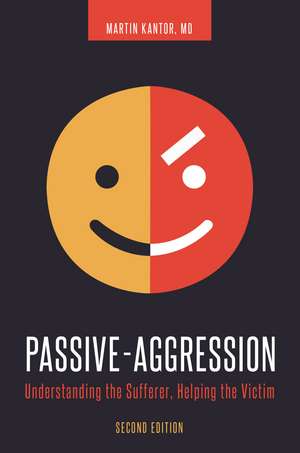
Passive-Aggression
Autor Martin Kantoren Limba Engleză Hardback – 30 sep 2017
Contrary to what is implied in the American Psychiatric Association's Diagnostic and Statistical Manual of Mental Disorders, Fifth Edition (DSM-5), and what some practitioners have believed in recent years, new thinking points to passive-aggression being a full disorder. A counterrevolution is now occurring, with some of the most centrist of authors participating in a concerted drive to bring back the diagnosis as being one of the fundamental personality disorders-indeed, a disorder that describes individuals with a distinctly troublesome personality. In this new book, Martin Kantor-a Harvard-trained psychiatrist and noted author of numerous medical texts-takes a new look at passive-aggression and passive-aggressive personality disorder (PAPD) that precisely and scientifically defines it in terms of description, causality, and therapeutic intervention, all based on recent theoretical findings.
Kantor makes a powerful argument that passive-aggression can only be reliably identified by answering three fundamental questions, the answers to which define the disorder: why these patients get so angry; why these patients cannot express their anger directly; and what anger styles they employ to express their aggressions. His examination of passive-aggression, which involves two people enmeshed with each other, logically takes two distinct points of view: that of the passive-aggressive individual, and that of his or her "victim" or "target." Specific clinical observation is presented to clarify theory. The book explains how passive-aggression can develop into a complex dyadic interaction in which it is difficult to determine who is doing what to whom, who started it, and what path to take to deescalate; and how using mutual understanding and healthy empathy plus compassion can preclude getting involved in sadomasochistic mutual provocation. The author also suggests ways for those who suffer from passive-aggression to be less hypersensitive, and to express what hypersensitivity they can't help feeling more directly, rather than via the various unhealthy anger styles that constitute the passive-aggressive modus operandi.
Preț: 387.55 lei
Preț vechi: 465.38 lei
-17%
Puncte Express: 581
Carte tipărită la comandă
Livrare economică 24 noiembrie-08 decembrie
Livrare prin curier în România Termenul estimat este afișat lângă disponibilitate.
Transport gratuit de la 400.00 lei Plată online sau ramburs, în funcție de opțiunile comenzii.
Retur gratuit în 14 zile Comandă securizată și suport în română.
Specificații
ISBN-13: 9781440837906
ISBN-10: 1440837902
Pagini: 296
Dimensiuni: 161 x 240 x 21 mm
Greutate: 0.66 kg
Ediția:Revised
Editura: Praeger
Locul publicării:New York, United States
ISBN-10: 1440837902
Pagini: 296
Dimensiuni: 161 x 240 x 21 mm
Greutate: 0.66 kg
Ediția:Revised
Editura: Praeger
Locul publicării:New York, United States
Cuprins
Acknowledgments
Introduction: An Overview
Part 1 Description
Chapter Making the Diagnosis
Chapter 2 Differential Diagnosis
Chapter 3 Anger Triggers: Reasons Why Passive-Aggressives Get So Angry
Chapter 4 More Reasons Why Passive-Aggressives Get So Angry (More Anger Triggers)
Chapter 5 Reasons Passive-Aggressives Can Only Express Their Anger Indirectly
Chapter 6 Anger Styles
Chapter 7 Other (Nonsyndromal) Anger Styles: Tactical, Cognitive-Behavioral, Interpersonal, and Biological Features
Chapter 8 Pseudopassive-Aggressives
Part 2 Victims of Passive-Aggressives
Chapter 9 Pseudovictims
Chapter 10 More Interactions Between Passive-Aggressives and Their Victims
Chapter 11 Sadomasochism
Part 3 Treatment
Chapter 12 Introduction to Treatment/Psychoanalytically Oriented Psychotherapy
Chapter 13 Cognitive Therapy
Chapter 14 Interpersonal Therapy
Chapter 15 Transference and Countertransference Issues
Chapter 16 Victims of Passive-Aggression
Chapter 17 Helping Passive-Aggressives Become Less So
Chapter 18 Anger Management
Notes
Index
Introduction: An Overview
Part 1 Description
Chapter Making the Diagnosis
Chapter 2 Differential Diagnosis
Chapter 3 Anger Triggers: Reasons Why Passive-Aggressives Get So Angry
Chapter 4 More Reasons Why Passive-Aggressives Get So Angry (More Anger Triggers)
Chapter 5 Reasons Passive-Aggressives Can Only Express Their Anger Indirectly
Chapter 6 Anger Styles
Chapter 7 Other (Nonsyndromal) Anger Styles: Tactical, Cognitive-Behavioral, Interpersonal, and Biological Features
Chapter 8 Pseudopassive-Aggressives
Part 2 Victims of Passive-Aggressives
Chapter 9 Pseudovictims
Chapter 10 More Interactions Between Passive-Aggressives and Their Victims
Chapter 11 Sadomasochism
Part 3 Treatment
Chapter 12 Introduction to Treatment/Psychoanalytically Oriented Psychotherapy
Chapter 13 Cognitive Therapy
Chapter 14 Interpersonal Therapy
Chapter 15 Transference and Countertransference Issues
Chapter 16 Victims of Passive-Aggression
Chapter 17 Helping Passive-Aggressives Become Less So
Chapter 18 Anger Management
Notes
Index