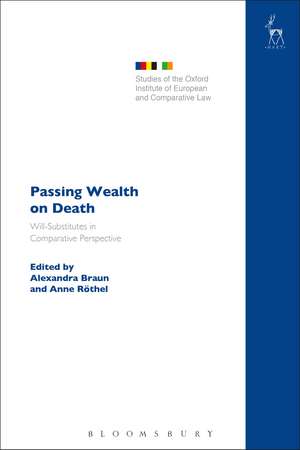
Passing Wealth on Death: Will-Substitutes in Comparative Perspective: Studies of the Oxford Institute of European and Comparative Law
Editat de Professor Alexandra Braun, Professor Dr Anne Röthelen Limba Engleză Hardback – 28 iul 2016
După parcurgerea acestui volum, cititorul va fi capabil să identifice și să utilizeze strategic mecanismele juridice alternative testamentului pentru transferul transfrontalier al averii, optimizând succesiunea în funcție de specificul jurisdicțiilor de common law sau civil law. Remarcăm că, deși testamentul rămâne instrumentul central de succesiune, Passing Wealth on Death demonstrează cum instrumente precum trusturile, contractele de asigurări de viață sau planurile de pensii (cunoscute în SUA ca „will-substitutes”) redefinesc dinamica moștenirii moderne. Descoperim aici o analiză riguroasă a modului în care aceste substitute interacționează cu drepturile creditorilor și pretențiile membrilor familiei.
Structura volumului este concepută pentru a oferi atât o profunzime locală, cât și o viziune de ansamblu. Prima parte este organizată pe jurisdicții individuale, oferind studii de caz detaliate pentru țări precum Germania, Scoția sau Italia. Cea de-a doua parte trece la perspective transversale, analizând impactul acestor instrumente asupra investitorilor internaționali și a structurilor de afaceri. Complementar volumului Comparative Succession Law, care se concentrează pe formalitățile testamentare clasice, această lucrare acoperă zona gri a transferurilor de active care au loc în afara procedurilor succesorale standard, dar care produc efecte post-mortem similare.
Spre deosebire de Postmortal succession on the example of Polish law in a comparative perspective, care explorează în profunzime sistemul polonez, lucrarea editată de Professor Alexandra Braun și Professor Dr Anne Röthel oferă un cadru mult mai vast, fiind prima care analizează substitutele testamentare dintr-o perspectivă cu adevărat globală și comparativă. Este o resursă esențială pentru înțelegerea tensiunilor dintre libertatea de a dispune de bunuri și politicile de protecție socială sau familială.
Din seria Studies of the Oxford Institute of European and Comparative Law
- 29%
 Preț: 279.46 lei
 - 24%
 Preț: 225.01 lei
 - 11%
 Preț: 391.33 lei
 - 22%
 Preț: 326.57 lei
 - 21%
 Preț: 334.89 lei
 - 22%
 Preț: 331.73 lei
 - 31%
 Preț: 423.59 lei
 - 22%
 Preț: 330.87 lei
 - 33%
 Preț: 559.50 lei
 - 33%
 Preț: 590.06 lei
 - 31%
 Preț: 515.92 lei
 - 33%
 Preț: 595.16 lei
 - 37%
 Preț: 590.06 lei
 - 33%
 Preț: 589.50 lei
 - 33%
 Preț: 1211.34 lei
 - 30%
 Preț: 591.32 lei
 - 33%
 Preț: 588.68 lei
 - 33%
 Preț: 589.23 lei
 - 33%
 Preț: 993.77 lei
 - 33%
 Preț: 619.87 lei
 - 33%
 Preț: 806.58 lei
 - 37%
 Preț: 559.73 lei
 - 33%
 Preț: 926.48 lei
 - 33%
 Preț: 528.26 lei
 - 24%
 Preț: 307.26 lei
 - 26%
 Preț: 271.10 lei
 - 22%
 Preț: 323.57 lei
 - 30%
 Preț: 426.99 lei
 - 22%
 Preț: 307.25 lei
 - 14%
 Preț: 528.83 lei
 - 33%
 Preț: 995.64 lei
 - 33%
 Preț: 620.32 lei
Preț: 623.55 lei
Preț vechi: 932.12 lei
-33%
Carte tipărită la comandă
Livrare economică 09-23 iunie
Specificații
ISBN-10: 184946698X
Pagini: 408
Dimensiuni: 164 x 238 x 30 mm
Greutate: 0.76 kg
Editura: Bloomsbury Publishing
Colecția Hart Publishing
Seria Studies of the Oxford Institute of European and Comparative Law
Locul publicării:London, United Kingdom
V-ar putea interesa
-
 The Idea of Property in LawJames Penner-31%Preț: 500.62 lei726.26 lei
 -
 Principles of European Law: Unjustified EnrichmentStephen Swann-37%Preț: 1200.59 lei1907.66 lei
 -
 Property and JusticeJ. W. Harris-11%Preț: 458.07 lei514.68 lei
 -
 Philosophical Foundations of Property LawJames Penner-27%Preț: 815.06 lei1109.39 lei
 -
 Land Law Lawcards 2012-2013RoutledgePreț: 333.88 lei
 -
 -15%Preț: 512.41 lei602.83 lei
 -
 Law of Estate AgencyJohn Murdoch-15%Preț: 500.32 lei588.61 lei
 -
 Preț: 195.30 lei
 -
 Landlord′s Legal Kit For DummiesRS GriswoldPreț: 211.22 lei
 -
 The Habitats Directive: A Developer's Obstacle Course?Gregory Jones KC-30%Preț: 803.27 lei1139.88 lei
 -
 An Introduction to Land LawSimon Gardner-23%Preț: 239.42 lei311.93 lei
De ce să citești această carte
Această carte este indispensabilă avocaților specializați în planificare patrimonială și succesiuni internaționale. Veți câștiga o înțelegere clară a modului în care activele pot fi transferate eficient prin metode alternative testamentului, evitând blocajele birocratice și protejând interesele moștenitorilor sau ale partenerilor de afaceri în multiple jurisdicții. Este un instrument de lucru pragmatic pentru gestionarea averilor mari în context global.
Descriere
Much has been written about the effect of the use of will-substitutes in the US, but little is generally known about developments in other jurisdictions. For the first time, this collection of contributions looks at will-substitutes from a comparative perspective. It examines mechanisms that pass wealth on death across a number of common law, civil law and mixed legal jurisdictions, and explores the rationale behind their use. It analyses them from different viewpoints, including those of owners of businesses, investors, as well as creditors, family members and dependants. The aims of the volume are to show the complexity and dynamics of wealth transfers on death across jurisdictions, to identify patterns between jurisdictions, and to report the attitudes towards the different modes of transfer in light of their utility and the potential frictions they give rise to with policies and principles underpinning current laws.
Cuprins
1. Will-Substitutes: A US Perspective
THOMAS P GALLANIS
2. Will-Substitutes in Canada
ANGELA CAMPBELL
3. Will-Substitutes in England and Wales
ALEXANDRA BRAUN
4. Will-Substitutes in Scotland
DANIEL CARR
5. Will-Substitutes in New Zealand and Australia
NICOLA PEART AND PRUE VINES
6. Will-Substitutes in Italy
GREGOR CHRISTANDL
7. Will-Substitutes in France
CÉCILE PÉRÈS
8. Will-Substitutes in Germany
ANATOL DUTTA
9. Will-Substitutes in Switzerland and Liechtenstein
DOMINIQUE JAKOB
Part II: Overarching Perspectives
10. Will-Substitutes from the Perspective of Business Owners
SUSANNE KALSS
11. Will-Substitutes from the Perspective of (International) Investors
PAUL MATTHEWS
12. Will-Substitutes and Creditors: Canada and the US
LIONEL SMITH
13. Will-Substitutes: The Perspective of Creditors in Germany, and England and Wales
REINHARD BORK
14. Will-Substitutes and the Claims of Family Members and Carers
JONATHAN HERRING
15. Will-Substitutes and the Family: A Continental Perspective
ANNE RÖTHEL
16. Exploring Means of Transferring Wealth on Death: A Comparative Perspective
ALEXANDRA BRAUN AND ANNE RÖTHEL
Recenzii
The eminent contributors have clearly put a high level of careful scholarship into the individual essays in the volume. The project has greatly advanced our understanding of will-substitutes and their place in the law of succession ... given the quality of the analysis it offers, the book is a highly recommended purchase for university libraries, for scholars in the area of succession law, and for larger legal practices with an interest in international estate planning.
It lays the foundation for further study both at a national level and comparatively. While the picture is a complex one, at the very least the pervasive use of will substitutes calls for a re-evaluation of the operation of succession law. Further, this project has opened a new and more subtle aspect in the discussion probing the use of functional equivalents. This volume is therefore very welcome and deserves a wide audience among both succession lawyers and comparatists.
This book is helpful in categorizing the multitude of means to pass wealth on death in modern society... For those readers who enjoy the view from 30,000 feet up, as well as an invigorating flight plan through several different legal cultures, this book offers both. And at the end of the journey, one arrives with a refreshed and more insightful understanding of modern succession law on death.
Although much has been written about the effect of the use of will-substitutes in the United States, contributors to Braun and Rothel's volume look at them in comparative perspective, examining mechanisms that pass wealth on death across a number of common law, civil law, and mixed legal jurisdictions, and exploring the rationale behind their use.
I found this book to be informative, interesting and easy to read. I recommend practitioners giving estate, trust and asset planning advice read this text while tax lawyers will also find it interesting.
In acknowledging and exploring the realities of wealth transfer upon death, Braun and Röthel call upon the international legal community to reconsider the scope of succession laws and whether they are achieving their underlying goals.
It is clear that this book sets the gold standard for all future studies on the subject. (Translated from the original German)