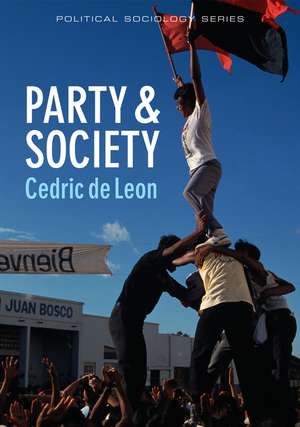
Party & Society
Autor Cedric De Leonen Limba Engleză Hardback – 31 dec 2013
In this timely book, Cedric de Leon examines the ways in which social scientists and other observers have imagined the relationship between parties and society. He introduces and critiques the full range of approaches, using enlivening comparative examples from across the globe. Cutting through a vast body of research, de Leon offers a succinct and lively analysis that outlines the key thinking in the field, placing it in historical and contemporary context. The resulting book will appeal to students of sociology, political science, social psychology, and related fields.
Preț: 332.61 lei
Preț vechi: 461.37 lei
-28%
Puncte Express: 499
Carte indisponibilă temporar
Doresc să fiu notificat când acest titlu va fi disponibil:
Se trimite...
Specificații
ISBN-13: 9780745653686
ISBN-10: 0745653685
Pagini: 176
Dimensiuni: 150 x 211 x 23 mm
Greutate: 0.36 kg
Editura: Polity Press
Locul publicării:Chichester, United Kingdom
ISBN-10: 0745653685
Pagini: 176
Dimensiuni: 150 x 211 x 23 mm
Greutate: 0.36 kg
Editura: Polity Press
Locul publicării:Chichester, United Kingdom
Public țintă
Upper–level students of political sociology, political science and related subjects.Notă biografică
Cedric de Leon is associate professor of sociology at Providence College.
Descriere
In this timely book, Cedric de Leon examines the ways in which social scientists and other observers have imagined the relationship between parties and society. He introduces and critiques the full range of approaches, using enlivening comparative examples from across the globe.