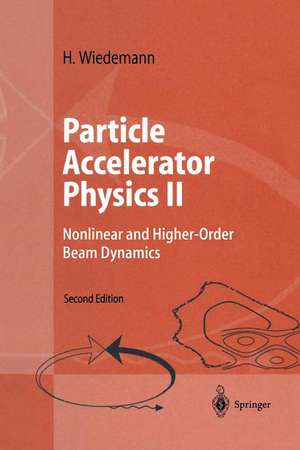
Particle Accelerator Physics II
Autor H. Wiedemannen Limba Engleză Paperback – 5 noi 2011
Preț: 654.20 lei
Preț vechi: 769.65 lei
-15%
Puncte Express: 981
Carte tipărită la comandă
Livrare economică 07-21 decembrie
Livrare prin curier în România Termenul estimat este afișat lângă disponibilitate.
Transport gratuit pentru acest produs Plată online sau ramburs, în funcție de opțiunile comenzii.
Retur gratuit în 14 zile Comandă securizată și suport în română.
Specificații
ISBN-13: 9783642641770
ISBN-10: 3642641776
Pagini: 496
Ilustrații: XVIII, 472 p.
Dimensiuni: 155 x 235 x 27 mm
Greutate: 0.74 kg
Ediția:Second Edition 1999
Editura: Springer
Locul publicării:Berlin, Heidelberg, Germany
ISBN-10: 3642641776
Pagini: 496
Ilustrații: XVIII, 472 p.
Dimensiuni: 155 x 235 x 27 mm
Greutate: 0.74 kg
Ediția:Second Edition 1999
Editura: Springer
Locul publicării:Berlin, Heidelberg, Germany
V-ar putea interesa
-
 Anomalies in Quantum Field TheoryReinhold A. Bertlmann-14%Preț: 699.88 lei813.81 lei
 -
 Supersymmetry: Theory, Experiment, and CosmologyPierre Binétruy-25%Preț: 570.94 lei758.52 lei
 -
 Experimental Neutron ScatteringB. T. M. Willis-22%Preț: 439.26 lei562.64 lei
 -
 Quantum Chromodynamics at High EnergyYuri V. Kovchegov-23%Preț: 611.37 lei797.28 lei
 -
 The Future of Theoretical Physics and CosmologyG. W. GibbonsPreț: 445.07 lei
 -
 Higgs ForceNicholas MeePreț: 96.49 lei
 -
 Modern Particle PhysicsMark ThomsonPreț: 451.06 lei
 -
 The Standard ModelCliff Burgess-11%Preț: 565.47 lei635.35 lei
 -
 Particle Physics, Fourth EditionBrian R. Martin-23%Preț: 469.44 lei609.67 lei
 -
 The Fukushima 2011 DisasterRonald Eisler-18%Preț: 893.59 lei1089.75 lei
 -
 Introduction to Elementary ParticlesDavid Griffiths-11%Preț: 490.46 lei551.08 lei
 -
 Quantum ChromodynamicsWalter Greiner-18%Preț: 784.06 lei956.18 lei
Public țintă
Professional/practitionerCuprins
1. Hamiltonian Formulation of Beam Dynamics.- 1.1 Hamiltonian Formalism.- 1.2 Hamiltonian Resonance Theory.- 1.3 Hamiltonian and Coupling.- 1.4 Symplectic Transformation.- Problems.- 2. General Electromagnetic Fields.- 2.1 General Transverse Magnetic-Field Expansion.- 2.2 Third-Order Differential Equation of Motion.- 2.3 Periodic Wiggler Magnets.- 2.4 Superconducting Magnet.- Problems.- 3. Dynamics of Coupled Motion.- 3.1 Conjugate Trajectories.- 3.2 Particle Motion in a Solenoidal Field.- 3.3 Transverse Coupled Oscillations.- Problems.- 4. Higher-Order Perturbations.- 4.1 Kinematic Perturbation Terms.- 4.2 Control of the Central Beam Path.- 4.3 Dipole Field Errors and Dispersion Function.- 4.4 Dispersion Function in Higher Order.- 4.5 Perturbation Methods in Beam Dynamics.- Problems.- 5. Hamiltonian Nonlinear Beam Dynamics.- 5.1 Higher-Order Beam Dynamics.- 5.2 Aberrations.- 5.3 Hamiltonian Perturbation Theory.- Problems.- 6. Charged Particle Acceleration.- 6.1 Accelerating Fields in Resonant rf Cavities.- 6.2 Beam-Cavity Interaction.- 6.3 Higher-Order Phase Focusing.- 6.4 FODO Lattice and Acceleration.- Problems.- 7. Synchrotron Radiation.- 7.1 Theory of Synchrotron Radiation.- 7.2 Synchrotron Radiation Power and Energy Loss.- 7.3 Spatial Distribution of Synchrotron Radiation.- 7.4 Synchrotron Radiation Spectrum.- Problems.- 8. Hamiltonian Many Particle Systems.- 8.1 The Vlasov Equation.- 8.2 Damping of Oscillations in Electron Accelerators.- 8.3 The Fokker-Planck Equation.- Problems.- 9. Particle Beam Parameters.- 9.1 Particle Distribution in Phase Space.- 9.2 Equilibrium Energy Spread and Bunch Length.- 9.3 Phase-Space Manipulation.- 9.4 Polarization of Particle Beam.- Problems.- 10. Collective Phenomena.- 10.1 Statistical Effects.- 10.2 Collective Self Fields.- 10.3 Beam-Current Spectrum.- 10.4 Wake Fields and Impedance.- 10.5 Coasting-Beam Instabilities.- 10.6 Longitudinal Single-Bunch Effects.- 10.7 Transverse Single-Bunch Instabilities.- 10.8 Multi-Bunch Instabilities.- Problems.- 11. Insertion Device Radiation.- 11.1 Particle Dynamics in an Undulator.- 11.2 Undulator Radiation.- 11.3 Undulator Radiation Distribution.- 11.4 Elliptical Polarization.- Problems.- References.- Suggested Reading.- Author Index.
Textul de pe ultima copertă
Particle Accelerator Physics II continues the discussion of particle accelerator physics beyond the introductory Particle Accelerator Physics I. Aimed at students and scientists who plan to work or are working in the field of accelerator physics. Basic principles of beam dynamics already discussed in Vol.I are expanded into the nonlinear regime in order to tackle fundamental problems encountered in present-day accelerator design and development. Nonlinear dynamics is discussed both for the transverse phase space to determine chromatic and geometric aberrations which limit the dynamic aperture as well as for the longitude phase space in connection with phase focusing at very small values of the momentum compaction. Effects derived theoretically are compared with observations made at existing accelerators.
Caracteristici
First genuine textbook in its field Incorporates important recent developments not considered in competing literature Extends the didactic approach of vol. I to include non-linear and higher-order beam dynamics