
Parenting: Contemporary Clinical Perspectives
Editat de Steven Tuberen Limba Engleză Hardback – 24 iun 2016
Preț: 521.17 lei
Preț vechi: 735.87 lei
-29%
Puncte Express: 782
Carte tipărită la comandă
Livrare economică 30 noiembrie-14 decembrie
Livrare prin curier în România Termenul estimat este afișat lângă disponibilitate.
Transport gratuit pentru acest produs Plată online sau ramburs, în funcție de opțiunile comenzii.
Retur gratuit în 14 zile Comandă securizată și suport în română.
Specificații
ISBN-13: 9781442254817
ISBN-10: 1442254815
Pagini: 268
Dimensiuni: 159 x 235 x 24 mm
Greutate: 0.55 kg
Editura: Bloomsbury Publishing
Colecția Rowman & Littlefield
Locul publicării:New York, United States
ISBN-10: 1442254815
Pagini: 268
Dimensiuni: 159 x 235 x 24 mm
Greutate: 0.55 kg
Editura: Bloomsbury Publishing
Colecția Rowman & Littlefield
Locul publicării:New York, United States
V-ar putea interesa
-
 All Joy and No Fun: The Paradox of Modern ParenthoodJennifer Senior-27%Preț: 67.75 lei92.94 lei
 -
 Parenting from the Inside OutDaniel J. SiegelPreț: 127.67 lei
 -
 Between Parent and Child: Revised and UpdatedHaim G. Ginott-21%Preț: 78.03 lei98.16 lei
 -
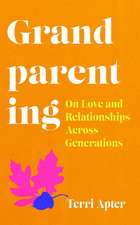 GrandparentingTerri ApterPreț: 107.73 lei
 -
 Understanding Your Child Beyond Words: Psychoanalytic Techniques for ParentsCayetano Garcia-Castrillón ArmengouPreț: 220.50 lei
 -
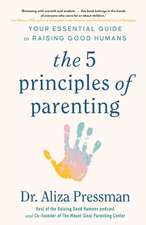 -27%Preț: 78.80 lei107.43 lei
 -
 -25%Preț: 107.17 lei143.49 lei
 -
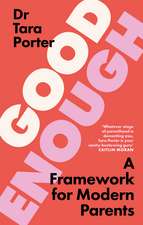 -27%Preț: 89.42 lei121.82 lei
 -
 -26%Preț: 79.42 lei107.77 lei
 -
 Working with Parents in Child PsychotherapyElisa Bronfman-5%Preț: 375.58 lei395.35 lei
 -
 The Last Parenting Book You'll Ever ReadMeagan FrancisPreț: 98.32 lei
 -
 -25%Preț: 104.20 lei138.67 lei
 -
 -20%Preț: 96.05 lei120.29 lei
 -
 -20%Preț: 97.14 lei120.92 lei
 -
 -20%Preț: 96.55 lei120.57 lei
 -
 Hold on to Your KidsGabor Maté-19%Preț: 75.97 lei93.47 lei
 -
 -20%Preț: 62.75 lei78.19 lei
 -
 Parent Yourself FirstBryana KappadakunnelPreț: 121.63 lei
 -
 The Good Enough ParentThe School Of Life-28%Preț: 87.62 lei121.90 lei
 -
 -17%Preț: 72.94 lei87.97 lei
Cuprins
Part I: Theorizing on the Process of Parenting
Parenting Across the Lifespan: Some Personal and Conceptual Musings / Steven Tuber, PhD, ABPPNot Your Mother's Identity: Good-Enough Parenting in the Age of Maximization / Lisa Samstag, PhD and Nick Samstag, PhDOn Being Essential: Parenting, Immigration, and Acculturation / Diana Punales Morejon, PhDWe Are Always Essential / Ken Barish, PhDPart II: Parenting and Its Impact on Clinical Work
The Therapist's Experience as Parent: The Complex Interaction Between Parent Process and Clinical Work / Leslie Gibson, PhDParental Humility / Kevin Meehan, PhD and Elizabeth Zick, PhDRage, Forgiveness, and Acceptance: Parenting Through Difficult Moments / Paul Donahue, PhD"I Can't Stand Her": The Role Of Hatred in Development / Marsha Levy Warren, PhDPart III: The Impact of Clinical Work on Parenting
Transformative Aspects of Our Own Analyses and Their Resonance in Our Parenting and Work with Patients / Lauren Levine, PhDWhy Did You Choose Me?: Some Thoughts on the Wish to Have a Child and the Child's Wished-For Parent / Banu Seckin-Ertal, PhDSelf-Disclosure, Reverie, and Countertransference as Essential Aspects of Psychotherapy / Monique S. Bowen, PhDBecoming a Grandparent: Memories, Identifications, and Reenactments / Jerry Meyer, MDGardening in the Softball League: How Teachers Parent / Benjamin Harris, PhD
Parenting Across the Lifespan: Some Personal and Conceptual Musings / Steven Tuber, PhD, ABPPNot Your Mother's Identity: Good-Enough Parenting in the Age of Maximization / Lisa Samstag, PhD and Nick Samstag, PhDOn Being Essential: Parenting, Immigration, and Acculturation / Diana Punales Morejon, PhDWe Are Always Essential / Ken Barish, PhDPart II: Parenting and Its Impact on Clinical Work
The Therapist's Experience as Parent: The Complex Interaction Between Parent Process and Clinical Work / Leslie Gibson, PhDParental Humility / Kevin Meehan, PhD and Elizabeth Zick, PhDRage, Forgiveness, and Acceptance: Parenting Through Difficult Moments / Paul Donahue, PhD"I Can't Stand Her": The Role Of Hatred in Development / Marsha Levy Warren, PhDPart III: The Impact of Clinical Work on Parenting
Transformative Aspects of Our Own Analyses and Their Resonance in Our Parenting and Work with Patients / Lauren Levine, PhDWhy Did You Choose Me?: Some Thoughts on the Wish to Have a Child and the Child's Wished-For Parent / Banu Seckin-Ertal, PhDSelf-Disclosure, Reverie, and Countertransference as Essential Aspects of Psychotherapy / Monique S. Bowen, PhDBecoming a Grandparent: Memories, Identifications, and Reenactments / Jerry Meyer, MDGardening in the Softball League: How Teachers Parent / Benjamin Harris, PhD
Recenzii
In this book, the contributors expertly argue that successful parents realize the objectives of parenting depend on a host of factors, including the normative developmental needs of children and the contexts surrounding families. As children mature or familial contexts change, successful parents modify their objectives to match new conditions. The following statement appears within the work's introduction: 'This book has, at its core paradigm, an intrinsic paradox: while we must become essential to our children as early as possible in their lives in order to help them create an internalized experience of being valued, we must simultaneously give up this exclusive essentialness over time if we want them to develop a sense of autonomy and individuality.' Thirteen chapters by clinicians and parents thoroughly explore topics such as various stages of parent roles, the essence of maternal/paternal identities, the stages of pride parents experience, the impacts felt by clinicians with clients dealing with parental issues, and the ability to recognize grandparenting as an opportunity to reenact and rework the original essentialness paradox. These topics are methodically explored with the central theme of how parents can maintain a continuity of purpose as they face normative developmental changes in their roles as parents.
Summing Up: Highly recommended. All readers.
Overall, I enjoyed most of the chapters in this book. I am not a psychoanalyst and lean more toward cognitive-behavioral approaches to therapy but I have not forgotten my psychodynamic roots and appreciate the reminder that while symptom relief is important, exploring relational issues and their effects on an unconscious level can contribute much to a client's improvement. I liked learning about the effects parenting has had on other clinician parents. I especially liked being reintroduced to psychoanalysis as a more practical practice. Several years ago when my son with ADHD was an adolescent, I went to a psychoanalytic therapist for a year. It did not help me with the struggles I was having. I became very disillusioned about that form of therapy then and consciously chose to move in the direction of more immediate symptom relief in my own practice. In light of what I have just read, I would say it was a case of me as clinician being affected by my experience as parent, the implications of which I had not previously taken the time to consider. I feel encouraged to revisit this decision.
[A] well-conceived and well-executed volume.... I want to highlight that Tuber's conceptual framework holds considerable untapped potential.. Clearly, Tuber's original contribution of a developmental line in parenting has potential in our clinical work as a signpost for termination. I believe it also holds promise as a perspective applicable in appreciating other intimate relationships, such as pair bonds between adults. All who are familiar with Tuber's writing will recognize in his rendering of his memory of dancing with his father the playfulness and fluidity that informs his parenting, his clinical work, and his teaching.
"What an extraordinarily important-and well done-book. Therapists are so inclined to focus on bad parenting that this examination of what parenting should be, without imposing rose-colored lenses or glossing over the complexities, is truly a landmark contribution. Bravo!"
"Parenting: Contemporary Clinical Perspectives is just a wonderful book. Despite the fact that parenting is a nearly ubiquitous human experience, the study of the experience of parenting, and its effect on a therapist's development as a person and as a clinician have been all but absent from the dynamic psychotherapy literature (or any psychotherapy literature, for that matter!). Steven Tuber's collection of courageous, thoughtful, and creative reflections on parenting and parenthood by experienced clinicians not only breaks the mold by bringing together the professional and personal in poignant, deeply revealing, and imaginative ways, but also sets the gold standard for explorations of the complexity and joy of becoming essential to another. I cannot recommend it highly enough. It's the kind of book we hunger for as clinicians, full of life, wisdom, and humanity."
Summing Up: Highly recommended. All readers.
Overall, I enjoyed most of the chapters in this book. I am not a psychoanalyst and lean more toward cognitive-behavioral approaches to therapy but I have not forgotten my psychodynamic roots and appreciate the reminder that while symptom relief is important, exploring relational issues and their effects on an unconscious level can contribute much to a client's improvement. I liked learning about the effects parenting has had on other clinician parents. I especially liked being reintroduced to psychoanalysis as a more practical practice. Several years ago when my son with ADHD was an adolescent, I went to a psychoanalytic therapist for a year. It did not help me with the struggles I was having. I became very disillusioned about that form of therapy then and consciously chose to move in the direction of more immediate symptom relief in my own practice. In light of what I have just read, I would say it was a case of me as clinician being affected by my experience as parent, the implications of which I had not previously taken the time to consider. I feel encouraged to revisit this decision.
[A] well-conceived and well-executed volume.... I want to highlight that Tuber's conceptual framework holds considerable untapped potential.. Clearly, Tuber's original contribution of a developmental line in parenting has potential in our clinical work as a signpost for termination. I believe it also holds promise as a perspective applicable in appreciating other intimate relationships, such as pair bonds between adults. All who are familiar with Tuber's writing will recognize in his rendering of his memory of dancing with his father the playfulness and fluidity that informs his parenting, his clinical work, and his teaching.
"What an extraordinarily important-and well done-book. Therapists are so inclined to focus on bad parenting that this examination of what parenting should be, without imposing rose-colored lenses or glossing over the complexities, is truly a landmark contribution. Bravo!"
"Parenting: Contemporary Clinical Perspectives is just a wonderful book. Despite the fact that parenting is a nearly ubiquitous human experience, the study of the experience of parenting, and its effect on a therapist's development as a person and as a clinician have been all but absent from the dynamic psychotherapy literature (or any psychotherapy literature, for that matter!). Steven Tuber's collection of courageous, thoughtful, and creative reflections on parenting and parenthood by experienced clinicians not only breaks the mold by bringing together the professional and personal in poignant, deeply revealing, and imaginative ways, but also sets the gold standard for explorations of the complexity and joy of becoming essential to another. I cannot recommend it highly enough. It's the kind of book we hunger for as clinicians, full of life, wisdom, and humanity."