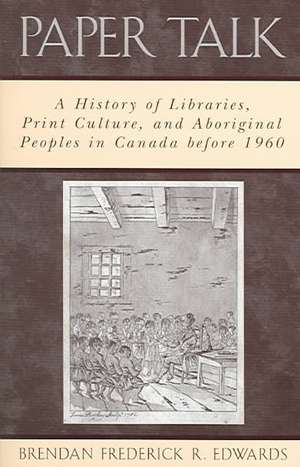
Paper Talk: A History of Libraries, Print Culture, and Aboriginal Peoples in Canada before 1960
Autor Brendan Frederick R. Edwardsen Limba Engleză Paperback – 10 dec 2004
Preț: 450.55 lei
Preț vechi: 865.07 lei
-48%
Puncte Express: 676
Carte tipărită la comandă
Livrare economică 20 noiembrie-01 decembrie
Livrare prin curier în România Termenul estimat este afișat lângă disponibilitate.
Transport gratuit pentru acest produs Plată online sau ramburs, în funcție de opțiunile comenzii.
Retur gratuit în 14 zile Comandă securizată și suport în română.
Specificații
ISBN-13: 9780810851139
ISBN-10: 081085113X
Pagini: 248
Ilustrații: Illustrations, map, ports.
Dimensiuni: 136 x 214 x 14 mm
Greutate: 0.34 kg
Ediția:New.
Editura: Bloomsbury Publishing
Colecția Scarecrow Press
Locul publicării:New York, United States
ISBN-10: 081085113X
Pagini: 248
Ilustrații: Illustrations, map, ports.
Dimensiuni: 136 x 214 x 14 mm
Greutate: 0.34 kg
Ediția:New.
Editura: Bloomsbury Publishing
Colecția Scarecrow Press
Locul publicării:New York, United States
Cuprins
Chapter 1 Acknowledgments
Chapter 2 Introduction
Chapter 3 1. Contexts and Foundations: Placing this history: literacy, books, libraries, and First Peoples
Chapter 4 2. The Nineteenth Century: "Read, write, and worship God daily": The Missionary's tools: the written word, books, and education
Chapter 5 3. First Quarter of the Twentieth Century: Books in the schools and Aboriginal literary initiatives
Chapter 6 4. 1930 through 1960: Community development, philanthropy, and educational neglect: Aboriginal and non-Aboriginal literary perspectives
Chapter 7 Conclusion: Knowledge keepers: libraries and the printed word
Chapter 8 Appendix 1: Approved Supplementary Reading Books for Indian Schools, 1931-1938
Chapter 9 Appendix 2: Day School Libraries, 1943
Chapter 10 Bibliography
Chapter 11 Index
Chapter 12 About the Author
Chapter 2 Introduction
Chapter 3 1. Contexts and Foundations: Placing this history: literacy, books, libraries, and First Peoples
Chapter 4 2. The Nineteenth Century: "Read, write, and worship God daily": The Missionary's tools: the written word, books, and education
Chapter 5 3. First Quarter of the Twentieth Century: Books in the schools and Aboriginal literary initiatives
Chapter 6 4. 1930 through 1960: Community development, philanthropy, and educational neglect: Aboriginal and non-Aboriginal literary perspectives
Chapter 7 Conclusion: Knowledge keepers: libraries and the printed word
Chapter 8 Appendix 1: Approved Supplementary Reading Books for Indian Schools, 1931-1938
Chapter 9 Appendix 2: Day School Libraries, 1943
Chapter 10 Bibliography
Chapter 11 Index
Chapter 12 About the Author
Recenzii
In this text, Edwards analyses the contributions of a number of Aboriginals that were instrumental in articulating their peoples' concerns. He discusses the challenges and contributions made by such people as Peter Jones, George Copway, Charles Cooke, Dr. Oronhyaetkha, and Edward Ahenakew. Edwards' text provides compelling background to contemporary literacy and print culture issues. Paper Talk provides an excellent initial contribution to a field deserving increased scholarly and public attention.
The history of the book in Canadian Aboriginal communities is becoming a subject of concentrated interest...Paper Talk is an original and fine addition to this ongoing discussion....Paper Talk provides a cohesive and richly detailed narrative that outline general patterns among Aboriginal people combined with illustrations of specific examples in local contexts. Edwards balances solid primary research with careful integration of published works in the field. The book will be of interest to scholars of both Aboriginal peoples and the history of the book.
Recommended. Upper-division undergraduates and above.
Covers the largely untold story of the introduction of print to Canadian aboriginal peoples by missionaries as a "civilizing" influence. Later, in the early twentieth century libraries were part of residential schools and the appendices include fascinating lists of approved books. Also documented are the initial efforts to establish public libraries in native communities, a void that remains today.
This is a history of libraries and print culture and their combined impact on Aboriginal people in Canada. There's even an interesting piece on school libraries and their adequacies and deficiencies in the years before 1960. A scholarly and interesting read.
Paper Talk is an almost ideal example of this phenomenon of academic scrutiny supporting aboriginal values. It takes a seemingly peripheral subject - the history of libraries in aboriginal-European relations - and brings it to bear on the larger story with solid research, inexorable logic and often devastating conclusions.
A scholar of library and information science, Canadian studies, and native studies, Edwards traces the introduction of books and print culture to Aboriginal people in Canada from the first endeavors of missionaries in the 1820s to the opening of the first official public library for natives. The overarching question he asks is what the motivations and effects were of introducing book literacy into Aboriginal cultures where orality and other variant forms of literacy already existed and had served the people well for many generations.
...Edwards' prose is clear and efficient...Edwards's extensive notes often provide lucid outlines of scholarly controversies, and his bibliography will tempt a variety of readers....All the current stakeholders-Canadians, librarians, cultural historians, and, not least, politicians and Indigenous peoples engaged in a digital age in which both the promise of access and the expense of ownership have risen dramatically-ought to read this learned and passionate book.
...fascinating.... this provocative, well-written, well-edited, and thoroughly documented study deserves a place on the "must read" list of any academic librarian interested in the history of libraries, the social implications of Western notions of literacy, and/or the provision of library services to aboriginal peoples. Brendan Edwards and Scarecrow Press are to be commended for making this important study available...
This book...is a wonderful read and a valuable addition to Canadian book and library history....Edward's works are informative histories that break new ground and cover more than a century of varying kinds of library service and print culture among Aboriginals across Canada.
The information in this book is excellent and important...
The history of the book in Canadian Aboriginal communities is becoming a subject of concentrated interest...Paper Talk is an original and fine addition to this ongoing discussion....Paper Talk provides a cohesive and richly detailed narrative that outline general patterns among Aboriginal people combined with illustrations of specific examples in local contexts. Edwards balances solid primary research with careful integration of published works in the field. The book will be of interest to scholars of both Aboriginal peoples and the history of the book.
Recommended. Upper-division undergraduates and above.
Covers the largely untold story of the introduction of print to Canadian aboriginal peoples by missionaries as a "civilizing" influence. Later, in the early twentieth century libraries were part of residential schools and the appendices include fascinating lists of approved books. Also documented are the initial efforts to establish public libraries in native communities, a void that remains today.
This is a history of libraries and print culture and their combined impact on Aboriginal people in Canada. There's even an interesting piece on school libraries and their adequacies and deficiencies in the years before 1960. A scholarly and interesting read.
Paper Talk is an almost ideal example of this phenomenon of academic scrutiny supporting aboriginal values. It takes a seemingly peripheral subject - the history of libraries in aboriginal-European relations - and brings it to bear on the larger story with solid research, inexorable logic and often devastating conclusions.
A scholar of library and information science, Canadian studies, and native studies, Edwards traces the introduction of books and print culture to Aboriginal people in Canada from the first endeavors of missionaries in the 1820s to the opening of the first official public library for natives. The overarching question he asks is what the motivations and effects were of introducing book literacy into Aboriginal cultures where orality and other variant forms of literacy already existed and had served the people well for many generations.
...Edwards' prose is clear and efficient...Edwards's extensive notes often provide lucid outlines of scholarly controversies, and his bibliography will tempt a variety of readers....All the current stakeholders-Canadians, librarians, cultural historians, and, not least, politicians and Indigenous peoples engaged in a digital age in which both the promise of access and the expense of ownership have risen dramatically-ought to read this learned and passionate book.
...fascinating.... this provocative, well-written, well-edited, and thoroughly documented study deserves a place on the "must read" list of any academic librarian interested in the history of libraries, the social implications of Western notions of literacy, and/or the provision of library services to aboriginal peoples. Brendan Edwards and Scarecrow Press are to be commended for making this important study available...
This book...is a wonderful read and a valuable addition to Canadian book and library history....Edward's works are informative histories that break new ground and cover more than a century of varying kinds of library service and print culture among Aboriginals across Canada.
The information in this book is excellent and important...