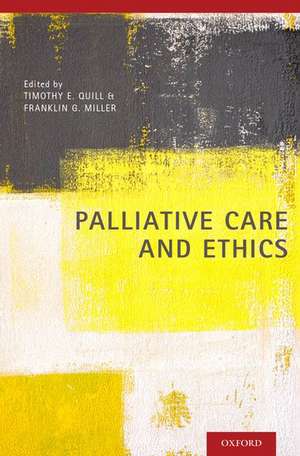
Palliative Care and Ethics
Editat de Timothy E. Quill, Franklin G. Milleren Limba Engleză Paperback – 17 mar 2016
Preț: 460.83 lei
Preț vechi: 620.36 lei
-26%
Puncte Express: 691
Carte tipărită la comandă
Livrare economică 03-08 decembrie
Livrare prin curier în România Termenul estimat este afișat lângă disponibilitate.
Transport gratuit pentru acest produs Plată online sau ramburs, în funcție de opțiunile comenzii.
Retur gratuit în 14 zile Comandă securizată și suport în română.
Specificații
ISBN-13: 9780190604448
ISBN-10: 0190604441
Pagini: 322
Dimensiuni: 155 x 231 x 25 mm
Greutate: 0.48 kg
Editura: Oxford University Press
Colecția OUP USA
Locul publicării:New York, United States
ISBN-10: 0190604441
Pagini: 322
Dimensiuni: 155 x 231 x 25 mm
Greutate: 0.48 kg
Editura: Oxford University Press
Colecția OUP USA
Locul publicării:New York, United States
V-ar putea interesa
-
 Challenging Cases in Palliative CareFelicity Dewhurst-15%Preț: 463.72 lei547.87 lei
 -
 Research Methods in Palliative, Supportive, and End-of-Life CareIrene J. Higginson-16%Preț: 391.40 lei466.63 lei
 -
 Palliative Care PerspectivesJames L. Hallenbeck-17%Preț: 384.88 lei461.49 lei
 -
 Oxford Textbook of Palliative NursingTara A. Albrecht-23%Preț: 780.57 lei1010.11 lei
 -
 -22%Preț: 298.25 lei381.46 lei
 -
 -26%Preț: 166.21 lei224.60 lei
 -
 -21%Preț: 486.58 lei616.04 lei
 -
 Oxford Handbook of Palliative CareMax Watson-5%Preț: 374.34 lei394.04 lei
 -
 Oxford Case Histories in Palliative MedicineJonathan Pickard-15%Preț: 452.29 lei531.73 lei
 -
 Oxford Textbook of Palliative MedicineNathan I. Cherny-19%Preț: 1024.45 lei1263.19 lei
 -
 Ethical Dimensions in the Health ProfessionsRegina F. Doherty-26%Preț: 416.82 lei566.66 lei
 -
 Evidence-Based Practice of Palliative MedicineNathan E. Goldstein-27%Preț: 639.94 lei873.60 lei
 -
 Introducing Palliative CareANDREW WILCOCK-13%Preț: 189.16 lei218.12 lei
 -
 Handbook of Palliative CareRichard Kitchen-5%Preț: 475.61 lei500.64 lei
 -
 -24%Preț: 353.30 lei462.86 lei
 -
 Dying WellIra Byock-5%Preț: 93.71 lei98.63 lei
 -
 Nothing to FearJulie McFadden-5%Preț: 121.66 lei128.06 lei
 -
 -20%Preț: 130.20 lei163.01 lei
 -
 -18%Preț: 70.50 lei86.48 lei
 -
 Textbook of Palliative CareRoderick Duncan MacLeod-5%Preț: 3476.70 lei3659.68 lei
Recenzii
This is a very good read, not just for professionals working in the field, but for other disciplines, who would like to know more about the origins of palliative care and its relationship to other disciplines.
This is a good synopsis of the range of ethical issues encountered in palliative care, including the delivery of services, patient suffering and physician-assisted dying.
While there is not a standard format imposed on each chapter, the contributors often use clinical cases to illustrate the related ethical challenges. The attention to both breadth and depth of these issues contributes to the book's relevance. ... In addition to practitioners of palliative care, students in health-related fields or those with an interest in bioethics might find this book relevant.
This outstanding essay collection, edited by Quill and Miller, provides a survey of the clinical and ethical dilemmas clinicians face in palliative care contexts, mainly, but not exclusively, at life's end. The volume helpfully provides perspectives from the diverse disciplines represented in a contemporary palliative care team, general physicians, psychiatrists, nurses, etc. and the diverse locations in which palliative care takes place, from in-home hospice to inpatient hospital settings. The book treats the major ethical topics that arise in most clinical contexts; this includes issues related to pediatric cases, and also shared decision making and substituted judgment. [B]ecause of the clinical chapters, the book is best suited for health sciences libraries and professional programs in medicine and nursing. Highly recommended.
This outstanding essay collection, edited by Quill (Univ. of Rochester) and Miller (National Institutes of Health), provides a survey of the clinical and ethical dilemmas clinicians face in palliative care contexts, mainly, but not exclusively, at life's end. The volume helpfully provides perspectives from the diverse disciplines represented in a contemporary palliative care team, general physicians, psychiatrists, nurses, etc. and the diverse locations in which palliative care takes place, from in-home hospice to inpatient hospital settings.
This is a good synopsis of the range of ethical issues encountered in palliative care, including the delivery of services, patient suffering and physician-assisted dying.
While there is not a standard format imposed on each chapter, the contributors often use clinical cases to illustrate the related ethical challenges. The attention to both breadth and depth of these issues contributes to the book's relevance. ... In addition to practitioners of palliative care, students in health-related fields or those with an interest in bioethics might find this book relevant.
This outstanding essay collection, edited by Quill and Miller, provides a survey of the clinical and ethical dilemmas clinicians face in palliative care contexts, mainly, but not exclusively, at life's end. The volume helpfully provides perspectives from the diverse disciplines represented in a contemporary palliative care team, general physicians, psychiatrists, nurses, etc. and the diverse locations in which palliative care takes place, from in-home hospice to inpatient hospital settings. The book treats the major ethical topics that arise in most clinical contexts; this includes issues related to pediatric cases, and also shared decision making and substituted judgment. [B]ecause of the clinical chapters, the book is best suited for health sciences libraries and professional programs in medicine and nursing. Highly recommended.
This outstanding essay collection, edited by Quill (Univ. of Rochester) and Miller (National Institutes of Health), provides a survey of the clinical and ethical dilemmas clinicians face in palliative care contexts, mainly, but not exclusively, at life's end. The volume helpfully provides perspectives from the diverse disciplines represented in a contemporary palliative care team, general physicians, psychiatrists, nurses, etc. and the diverse locations in which palliative care takes place, from in-home hospice to inpatient hospital settings.
Notă biografică
Timothy E. Quill is a Professor of Medicine, Psychiatry, Medical Humanities and Nursing at the University of Rochester School of Medicine where he directs their Palliative Care Division. He is a board member and the immediate past president of the American Academy of Hospice and Palliative Medicine. He was the lead physician plaintiff on a US Supreme Court Case Quill v Vacco testing the legal permissibility of physician assisted death. Quill is a practicing palliative care physician, the previous author/editor of seven books, multiple peer-reviewed articles in major medical journals, and a regular lecturer and commentator on medical decision making, physician patient relationships, palliative care, and end of life issues.Franklin G. Miller. is a member of the senior faculty in the Department of Bioethics, National Institutes of Health (NIH) and Special Expert, National Institute of Mental Health Intramural Research Program. His principal current research interests are examination of ethical issues in clinical research, death and dying, and the placebo effect. Dr. Miller has co-authored Death, Dying, and Organ Transplantation (with Robert Truog), Oxford University Press (2012), edited five books and written numerous published articles in medical and bioethics journals on the ethics of clinical research, ethical issues concerning death and dying, professional integrity, health policy, pragmatism and bioethics, and the placebo effect.