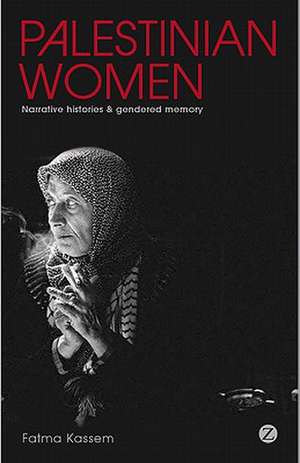
Palestinian Women: Narrative Histories and Gendered Memory
Autor Fatma Kassemen Limba Engleză Paperback – 24 feb 2011
Told in their own words, the women's experiences serve as a window for examining the complex intersections of gender, nationalism and citizenship in a situation of ongoing violent political conflict.
Known in Palestinian discourse as the 'Nakbeh', or the 'Catastrophe', these events of 60 years ago still have a powerful resonance in contemporary Palestinian-Jewish relations in the State of Israel and in the act of narrating these stories, the author argues that the realm of memory is a site of commemoration and resistance.
Preț: 186.42 lei
Preț vechi: 225.03 lei
-17%
Puncte Express: 280
Carte tipărită la comandă
Livrare economică 04-18 decembrie
Livrare prin curier în România Termenul estimat este afișat lângă disponibilitate.
Transport gratuit de la 400.00 lei Plată online sau ramburs, în funcție de opțiunile comenzii.
Retur gratuit în 14 zile Comandă securizată și suport în română.
Specificații
ISBN-13: 9781848134249
ISBN-10: 184813424X
Pagini: 272
Dimensiuni: 138 x 214 x 20 mm
Greutate: 0.42 kg
Editura: Bloomsbury Publishing
Colecția Zed Books
Locul publicării:London, United Kingdom
ISBN-10: 184813424X
Pagini: 272
Dimensiuni: 138 x 214 x 20 mm
Greutate: 0.42 kg
Editura: Bloomsbury Publishing
Colecția Zed Books
Locul publicării:London, United Kingdom
Cuprins
Introduction
1. My Family Stories
2. Life Story: Methodological Aspects
3. The Researcher's Story
4. Language
5. The Body
6. Home
Conclusion
Notes
References
1. My Family Stories
2. Life Story: Methodological Aspects
3. The Researcher's Story
4. Language
5. The Body
6. Home
Conclusion
Notes
References
Recenzii
A powerful and much-needed oral history of the Nakba from the "forgotten community" of Palestinian women who live on in Israel.
Fatma Kassem's book brings critical attention to the difficult position of Palestinian citizens of Israel. Her extremely moving, interesting and well written book adds to existing historical accounts of the Nakba by documenting the gendered memory and narrative history of a previously silenced population, namely Palestinian women living inside Israel. However, her own family history and her personal experiences within Israeli academia are also crucial to this important book as they tell us a lot about the politics of knowledge production and the micro-politics of the Israeli state.
This is the first book to systematically analyse the life stories of Palestinian women in Israel, highlighting the important formative effect of the events of 1948. This book should be read by students and scholars of Palestine and Israel as well as all those who seek alternative solutions for peace with justice.
Fatma Kassem's book brings critical attention to the difficult position of Palestinian citizens of Israel. Her extremely moving, interesting and well written book adds to existing historical accounts of the Nakba by documenting the gendered memory and narrative history of a previously silenced population, namely Palestinian women living inside Israel. However, her own family history and her personal experiences within Israeli academia are also crucial to this important book as they tell us a lot about the politics of knowledge production and the micro-politics of the Israeli state.
This is the first book to systematically analyse the life stories of Palestinian women in Israel, highlighting the important formative effect of the events of 1948. This book should be read by students and scholars of Palestine and Israel as well as all those who seek alternative solutions for peace with justice.