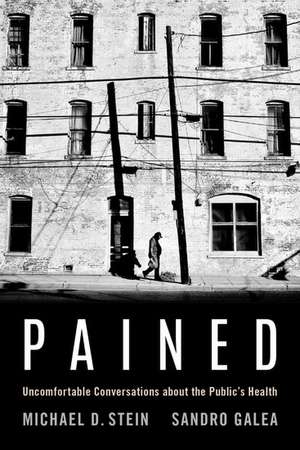
Pained: Uncomfortable Conversations about the Public's Health
Autor Michael Stein, Sandro Galeaen Limba Engleză Paperback – 5 iun 2020
Preț: 259.19 lei
Preț vechi: 335.29 lei
-23%
Puncte Express: 389
Carte disponibilă
Livrare economică 06-11 noiembrie
Livrare prin curier în România Termenul estimat este afișat lângă disponibilitate.
Transport gratuit de la 400.00 lei Plată online sau ramburs, în funcție de opțiunile comenzii.
Retur gratuit în 14 zile Comandă securizată și suport în română.
Specificații
ISBN-13: 9780197510384
ISBN-10: 0197510388
Pagini: 272
Dimensiuni: 206 x 137 x 18 mm
Greutate: 0.32 kg
Editura: Oxford University Press
Colecția OUP USA
Locul publicării:New York, United States
ISBN-10: 0197510388
Pagini: 272
Dimensiuni: 206 x 137 x 18 mm
Greutate: 0.32 kg
Editura: Oxford University Press
Colecția OUP USA
Locul publicării:New York, United States
V-ar putea interesa
-
 Population Health ScienceKatherine M. Keyes-26%Preț: 524.43 lei709.96 lei
 -
 Evidence-based Patient Choice: Inevitable or Impossible?Adrian Edwards-27%Preț: 252.69 lei347.27 lei
 -
 -25%Preț: 906.61 lei1202.71 lei
 -
 Viral Sex: The Nature of AIDSJaap Goudsmit-15%Preț: 244.04 lei287.48 lei
 -
 Managed Care Services: Policy, Programs, and ResearchNancy W. Veeder-24%Preț: 514.76 lei677.42 lei
 -
 Healthier Societies: From Analysis to ActionJody Heymann-23%Preț: 489.91 lei640.39 lei
 -
 -21%Preț: 210.81 lei266.53 lei
 -
 War and Public HealthBarry S. Levy-25%Preț: 632.29 lei848.25 lei
 -
 Accessing Healthcare: Responding to diversityJudith Healy-26%Preț: 1392.26 lei1891.46 lei
 -
 BSE: risk, science and governancePatrick Van Zwanenberg-26%Preț: 671.06 lei905.97 lei
 -
 -27%Preț: 801.65 lei1103.91 lei
 -
 Macrosocial Determinants of Population HealthSandro Galea-5%Preț: 1119.36 lei1178.28 lei
 -
 Handbook of Urban HealthSandro Galea-5%Preț: 901.80 lei949.26 lei
 -
 The Causes and Behavioral Consequences of DisastersSasha Rudenstine-5%Preț: 754.72 lei794.45 lei
 -
 Recommended Community Strategies and Measurements to Prevent Obesity in the United StatesDepartment of Health and Human Services-5%Preț: 117.97 lei124.18 lei
 -
 -5%Preț: 120.96 lei127.33 lei
 -
 Workers' Compensation InsuranceDepartment of Health and Human Services-5%Preț: 86.98 lei91.55 lei
 -
 The Systemic Integrative Thinking Approach to Problem Solving VolKwasi Yebaoh-Afihene-5%Preț: 153.19 lei161.25 lei
 -
 Public HealthDr Tariqul Islam-5%Preț: 86.82 lei91.40 lei
 -
 Reporting on the Reporting Pathology Protocols for Colon and Rectum Cancers ProjectNational Program of Cancer Registries-5%Preț: 120.96 lei127.33 lei
 -
 Fourth National Report on Human Exposure to Environmental Chemicals, 2009Department of Health and Human Services-5%Preț: 301.48 lei317.35 lei
 -
 Fourth National Report on Human Exposure to Environmental Chemicals, Updated Tables, September 2013U. S. Department of Heal Human Services-5%Preț: 369.19 lei388.61 lei
 -
 Public Health Emergency Response Guide for State, Local, and Tribal Public Health DirectorsU. S. Department of Health and Services-5%Preț: 110.28 lei116.08 lei
 -
 Competitive Foods and Beverages in U.S. SchoolsCenters for Dise Control and Prevention-5%Preț: 107.08 lei112.72 lei
 -
 Die letzte GeishaSayo MasudaPreț: 102.40 lei
 -
 Preț: 103.51 lei
Recenzii
In these pithy essays, Michael Stein and Sandro Galea convincingly show that American health depends less on medical care than on the state of our jobs, families, social networks, and environment. Recommended for anyone with an interest in public health.
A stellar essay will inform, captivate, and motivate the reader to action. In this respect, Sandro Galea and Michael Stein contribute not one, but more than 50 essays illustrating in their compelling fashion how healthy people represent more than just the integrity of their DNA and the quality of their medical care. In Pained, Galea and Stein underscore at once the magnitude of the challenges, the public nature of the solutions, and their daunting prospects. Fortunately, the public health community is accustomed to daunting challenges, and this book will serve as an important resource for development of the strategies required.
A stellar essay will inform, captivate, and motivate the reader to action. In this respect, Sandro Galea and Michael Stein contribute not one, but more than 50 essays illustrating in their compelling fashion how healthy people represent more than just the integrity of their DNA and the quality of their medical care. In Pained, Galea and Stein underscore at once the magnitude of the challenges, the public nature of the solutions, and their daunting prospects. Fortunately, the public health community is accustomed to daunting challenges, and this book will serve as an important resource for development of the strategies required.
Notă biografică
MICHAEL STEIN is Professor and Chair of Health Law, Policy and Management of the School of Public Health at Boston University. He is primary care doctor and has been a leader in general medicine and substance use research and policy for two decades. He is Executive Editor of Public Health Post, a popular website on matters of population health. He is the author of six novels and two works of non-fiction. He has been interviewed by Terry Gross on NPR's Fresh Air and has been included in Best American Essays Notables. SANDRO GALEA is Robert A. Knox Professor and Dean of the School of Public Health at Boston University. He is a past president of the Society for Epidemiologic Research and of the Interdisciplinary Society for Population Health Science, chair of the board of the Association of Schools and Programs of Public Health, and is an elected member of the National Academy of Medicine.
Cuprins
- Contents
- Acknowledgments
- Dedication
- Preface
- Section 1. THINKING DIFFERENTLY
- 1. Creating Health is Like Winning at Soccer
- 2. The Illusion of Clinical Success
- 3. Can We Reverse Course on Health?
- 4. A Party Trick
- 5. Treating Laura
- 6. Water Quality Violations
- 7. The Immigrant Experience in Hurricane Season
- Section 2. THE PERSONAL IS POLITICAL
- 8. Denying Climate Change is Denying Health
- 9. Public Health and a President's Racism
- 10. The Census and Public Health
- 11. When We Talk About Public Health
- 12. The Two Degree Solution
- 13. The Partisan Divide Over a Soda Tax
- Section 3. COUNTERINTUITIVE
- 14. What Kills Our Kids?
- 15. What Data Do We Need for Health?
- 16. We Cannot Have It All
- 17. The Microbiome and the Public's Health
- 18. Immigrants and Private Insurance: Pay More, Use Less
- 19. Dying Young in the USA
- Section 4. A SURE ARGUMENT
- 20. Vaccines and Conspiracies
- 21. Health Systems and Public Health Thinking
- 22. Misconceptions about Veterans and Health
- 23. Immigration and the Health of the Public
- 24. Out of School, Out of Luck
- 25. Pseudoscience and Abortion Policy
- Section 5. FOLLOW THE MONEY
- 26. Income Inequality and Our Health
- 27. Can CEOs Save the Health of Americans?
- 28. The Health of the Poorest 50%
- 29. Can We Promote Public Health and Generate Return on Our Investment?
- 30. The Poor People's Campaign
- 31. Spending Too Much On the Wrong Things
- 32. Clarifying Medical Bankruptcy
- 33. High Pay Gets Higher, Low Pay Gets Lower
- Section 6. DARK THOUGHTS
- 34. The Story We Are Not Talking About Enough
- 35. Names Matter in the Opioid Epidemic
- 36. Pain Drain
- 37. Violence is a Public Health Issue
- 38. Mental Health and Mortality
- 39. Three Notes on the Opioid Crisis
- 40. Invest in Health, Not Death
- 41. Direct-to-Docs Opioid Marketing
- 42. Firearm Legislation Linked with Fewer Fatal Police Shootings
- Section 7. THE FUNDAMENTALS
- 43. Housing and the Public's Health
- 44. Food Justice
- 45. Guns and Suicide
- 46. The Smoking Gap
- 47. Maybe the End of HIV
- 48. Homelessness
- 49. Documenting Delays in EMS Wait Times
- 50. Particular Particulates
- Section 8. WILL TECHNOLOGY SAVE US?
- 51. Should Black Boxes Be Welcome in Medicine?
- 52. The New Elderly Surveillance State
- 53. Good App Hunting
- 54. In Social Media We Trust
- 55. Racial Equity in Kidney Transplants
- 56. Air Quality Standards Have Room to Improve
- Section 9. WHAT NOBODY WANTS TO TALK ABOUT
- 57. Broken Justice and the Public's Health
- 58. The Promise of Palliative Care
- 59. Making Aging Healthier
- 60. The Downside of Drinking
- 61. How Far Do Women Have to Travel to Get an Abortion?
- 62. Planning for End-of-Life
- Section 10. MAKING THINGS BETTER
- 63. Volunteering for the Health of the Public
- 64. Mental Health on Campus
- 65. Healthy Homes
- 66. Toward a Muscular Public Health
- 67. Zero Tolerance for Preventable Deaths
- 68. Police and the Public's Health
- 69. Making Strides Towards Zero
- 70. Cancer Survival Is (Mostly) Improving
- Sources