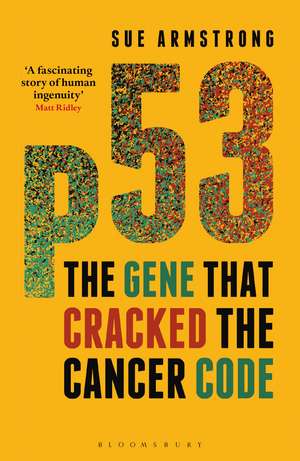
p53: The Gene that Cracked the Cancer Code
Autor Sue Armstrongen Limba Engleză Paperback – 5 noi 2015
The story of the search for p53--the most important gene in medicine.
All of us have lurking in our DNA a most remarkable gene: it is known simply as p53 and its job is to protect us from cancer. p53: The Gene that Cracked the Cancer Code tells the story of the discovery of the gene and of medical science's mission to unravel its mysteries and get to the heart of what happens in our cells when they turn cancerous. When all is well, this gene constantly scans our cells to ensure that when they grow and divide as part of the routine maintenance of our bodies, they do so without mishap. If a cell makes a mistake in copying its DNA during the process of division, p53 stops it in its tracks, sending in the repair team before allowing the cell to carry on dividing. Cancer cannot develop unless p53 itself is damaged or handicapped by some other fault in the system. Not surprisingly, p53 is the most studied single gene in history.
Through the personal accounts of key researchers, the book reveals the excitement of the hunt for new cures--the hype, the enthusiasm, the lost opportunities, the blind alleys and the thrilling breakthroughs. As the long-anticipated revolution in cancer treatment tailored to each individual patient's symptoms starts to take off at last, p53 is at the cutting edge. This is a timely tale of scientific discovery and advances in our understanding of a disease that still affects more than one in three of us at some point in our lives.
Preț: 63.74 lei
Preț vechi: 85.26 lei
-25%
Carte disponibilă
Livrare economică 14-28 noiembrie
Livrare express 03-07 noiembrie pentru 41.34 lei
Specificații
ISBN-10: 1472910524
Pagini: 288
Dimensiuni: 128 x 196 x 20 mm
Greutate: 0.21 kg
Editura: Bloomsbury Publishing
Colecția Bloomsbury Sigma
Locul publicării:London, United Kingdom
V-ar putea interesa
-
 -5%Preț: 102.79 lei108.19 lei
 -
 The Emperor of All MaladiesSiddhartha MukherjeePreț: 96.56 lei
 -
 Cancer Code Intl, TheJason FungPreț: 130.17 lei
 -
 The Gene: An Intimate HistorySiddhartha Mukherjee-26%Preț: 81.10 lei109.89 lei
 -
 Oxford Handbook of OncologyMiranda PaynePreț: 292.81 lei
 -
 DNADavid Weber-26%Preț: 48.24 lei64.99 lei
 -
 -16%Preț: 80.13 lei95.94 lei
 -
 AnticancerDavid Servan-SchreiberPreț: 106.29 lei
 -
 Understanding CancerRobin HeskethPreț: 97.97 lei
 -
 The BreakthroughCharles GraeberPreț: 124.42 lei
 -
 The Molecular Basis of CancerJohn Mendelsohn-34%Preț: 836.65 lei1274.55 lei
 -
 -26%Preț: 69.85 lei93.96 lei
 -
 -24%Preț: 72.24 lei95.44 lei
 -
 Life's Greatest Secret: The Race to Crack the Genetic CodeProfessor Matthew Cobb-19%Preț: 86.16 lei106.30 lei
 -
 The Complete Guide to Breast CancerLiz O'RiordanPreț: 136.67 lei
 -
 CancerPaul ScottingPreț: 58.67 lei
 -
 Gene MachineVenki RamakrishnanPreț: 76.91 lei
 -
 Crick: A Mind in Motion – from DNA to the BrainProfessor Matthew Cobb-16%Preț: 195.89 lei234.30 lei
 -
 Cancer: Principles and Practice of Oncology Primer of Molecular Biology in CancerVincent T. DeVita, Jr. MD-20%Preț: 601.94 lei751.74 lei
Descriere
All of us have lurking in our DNA a most remarkable gene, which has a crucial job - it protects us from cancer. Known simply as p53, this gene constantly scans our cells to ensure that they grow and divide without mishap. If a cell makes a mistake in copying its DNA during the process of division, p53 stops it in its tracks, summoning a repair team before allowing the cell to carry on dividing. If the mistake is irreparable and the rogue cell threatens to grow out of control, p53 commands the cell to commit suicide. Cancer cannot develop unless p53 itself is damaged or prevented from functioning normally.
This book tells the story of medical science's mission to unravel the mysteries of this crucial gene, and to get to the heart of what happens in our cells when they turn cancerous. Through the personal accounts of key researchers, p53: The Gene that Cracked the Cancer Code reveals the fascination of the quest for scientific understanding, as well as the excitement of the chase for new cures - the hype, the enthusiasm, the lost opportunities, the blind alleys, and the breakthroughs. And as the long-anticipated revolution in cancer treatment tailored to individual patient's symptoms begins to take off at last, p53 remains at the cutting edge.
This tale of scientific discovery highlights the tremendous recent advances made in our understanding of cancer, a disease that affects more than one in three of us at some point in our lives.
Cuprins
PrefaceChapter 1: Flesh of our Own FleshChapter 2: The Enemy WithinChapter 3: DiscoveryChapter 4: Unseeable BiologyChapter 5: Cloning the GeneChapter 6: A Case of Mistaken IdentityChapter 7: A New Angle on CancerChapter 8: p53 Reveals its True ColoursChapter 9: Master SwitchChapter 10: 'Guardian of the Genome'Chapter 11: Of Autumn Leaves and Cell DeathChapter 12: Of Mice and MenChapter 13: The Guardian's GatekeeperChapter 14: The Smoking GunChapter 15: Following the FingerprintsChapter 16: Cancer in the FamilyChapter 17: The Tropeiro Connection?Chapter 18: Jekyll and HydeChapter 19: Cancer and Ageing: A Balancing ActChapter 20: The Treatment RevolutionDramatis PersonaeGlossaryNotes on SourcesAcknowledgementsIndex
Recenzii
Armstrong's book is genuinely engrossing on many levels, and the story is very well told. It has considerable depth, yet sufficient clarity to be able to reach a wide audience ... a highly readable, well-written and crafted book.
A succinct, accessible study of humanity's genetic bulwark against cancer.
One of the best accounts I've read of how science is actually performed.
Armstrong paints a very human picture ... Not only does Armstrong make p53 understandable but she also sheds light on the scientific method. In an age of government austerity, highlighting the importance of scientific research is also a gift.
Ms. Armstrong¹s book comes alive in the sections where she explores cancer¹s human toll, including the devastating experience of families with rare genetic mutations, such as Li-Fraumeni syndrome, which leaves children of parents with a faulty gene vulnerable to cancer at almost any age. She also captures the excitement of researchers as they come upon eureka moments.
Ms. Armstrong¹s book comes alive in the sections where she explores cancer¹s human toll, including the devastating experience of families with rare genetic mutations, such as Li-Fraumeni syndrome, which leaves children of parents with a faulty gene vulnerable to cancer at almost any age. She also captures the excitement of researchers as they come upon eureka moments.