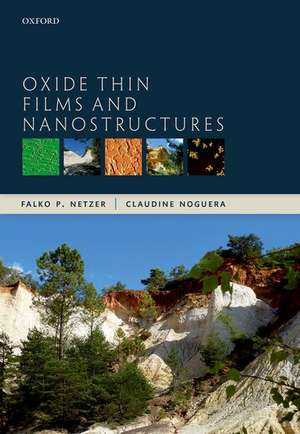
Oxide Thin Films and Nanostructures
Autor Falko P. Netzer, Claudine Nogueraen Limba Engleză Hardback – 25 feb 2021
Preț: 704.03 lei
Preț vechi: 914.32 lei
-23%
Puncte Express: 1056
Carte disponibilă
Livrare economică 07-21 noiembrie
Livrare prin curier în România Termenul estimat este afișat lângă disponibilitate.
Transport gratuit pentru acest produs Plată online sau ramburs, în funcție de opțiunile comenzii.
Retur gratuit în 14 zile Comandă securizată și suport în română.
Specificații
ISBN-13: 9780198834618
ISBN-10: 0198834616
Pagini: 352
Ilustrații: 168 line drawings and colour halftones
Dimensiuni: 175 x 255 x 25 mm
Greutate: 0.82 kg
Editura: OUP OXFORD
Colecția OUP Oxford
Locul publicării:Oxford, United Kingdom
ISBN-10: 0198834616
Pagini: 352
Ilustrații: 168 line drawings and colour halftones
Dimensiuni: 175 x 255 x 25 mm
Greutate: 0.82 kg
Editura: OUP OXFORD
Colecția OUP Oxford
Locul publicării:Oxford, United Kingdom
Recenzii
The authors of Oxide Thin Films and Nanostructures have produced a state-of-the-art reference on the topic, an interesting book reflecting the longstanding experience of its authors.
A very timely book. Oxides are all over the places on Earth and have proven of paramount importance in modern technologies. The book provides a good equilibrium between technical aspects and applications.
The book should have interdisciplinary appeal. There have been tremendous advances made in understanding oxide films and structures at the nano level, and the importance of such systems in solid state chemistry, physics, materials science, applied physics etc.
A very timely book. Oxides are all over the places on Earth and have proven of paramount importance in modern technologies. The book provides a good equilibrium between technical aspects and applications.
The book should have interdisciplinary appeal. There have been tremendous advances made in understanding oxide films and structures at the nano level, and the importance of such systems in solid state chemistry, physics, materials science, applied physics etc.
Notă biografică
Falko P. Netzer is Professor of Physics Emeritus at the Institute of Physics, University of Graz, Austria. He obtained his PhD in Physical Chemistry at the University of Innsbruck in 1971. After a postdoc stay in the Surface Physics Group of the University of York, England, he obtained his Habilitation in 1978, and became an Associate Professor at the University of Innsbruck. In 1980-82 he spent one and a half years as a Guest Scientist at the National Bureau of Standard, Gaithersburg, MD, and at the Physics Department at the University of Maryland. In 1991, he took the Chair of Experimental Physics at the University of Graz, where he set up a large surface science laboratory. He spent many sabbatical months at the University of California Berkeley, at the University of Washington, and at the Pacific Northwest National Laboratory. He served on many international committees and advisory boards and is the recipient of one of the prestigious ERC Advanced Grants from the European Research Council.Claudine Noguera is CNRS Research Director Exceptional Class at the Paris Institute of Nanosciences that she founded in 2005. She got her PhD in 1975 and her habilitation in 1981 at Orsay University, in France. She initiated the field of Oxide Surfaces at the international level at the end of the 1980ies, wrote a monograph on this subject in 1996 and created the series of IWOX conferences, which is still running. She settled a mixed theory/experiment group in Paris in 2002. Her research then developed towards the physics of oxide ultra-thin films and the understanding of nucleation and growth processes in the natural medium.