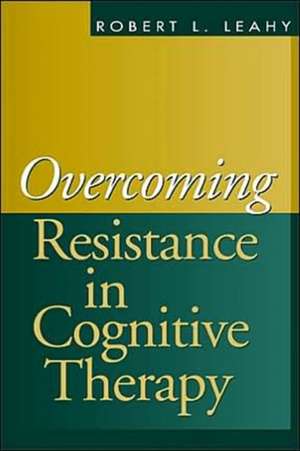
Overcoming Resistance in Cognitive Therapy
Autor Robert L. Leahyen Limba Engleză Paperback – 18 sep 2003
This practical guide presents Leahy's multidimensional model of resistance in cognitive therapy. Richly illustrated with case examples and session vignettes, the book addresses a variety of ways that clients may resist basic therapeutic procedures: noncompliance with agenda setting and homework assignments, splitting transference with other therapists, inappropriate behavior, and premature termination. Underlying processes of resistance are explored, from the desire for validation to risk aversion and self-handicapping. Also highlighted are ways that the therapist's own responses may inadvertently impede change. Provided are innovative tools for getting treatment back on track, including targeted interventions, in-session experiments, and questionnaires and graphic models to share with clients.
Preț: 261.12 lei
Preț vechi: 274.86 lei
-5%
Puncte Express: 392
Carte tipărită la comandă
Livrare economică 08-22 decembrie
Livrare prin curier în România Termenul estimat este afișat lângă disponibilitate.
Transport gratuit de la 400.00 lei Plată online sau ramburs, în funcție de opțiunile comenzii.
Retur gratuit în 14 zile Comandă securizată și suport în română.
Specificații
ISBN-13: 9781572309364
ISBN-10: 1572309369
Pagini: 309
Dimensiuni: 152 x 229 x 23 mm
Greutate: 0.44 kg
Ediția:New.
Editura: Guilford Publications
Colecția Guilford Press
ISBN-10: 1572309369
Pagini: 309
Dimensiuni: 152 x 229 x 23 mm
Greutate: 0.44 kg
Ediția:New.
Editura: Guilford Publications
Colecția Guilford Press
V-ar putea interesa
-
 Preț: 385.11 lei
 -
 -5%Preț: 493.31 lei519.27 lei
 -
 -18%Preț: 1346.71 lei1642.32 lei
 -
 Preț: 386.27 lei
 -
 -5%Preț: 478.35 lei503.53 lei
 -
 SandtrayRoxanne Rae-22%Preț: 503.80 lei643.31 lei
 -
 -5%Preț: 530.66 lei558.59 lei
 -
 The Consciousness of StardustJim FetterPreț: 156.49 lei
 -
 Cognitive Therapy: Basic Principles and ApplicationsRobert L. Leahy-31%Preț: 569.12 lei823.26 lei
 -
 -5%Preț: 326.95 lei344.16 lei
 -
 -26%Preț: 89.11 lei120.34 lei
 -
 -25%Preț: 117.88 lei156.93 lei
 -
 -5%Preț: 339.04 lei356.89 lei
 -
 Geiz, Trägheit, Neid & Co. in Therapie und SeelsorgeAnton Bucher-5%Preț: 355.00 lei373.68 lei
Public țintă
Professional and Professional Practice & DevelopmentCuprins
1. Introduction.
I. Theoretical and Conceptual Foundations.
2. Models of Resistance.
3. Resistance to Procedure.
II. Dimensions of Resistance.
4. Validation Resistance.
5. Self-Consistency.
6. Schematic Resistance.
7. Moral Resistance: Compulsive Responsibility.
8. Victim Resistance.
9. Risk Aversion and Depressive Resistance.
10. Self-Handicapping.
III. Cognitive Therapy and Countertransference.
11. Evaluating the Countertransference.
12. Using the Countertransference.
13. Conclusions
I. Theoretical and Conceptual Foundations.
2. Models of Resistance.
3. Resistance to Procedure.
II. Dimensions of Resistance.
4. Validation Resistance.
5. Self-Consistency.
6. Schematic Resistance.
7. Moral Resistance: Compulsive Responsibility.
8. Victim Resistance.
9. Risk Aversion and Depressive Resistance.
10. Self-Handicapping.
III. Cognitive Therapy and Countertransference.
11. Evaluating the Countertransference.
12. Using the Countertransference.
13. Conclusions
Recenzii
This book fills a major gap in the cognitive therapy literature, one that may often account for failure to attain therapeutic goals. The author, while committed to a cognitive model, shows a willingness to mine other therapeutic traditions for ideas that cognitive therapists can use. He has developed a well-thought-through typology of types of resistance, and provides a richness of clinical example and precise formulations of actions the therapist can take to help the patient overcome each type. This book will be an excellent text in courses in all the therapeutic disciplines. It will be especially useful for students in such professions as social work, who will encounter many clients who are induced by environmental and socialization influences to erect barriers to change.--Charles Garvin, PhD, School of Social Work, University of Michigan
For any cognitive-behavioral clinician who has ever asked, 'Why am I having such a difficult time helping my client change?', Leahy has provided an engaging, thought-provoking, integrative text that addresses this question most effectively. The text will appeal to therapists at all levels of experience, offering interesting variations on conceptual themes about why clients think and act in ways that maintain their problematic status quo in life, and in therapy. The book also succeeds in guiding therapists to assess and manage their own unwitting contributions to their clients' resistance, and thus become more adept in helping clients to progress.--Cory F. Newman, PhD, ABPP, Director, Center for Cognitive Therapy, University of Pennsylvania School of Medicine
Every so often, a clinical text is written that offers an innovative, rich perspective on a previously neglected problem of immense clinical importance. This volume achieves such heights. A 'must read' for any clinician who has been challenged by resistance in the therapy session, the volume is full of practical insight and treatment suggestions presented in a scholarly, thoughtful, and yet pragmatic fashion. Leahy addresses a significant gap in the cognitive-behavioral literature, integrating his clinical experience with psychoanalytic, behavioral, developmental, social, and cognitive theory and research on the topic. Whether a novice or expert in cognitive therapy, the reader will find this a stimulating and thought-provoking text with immediate application to the therapy session. It will be a valuable resource for graduate courses or professional workshops on cognitive therapy.--David A. Clark, PhD, Department of Psychology, University of New Brunswick, Canada
This volume fills an important gap. In his inimitable style, Robert Leahy addresses a topic that has been neglected by cognitive-behavioral therapists: how to work effectively with the client who is reluctant to embrace the many technical interventions the therapy offers. The book is easy to read and immediately useful to all cognitive-behavioral therapists, from students to experienced clinicians. This book will serve as an excellent supplementary text for graduate courses in cognitive-behavioral therapy. It is thought-provoking and rich, with dozens of clinical examples of effective work by an experienced and masterful therapist.--Jacqueline B. Persons, PhD, San Francisco Bay Area Center for Cognitive Therapy, and University of California, Berkeley
-For any cognitive-behavioral clinician who has ever asked, 'Why am I having such a difficult time helping my client change?', Leahy has provided an engaging, thought-provoking, integrative text that addresses this question most effectively. The text will appeal to therapists at all levels of experience, offering interesting variations on conceptual themes about why clients think and act in ways that maintain their problematic status quo in life, and in therapy. The book also succeeds in guiding therapists to assess and manage their own unwitting contributions to their clients' resistance, and thus become more adept in helping clients to progress.--Cory F. Newman, PhD, ABPP, Director, Center for Cognitive Therapy, University of Pennsylvania School of Medicine
Every so often, a clinical text is written that offers an innovative, rich perspective on a previously neglected problem of immense clinical importance. This volume achieves such heights. A 'must read' for any clinician who has been challenged by resistance in the therapy session, the volume is full of practical insight and treatment suggestions presented in a scholarly, thoughtful, and yet pragmatic fashion. Leahy addresses a significant gap in the cognitive-behavioral literature, integrating his clinical experience with psychoanalytic, behavioral, developmental, social, and cognitive theory and research on the topic. Whether a novice or expert in cognitive therapy, the reader will find this a stimulating and thought-provoking text with immediate application to the therapy session. It will be a valuable resource for graduate courses or professional workshops on cognitive therapy.--David A. Clark, PhD, Department of Psychology, University of New Brunswick, Canada
This volume fills an important gap. In his inimitable style, Robert Leahy addresses a topic that has been neglected by cognitive-behavioral therapists: how to work effectively with the client who is reluctant to embrace the many technical interventions the therapy offers. The book is easy to read and immediately useful to all cognitive-behavioral therapists, from students to experienced clinicians. This book will serve as an excellent supplementary text for graduate courses in cognitive-behavioral therapy. It is thought-provoking and rich, with dozens of clinical examples of effective work by an experienced and masterful therapist.--Jacqueline B. Persons, PhD, San Francisco Bay Area Center for Cognitive Therapy, and University of California, Berkeley
I was very impressed....I found it easy to assimilate Leahy's conceptualization of resistance into the cognitive paradigm....Reading this text offers providers a rich opportunity to learn about their own schemas and how they affect relationships with patients. The text has something to offer any provider who conducts cognitive therapy—not just for depression, but for any problem. In addition, Part 3 is an excellent resource for clinical supervision of students, interns, and residents. I plan to use Leahy's Therapist's Schema Questionnaire to help cognitive therapy students recognize their own schemas and manage them to optimize therapeutic change....I enthusiastically praise Overcoming Resistance in Cognitive Therapy as a pioneering attempt to improve upon cognitive therapy. The author of this text is an undisputed superstar in the cognitive-behavioral, scientific community. The concepts discussed in this book are truly visionary.
--Psychiatry: Interpersonal and Biological Processes, 7/18/2003ƒƒThis is an excellent book that will be profitably read and studied by both beginning and experienced therapists with some sophistication in cognitive-behavioral therapy and by practitioners of other approaches that like to keep informed on innovations in the field of psychotherapy.
--American Journal of Psychotherapy, 7/18/2003ƒƒThe book is especially relevant to cognitive therapists who can assess and revise their own attempts to reduce resistance and recognize the limits of the cognitive model, but it remains applicable to any therapists who have worked with clients who do not respond to therapy. ....Information is [presented] in an organized, concise, and reader-friendly manner, which makes this book a particularly useful resource for graduate courses in addition to a clinical tool to be used in practice.
--Contemporary Psychology, 7/18/2003ƒƒA superb book that outlines clinical strategies for the detection and amelioration of the barriers, or resistances, to engagement in cognitive therapy in order to reach those patients who are otherwise unlikely to fully benefit from standardized interventions....The text contains a wealth of ideas and illustrative case material to help the (cognitive) therapist navigate patient and therapist-patient resistances. It is destined to be a standard reference within the case conceptualization approach and is relevant for everyone practicing cognitive therapy.
--Journal of Nervous and Mental Disease, 7/18/2003ƒƒLeahy's work will be a much valued and practical addition to the bookshelf of CBT practitioners, and should be applauded for helping to establish resistance as an important area of inquiry on the CBT landscape.
--The Clinical Psychologist, 7/18/2003Notă biografică
Robert L. Leahy, PhD, is Director of the American Institute for Cognitive Therapy in New York City and Clinical Professor of Psychology in the Department of Psychiatry at Weill Cornell Medical College. Dr. Leahy is Associate Editor of the International Journal of Cognitive Therapy and is past president of the Association for Behavioral and Cognitive Therapies (ABCT), the International Association for Cognitive Psychotherapy, and the Academy of Cognitive and Behavioral Therapies (A-CBT). He is a recipient of the Outstanding Clinician Award from ABCT and the Aaron T. Beck Award from A-CBT. Dr. Leahy is author or editor of 29 books for mental health professionals and the general public, including If Only and The Worry Cure. His books have been translated into 21 languages.
Descriere
This practical guide presents Leahy's multidimensional model of resistance in cognitive therapy. Richly illustrated with case examples and session vignettes, the book addresses a variety of ways that clients may resist basic therapeutic procedures: noncompliance with agenda setting and homework assignments, splitting transference with other therapists, inappropriate behavior, and premature termination. Underlying processes of resistance are explored, from the desire for validation to risk aversion and self-handicapping. Also highlighted are ways that the therapist's own responses may inadvertently impede change. Provided are innovative tools for getting treatment back on track, including targeted interventions, in-session ""experiments,"" and questionnaires and graphic models to share with clients.