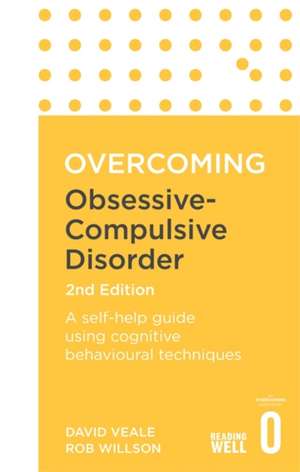
Overcoming Obsessive Compulsive Disorder, 2nd Edition: A self-help guide using cognitive behavioural techniques
Autor David Veale, Rob Willsonen Limba Engleză Paperback – 26 aug 2021
'Clear, practical, focused and useful... extremely helpful both for those who suffer from obsessive compulsive disorder and those who care for them'
Paul Salkovkis, University of Bath
Are you plagued by a recurring thought or idea that just won't go away, or feel the need to wash your hands repeatedly, to hoard things, or to repeatedly check all appliances in the house have been turned off before you leave? These are common symptoms of obsessive compulsive disorder (OCD), a condition that causes distress to hundreds of thousands of people.
Using methods based on real clinical practice and proven cognitive behavioural therapy (CBT) techniques, this revised and updated edition teaches you:
· How to face fears and avoided situations
· How to control disturbing thoughts, images and urges
· Strategies to break free from the destructive cycle of obsessive behaviour
Overcoming self-help guides use clinically proven techniques to treat long-standing and disabling conditions, both psychological and physical.
READING WELL
This book is recommended by the national Reading Well Books on Prescription scheme for England delivered by The Reading Agency and the Society of Chief Librarians with funding from Arts Council England and Wellcome.
www.reading-well.org.uk
Series editor: Professor Peter Cooper
Preț: 83.13 lei
Preț vechi: 109.99 lei
-24%
Puncte Express: 125
Carte disponibilă
Livrare economică 09-23 noiembrie
Livrare express 23-29 octombrie pentru 58.37 lei
Livrare prin curier în România Termenul estimat este afișat lângă disponibilitate.
Transport gratuit de la 400.00 lei Plată online sau ramburs, în funcție de opțiunile comenzii.
Retur gratuit în 14 zile Comandă securizată și suport în română.
Specificații
ISBN-13: 9781472136015
ISBN-10: 1472136012
Pagini: 592
Ilustrații: 20 b/w integrated illustrations
Dimensiuni: 126 x 196 x 40 mm
Greutate: 0.46 kg
Editura: Little Brown
Colecția Robinson
Locul publicării:London, United Kingdom
ISBN-10: 1472136012
Pagini: 592
Ilustrații: 20 b/w integrated illustrations
Dimensiuni: 126 x 196 x 40 mm
Greutate: 0.46 kg
Editura: Little Brown
Colecția Robinson
Locul publicării:London, United Kingdom
Recenzii
Break free from unhelpful rituals and take control of your life
'Clear, practical, focused and useful... extremely helpful both for those who suffer from obsessive compulsive disorder and those who care for them'
Paul Salkovkis,
University of Bath
Are you plagued by a recurring thought or idea that just won't go away, or feel the need to wash your hands repeatedly, to hoard things, or to repeatedly check all appliances in the house have been turned off before you leave? These are common symptoms of obsessive compulsive disorder (OCD), a condition that causes distress to hundreds of thousands of people.
Using methods based on real clinical practice and proven cognitive behavioural therapy (CBT) techniques, this revised and updated edition teaches you:
· How to face fears and avoided situations
· How to control disturbing thoughts, images and urges
· Strategies to break free from the destructive cycle of obsessive behaviour
DAVID VEALE is a consultant psychiatrist in CBT and visiting senior lecturer at the Institute of Psychiatry, Kings College London and was President of the British Association of Behavioural and Cognitive Psychotherapies. ROB WILLSON currently divides the majority of his work time between private practice and conducting research on Body Dysmorphic Disorder (BDD) at the Institute of Psychiatry, London. He is currently the chair of the BDD Foundation.
Overcoming self-help guides use clinically proven techniques to treat long-standing and disabling conditions, both psychological and physical.
READING WELL
This book is recommended by the national Reading Well Books on Prescription scheme for England delivered by The Reading Agency and the Society of Chief Librarians with funding from Arts Council England and Wellcome.
www.reading-well.org.uk
Series editor: Professor Peter Cooper
'Clear, practical, focused and useful... extremely helpful both for those who suffer from obsessive compulsive disorder and those who care for them' Paul Salkovkis, University of Bath
'Clear, practical, focused and useful... extremely helpful both for those who suffer from obsessive compulsive disorder and those who care for them'
Paul Salkovkis,
University of Bath
Are you plagued by a recurring thought or idea that just won't go away, or feel the need to wash your hands repeatedly, to hoard things, or to repeatedly check all appliances in the house have been turned off before you leave? These are common symptoms of obsessive compulsive disorder (OCD), a condition that causes distress to hundreds of thousands of people.
Using methods based on real clinical practice and proven cognitive behavioural therapy (CBT) techniques, this revised and updated edition teaches you:
· How to face fears and avoided situations
· How to control disturbing thoughts, images and urges
· Strategies to break free from the destructive cycle of obsessive behaviour
DAVID VEALE is a consultant psychiatrist in CBT and visiting senior lecturer at the Institute of Psychiatry, Kings College London and was President of the British Association of Behavioural and Cognitive Psychotherapies. ROB WILLSON currently divides the majority of his work time between private practice and conducting research on Body Dysmorphic Disorder (BDD) at the Institute of Psychiatry, London. He is currently the chair of the BDD Foundation.
Overcoming self-help guides use clinically proven techniques to treat long-standing and disabling conditions, both psychological and physical.
READING WELL
This book is recommended by the national Reading Well Books on Prescription scheme for England delivered by The Reading Agency and the Society of Chief Librarians with funding from Arts Council England and Wellcome.
www.reading-well.org.uk
Series editor: Professor Peter Cooper
'Clear, practical, focused and useful... extremely helpful both for those who suffer from obsessive compulsive disorder and those who care for them' Paul Salkovkis, University of Bath