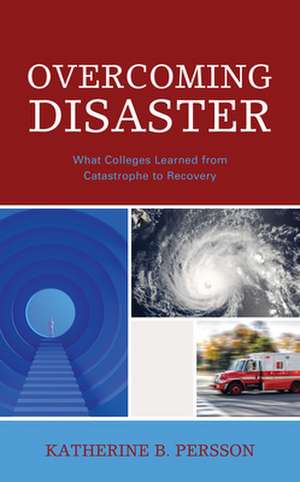
Overcoming Disaster: What Colleges Learned from Catastrophe to Recovery
Autor Katherine B. Perssonen Limba Engleză Paperback – 15 feb 2022
| Toate formatele și edițiile | Preț | Express |
|---|---|---|
| Paperback (1) | 209.17 lei 6-8 săpt. | |
| Bloomsbury Publishing – 15 feb 2022 | 209.17 lei 6-8 săpt. | |
| Hardback (1) | 468.48 lei 6-8 săpt. | |
| Bloomsbury Publishing – 15 feb 2022 | 468.48 lei 6-8 săpt. |
Preț: 209.17 lei
Preț vechi: 278.69 lei
-25%
Puncte Express: 314
Preț estimativ în valută:
37.04€ • 43.26$ • 32.18£
37.04€ • 43.26$ • 32.18£
Carte tipărită la comandă
Livrare economică 21 februarie-07 martie
Preluare comenzi: 021 569.72.76
Specificații
ISBN-13: 9781475864427
ISBN-10: 1475864426
Pagini: 220
Dimensiuni: 154 x 231 x 15 mm
Greutate: 0.31 kg
Editura: Bloomsbury Publishing
Colecția Rowman & Littlefield Publishers
Locul publicării:New York, United States
ISBN-10: 1475864426
Pagini: 220
Dimensiuni: 154 x 231 x 15 mm
Greutate: 0.31 kg
Editura: Bloomsbury Publishing
Colecția Rowman & Littlefield Publishers
Locul publicării:New York, United States
V-ar putea interesa
-
 -7%Preț: 283.17 lei303.09 lei
 -
 Preț: 442.21 lei
 -
 -18%Preț: 1015.97 lei1238.99 lei
 -
 Preț: 349.89 lei
 -
 Preț: 379.91 lei
 -
 Preț: 387.62 lei
 -
 Preț: 387.09 lei
 -
 Preț: 374.87 lei
 -
 Rethinking LGBTQIA Students and Collegiate Contexts: Identity, Policies, and Campus ClimateEboni M. Zamani-GallaherPreț: 376.65 lei
 -
 Handbook of Research on the Education of Young ChildrenOlivia N. Saracho-18%Preț: 716.97 lei874.36 lei
 -
 -18%Preț: 1068.32 lei1302.83 lei
 -
 Community College Leadership and AdministrationCarlos Nevarez-9%Preț: 800.25 lei879.40 lei
 -
 -31%Preț: 461.04 lei671.35 lei
 -
 -23%Preț: 242.93 lei315.32 lei
 -
 Soft Skills for Leaders: Scenarios from Higher Education Administrators: Volume 2Wanda S. Maulding Green-18%Preț: 136.61 lei167.30 lei
 -
 Academic Advising in the Community CollegeTerry U. O'Banion-28%Preț: 372.86 lei517.55 lei
 -
 Academic Advising in the Community CollegeTerry U. O'Banion-22%Preț: 207.76 lei265.21 lei
 -
 -22%Preț: 207.57 lei265.09 lei
 -
 -28%Preț: 373.47 lei517.97 lei
 -
 -22%Preț: 208.32 lei265.57 lei
 -
 Preț: 344.11 lei
 -
 Preț: 362.15 lei
Cuprins
Dedication
Preface
Acknowledgements
Introduction
Part 1: What Happened
Chapter 1: Lone Star College-Kingwood
Chapter 2: Gulf Coast State College
Chapter 3: Umpqua Community College
Part II: Hindsight: What We Wish We Knew
Chapter 4: The Settings
Chapter 5: Don't Be Naïve
Chapter 6: Guns, Drugs and Money
Chapter 7: Power
Chapter 8: Move Things to a Higher Place
Chapter 9: Identity Theft
Chapter 10: Loss of Personal Items and Loss of Lives
Chapter 11: What You Should Know and Do to Help Recovery Efforts
Part III: What Helped Us
Chapter 12: Leadership Team
Chapter 13: Culture
Chapter 14: Policies
Chapter 15: Resources
Chapter 16: Friends, Partners, and Others Wanting to Help
Part IV: What Hindered Us
Chapter 17: Inexperience
Chapter 18: FEMA and Other Bureaucracies
Chapter 19: Procurement Policies
Chapter 20: Personnel Changes
Part V: Aftermath to Recovery
Chapter 21: Trauma and Grief
Chapter 22: Overwhelming State of Mind
Chapter 23: Healing and Recovering
Chapter 24: Recovery Strategies Used by Individuals
Chapter 25: Recovery Strategies Used Organizations
Chapter 26: Community Healing
Part VI: Preparation for the Next Crisis - A Global Pandemic
Part VII: Master Crisis Response Cheat Sheet
Closing Statement
Appendix A:Harvey Timeline Summary: August 23, 2017 - February 2020
Appendix B.LSC-Kingwood Student Success Pre and Post Harvey
Appendix C:Harvey Revenues and Expenses
Appendix D:LSC Procurement Process
Appendix E:Testimonials from Student, Staff, and Faculty
References
About the Author
About the Contributors
Preface
Acknowledgements
Introduction
Part 1: What Happened
Chapter 1: Lone Star College-Kingwood
Chapter 2: Gulf Coast State College
Chapter 3: Umpqua Community College
Part II: Hindsight: What We Wish We Knew
Chapter 4: The Settings
Chapter 5: Don't Be Naïve
Chapter 6: Guns, Drugs and Money
Chapter 7: Power
Chapter 8: Move Things to a Higher Place
Chapter 9: Identity Theft
Chapter 10: Loss of Personal Items and Loss of Lives
Chapter 11: What You Should Know and Do to Help Recovery Efforts
Part III: What Helped Us
Chapter 12: Leadership Team
Chapter 13: Culture
Chapter 14: Policies
Chapter 15: Resources
Chapter 16: Friends, Partners, and Others Wanting to Help
Part IV: What Hindered Us
Chapter 17: Inexperience
Chapter 18: FEMA and Other Bureaucracies
Chapter 19: Procurement Policies
Chapter 20: Personnel Changes
Part V: Aftermath to Recovery
Chapter 21: Trauma and Grief
Chapter 22: Overwhelming State of Mind
Chapter 23: Healing and Recovering
Chapter 24: Recovery Strategies Used by Individuals
Chapter 25: Recovery Strategies Used Organizations
Chapter 26: Community Healing
Part VI: Preparation for the Next Crisis - A Global Pandemic
Part VII: Master Crisis Response Cheat Sheet
Closing Statement
Appendix A:Harvey Timeline Summary: August 23, 2017 - February 2020
Appendix B.LSC-Kingwood Student Success Pre and Post Harvey
Appendix C:Harvey Revenues and Expenses
Appendix D:LSC Procurement Process
Appendix E:Testimonials from Student, Staff, and Faculty
References
About the Author
About the Contributors
Recenzii
Overcoming Disaster: What Colleges Learned from Catastrophe To Recovery is a MUST READ for college trustees, administrators, faculty and especially community leaders who face uncertainty and chaos almost daily. Since Dr. Persson began this most important study, I have been made aware of the degree of uncertainty that colleges and all other public institutions face. Living in Texas during this pandemic and especially so the recent ice storm and the resultant power outages across the state makes us all aware of how unpredictable the challenges are that can and do face our colleges. Having a plan of preparation and response is increasingly the role of campus leaders. This book is the handbook for understanding and preparing for the unexpected events than can bring a total stop to the organization.
Dr. Katherine Persson's gift to the professional and business community is this deep sharing of the recovery process after a natural or man-made disaster. Current disaster protocols focus on preparation, response, and mitigation with very little available on the long term emotional and physical process of recovery. The hardest part of a disaster is the lengthy, draining, and exhausting recovery. This book is a gift that will help people learn the questions they did not know they needed to ask and understand the broad and far-reaching impact of the recovery process on the individuals and the institutions affected. It should be required reading for any leader who might face long term disaster recovery. From those of us in the nonprofit community who are consumed by long term recoveries in our communities, thank you, Dr. Persson, for spotlighting this critical and neglected topic! It will improve future disaster recoveries immensely!
Bravo to Katherine Persson for documenting the lessons learned on how college leaders recover from disaster. As we are emerging from the Covid-19 pandemic, this book is a must read for all community college leaders. Never in our community college history has a book been more timely. College presidents prepare for the onset of hurricanes, active shooters, and other disasters. College leaders are generally not well equipped for the aftermath of these disasters. This volume provides insights from three presidents on their recovery process from diverse disasters experienced at their respective colleges. The voices of students, staff, and faculty on the recovery process add depth to the understanding of recovery. Of particular value is the Master Crisis Response Cheat Sheet included in the book. Having this template for recovering from any major disaster is a must for every college leader. You can now be prepared for the crisis and be prepared for the recovery after the crisis. Overcoming disaster: What collegs learned from catastrophe to recovery is well written, thoughtful, and should be required reading for all current and future leaders of community colleges.
There are plenty of books on disaster preparedness, but very few guides for organizations to utilize during the crucial days, weeks, and months following a disaster.until now. This book provides a crisis response roadmap full of tested strategies from an experienced leader following the most significant tropical cyclone rainfall event in U.S. history, making it an essential read for organization executives.
Dr. Katherine Persson's gift to the professional and business community is this deep sharing of the recovery process after a natural or man-made disaster. Current disaster protocols focus on preparation, response, and mitigation with very little available on the long term emotional and physical process of recovery. The hardest part of a disaster is the lengthy, draining, and exhausting recovery. This book is a gift that will help people learn the questions they did not know they needed to ask and understand the broad and far-reaching impact of the recovery process on the individuals and the institutions affected. It should be required reading for any leader who might face long term disaster recovery. From those of us in the nonprofit community who are consumed by long term recoveries in our communities, thank you, Dr. Persson, for spotlighting this critical and neglected topic! It will improve future disaster recoveries immensely!
Bravo to Katherine Persson for documenting the lessons learned on how college leaders recover from disaster. As we are emerging from the Covid-19 pandemic, this book is a must read for all community college leaders. Never in our community college history has a book been more timely. College presidents prepare for the onset of hurricanes, active shooters, and other disasters. College leaders are generally not well equipped for the aftermath of these disasters. This volume provides insights from three presidents on their recovery process from diverse disasters experienced at their respective colleges. The voices of students, staff, and faculty on the recovery process add depth to the understanding of recovery. Of particular value is the Master Crisis Response Cheat Sheet included in the book. Having this template for recovering from any major disaster is a must for every college leader. You can now be prepared for the crisis and be prepared for the recovery after the crisis. Overcoming disaster: What collegs learned from catastrophe to recovery is well written, thoughtful, and should be required reading for all current and future leaders of community colleges.
There are plenty of books on disaster preparedness, but very few guides for organizations to utilize during the crucial days, weeks, and months following a disaster.until now. This book provides a crisis response roadmap full of tested strategies from an experienced leader following the most significant tropical cyclone rainfall event in U.S. history, making it an essential read for organization executives.