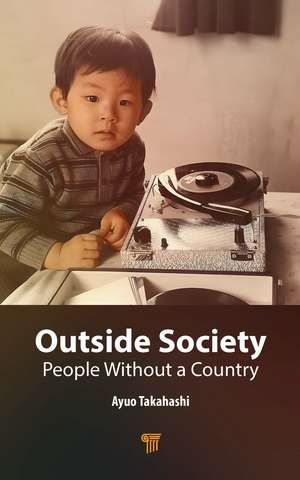
Outside Society: People Without a Country
Autor Ayuo Takahashien Limba Engleză Hardback – 7 aug 2025
Appearing in the book: Yokoo Tadanori, Shuji Terayama, Hiroshi Teshigahara, Kishin Shinoyama, Seiji Ozawa, Yukio Mishima, Miles Davis, Andy Warhol, Yuji Takahashi, Takehisa Kosugi, Steve Lacy, Ryuichi Sakamoto, Bill Bruford, Keiji Haino, Mutsuro Takahashi, John Zorn, Peter Hammill, Maddy Prior, Dave Mattacks, Horace Silver, John Cage, Terry Riley, Kazue Sawai, Hiromi Ohta, EPO, John Cale...
Preț: 341.38 lei
Puncte Express: 512
Carte disponibilă
Livrare economică 07-21 noiembrie
Livrare express 27-31 octombrie pentru 53.11 lei
Livrare prin curier în România Termenul estimat este afișat lângă disponibilitate.
Transport gratuit de la 400.00 lei Plată online sau ramburs, în funcție de opțiunile comenzii.
Retur gratuit în 14 zile Comandă securizată și suport în română.
Specificații
ISBN-13: 9789815129540
ISBN-10: 9815129546
Pagini: 450
Ilustrații: 72
Dimensiuni: 152 x 229 x 34 mm
Greutate: 0.86 kg
Ediția:1
Editura: Jenny Stanford Publishing
Colecția Jenny Stanford Publishing
ISBN-10: 9815129546
Pagini: 450
Ilustrații: 72
Dimensiuni: 152 x 229 x 34 mm
Greutate: 0.86 kg
Ediția:1
Editura: Jenny Stanford Publishing
Colecția Jenny Stanford Publishing
Public țintă
Academic and PostgraduateNotă biografică
Ayuo Takahashi is a musician (songwriter, lyricist, composer, vocalist, and guitarist) with over 20 albums released in Japan and the United States. Ayuo grew up in New York during the 1960s, interacting with many cultural figures while still a child including Seiji Ozawa, Toru Takemitsu, Yokoo Tadanori, Hiroshi Teshigahara, John Cage, and others. He has recordings with Ryuichi Sakamoto, John Zorn, and Peter Hammill, among others, released on JVC, Tzadik, MIDI, Epic-Sony, and other labels. He continues to create works based on medieval mythology and contemporary literature. In recent years, Ayuo's work has increasingly included music theater and chamber music mixed with dance and theatrical elements. He is also a journalist writing about music, films, and culture for magazines in Japan. In 2020, the compilation album "Kankyo Ongaku: Japanese Ambient Music," which includes Ayuo’s composition "Nagareru," was nominated for a U.S. Grammy Award. His recent works are available at ayuo.bandcamp.com.
Recenzii
“During my stay in New York City in the 60s and 70s, I often attended rock concerts with this young friend. He was still in the early grades of elementary school, but his knowledge was that of an expert. I was afraid that Ayuo’s talent might turn him into a madman, but his reasoning transformed him into a musical genius. The Japanese rock scene has much, much more to learn from him.”
-Yokoo Tadanori, artist.
“I started reading the book as soon as I received it. Wow! Interesting. Nationality. Race. About family. About art. About the times. In many ways, these are topics that should be talked about. Ayuo’s writing is totally frank, totally unadorned, but driven by a certain rhythm and tension. It is a quiet testimony. It overflows with emotion. The dimension of scale is unique and universal. This is a book that gradually opens one’s eyes to what it means to actually live the essence of art. It is a book that seems to predict a certain future. Yes, I believe that people who live in the Outside Society will be the bearers of art and culture in the future. Ayuo is one of them, a kind of pioneer. Therefore, he wears the pain and sorrow of a pioneer. I feel that this, hand in hand with his extremely intellectual sensitivity, is also the core of his art.”
-Ken Awazu, art producer.
“When Ayuo invited me to become involved in his project Songs from a Eurasian Journey, I was delighted to be able to do so. We share a love of early music, both in itself and as an exemplary of common origin. When we hear the old stuff, we are potentially tapped into more than merely musical history and there is a sense of homogeneity in more than simply musical modes. It’s a fascinating exercise to take music from the 6th and 7th centuries (among others) in various different cultures, combine them together, compare and contrast them with each other and emerge with something truly new, yet strangely familiar. Today (2025) I can say that working with Ayuo was always a pleasure and fun and also quite serious. All in all, that makes for proper work.”
-Peter Hammill, musician.
“What a triumph it is to see the English publication of Ayuo Takahashi’s autobiography, which uniquely mirrors the eclecticism of Ayuo’s life in composition, film-scoring, illustration, and poetry, as well as his remarkable paradoxical life experience growing up between two cultures. One of the through lines in Ayuo’s work is identity itself, and the journey toward selfhood and radicalism through art. Finally, we have a book that is both life-affirming for the Asian Diaspora and deeply informative in capturing the multicultural music and art scene during the 1960s through the 2000s.”
-Tristan Teshigahara Pollack, composer, musician, and writer.
“The trajectory of Ayuo Takahashi’s biography is boundless—in wedding the history of his adolescence with interviews, musical theory, and essays on multiple fields of art, his work clinches on a fundamental humanism beyond geographic borders. As an Asian-Canadian reader, I have found this book to encompass realms of music, film, science, and self-reflection; in doing so, Ayuo manifests a tome of incredible testimony—poring over the very way we as human beings interact and engage with one another.”
-Hsu Jui-Ting, radio show host, musician, and writer.
-Yokoo Tadanori, artist.
“I started reading the book as soon as I received it. Wow! Interesting. Nationality. Race. About family. About art. About the times. In many ways, these are topics that should be talked about. Ayuo’s writing is totally frank, totally unadorned, but driven by a certain rhythm and tension. It is a quiet testimony. It overflows with emotion. The dimension of scale is unique and universal. This is a book that gradually opens one’s eyes to what it means to actually live the essence of art. It is a book that seems to predict a certain future. Yes, I believe that people who live in the Outside Society will be the bearers of art and culture in the future. Ayuo is one of them, a kind of pioneer. Therefore, he wears the pain and sorrow of a pioneer. I feel that this, hand in hand with his extremely intellectual sensitivity, is also the core of his art.”
-Ken Awazu, art producer.
“When Ayuo invited me to become involved in his project Songs from a Eurasian Journey, I was delighted to be able to do so. We share a love of early music, both in itself and as an exemplary of common origin. When we hear the old stuff, we are potentially tapped into more than merely musical history and there is a sense of homogeneity in more than simply musical modes. It’s a fascinating exercise to take music from the 6th and 7th centuries (among others) in various different cultures, combine them together, compare and contrast them with each other and emerge with something truly new, yet strangely familiar. Today (2025) I can say that working with Ayuo was always a pleasure and fun and also quite serious. All in all, that makes for proper work.”
-Peter Hammill, musician.
“What a triumph it is to see the English publication of Ayuo Takahashi’s autobiography, which uniquely mirrors the eclecticism of Ayuo’s life in composition, film-scoring, illustration, and poetry, as well as his remarkable paradoxical life experience growing up between two cultures. One of the through lines in Ayuo’s work is identity itself, and the journey toward selfhood and radicalism through art. Finally, we have a book that is both life-affirming for the Asian Diaspora and deeply informative in capturing the multicultural music and art scene during the 1960s through the 2000s.”
-Tristan Teshigahara Pollack, composer, musician, and writer.
“The trajectory of Ayuo Takahashi’s biography is boundless—in wedding the history of his adolescence with interviews, musical theory, and essays on multiple fields of art, his work clinches on a fundamental humanism beyond geographic borders. As an Asian-Canadian reader, I have found this book to encompass realms of music, film, science, and self-reflection; in doing so, Ayuo manifests a tome of incredible testimony—poring over the very way we as human beings interact and engage with one another.”
-Hsu Jui-Ting, radio show host, musician, and writer.
Cuprins
Part I. 1. My first memory/Age 3, plane trip to Berlin/Kennedy Assassination/New York. 2. The Beatles/Rhythm and sound. 3. New York in the late 1960s/My mother’s artist friends (Yokoo Tadanori, Shuji Terayama, Hiroshi Teshigahara, Kishin Shinoyama, Mutsuo Takahashi, etc.)/The Filmore East/Electric Circus/Terry Riley/John Cage and Marcel Duchamp/Living Theater/Horace Silver/Joan Gilberto/Thelonius Monk/Muddy Waters. 4. Started learning guitar/1968: The year of changes/My parents’ divorce/Psychedelic rock/Started writing poetry/Open-tuning guitar. 5. My mother’s marriage to Mansour Malekpour/Jethro Tull/Ten Years After/Alice Cooper/Emerson, Lake & Palmer/Pink Floyd/Fairport Convention/Earth, Wind, and Fire/Steely Dan/The Who and more. 6. Influences from Peter Gabriel’s performances. 7. David, the actor/Experimental films/The Strawbs. 8. The junior high school I attended/Studying medieval European history/Teaching methods that make the students think for themselves/The Italian school in my neighborhood. 9. The disintegration of my family life/Suddenly leaving
New York City in 1975. 10. Arrival in Tokyo/Father, Yuji Takahashi/Stepmother,
Karen/Enrollment in Yokohama International School. 11. My father’s recordings/Left-wing political activists began to visit our residence/Takehisa Kosugi/Steve Lacy/Aquirax Aida/Meeting Ryuichi Sakamoto. 12. Going to Yokohama International High School/Friends/Cannabis/LSD/“The Lamb Lies Down on Broadway” by Genesis. 13. Father forces me to drop out from high school for
political reasons/Separated from father/The music activities in Tokyo in the late 1970s/Keiji Haino/Kichijoji Minor/Live performances at Seibu Auditorium, Kyoto University/Aunt Sally. 14. Performances with Junichi Kawahara, Chie Mukai,
Takeo Suzuki, Takuya Nishimura and others in the early 1980s/Kansai tour. 15. 1983, Record debut is decided/First solo album, Carmina/Interviews where communication is not established/Morgan Fisher/Moonriders. 16. 1984, signing with MIDI records. 17. Silent Film album/The misunderstood promotion/Memory Theatre album. 18. Departure to record in the UK in the summer of 1986/Stopover in New York City/John Zorn/Arrival in London/AMM/David Lord/Fairport Convention/Photographer Richard Haughton/Steeleye Span and Renaissance in concert/Recordings at Crescent Studios/Dave Mattacks/Maddy Prior/Peter Knight. 19. Meeting Peter Hammill/Visit to Peter Hammill’s house/Interview with Peter Hammill. 20. Completion of the album, Nova Carmina/Seeing Steve Marriott live. 21. Prolific creation in neurotic states. 22. 1987, Producing Kazue Sawai’s album, Eye to Eye/David Lord/Hiromi Ota/Peter Hammill/Guy Evans/Sara Jane Morris/James Warren. 23. The Hungerford massacre/J. G. Ballard. 24. From 1990 to now. Part II. Rock concerts I saw before and after 1970. The Kinks. About Yes. Bill Bruford interview. I met Andy Warhol when I was in the fifth grade. The school I went to in New York City. Winter 1983. End of Earth. Part III. I don’t understand the Japanese. Why I don’t understand the Japanese.
Part IV. Tokyo and my mother in the 1950s and early 1960s. Questions of identity in Hiroshi Teshigahara’s films and Kobo Abe’s novels. Toru Takemitsu’s ear for sound. What is psychedelic? Yokoo Tadanori, Toshi Ichiyanagi, and the psychedelic music scene. Taj Mahal Travellers and Takehisa Kosugi. John Cale Interview (from 2001): A musical journey from Xenakis, La Monte Young, Velvet Underground, and back to his roots in Wales. Yukio Mishima. The experience of death. Persian classical music and my stepfather, Mansour. Part V. Carl Jung, Joseph Campbell, and John Cage. Music and mythology. Folk society. About rhythm. The rhythm of the words we speak affects the rhythmic sense of the person who speaks them. The difference between English and Japanese lyrics. Classical music’s influence in Rock music. Influences from Joni Mitchell and my mono opera Izutsu. Yokoo Tadanori: The hometown is the source of creation. Part VI. Outside Society: People Without a Country—The poem. Discography. About the Author.
New York City in 1975. 10. Arrival in Tokyo/Father, Yuji Takahashi/Stepmother,
Karen/Enrollment in Yokohama International School. 11. My father’s recordings/Left-wing political activists began to visit our residence/Takehisa Kosugi/Steve Lacy/Aquirax Aida/Meeting Ryuichi Sakamoto. 12. Going to Yokohama International High School/Friends/Cannabis/LSD/“The Lamb Lies Down on Broadway” by Genesis. 13. Father forces me to drop out from high school for
political reasons/Separated from father/The music activities in Tokyo in the late 1970s/Keiji Haino/Kichijoji Minor/Live performances at Seibu Auditorium, Kyoto University/Aunt Sally. 14. Performances with Junichi Kawahara, Chie Mukai,
Takeo Suzuki, Takuya Nishimura and others in the early 1980s/Kansai tour. 15. 1983, Record debut is decided/First solo album, Carmina/Interviews where communication is not established/Morgan Fisher/Moonriders. 16. 1984, signing with MIDI records. 17. Silent Film album/The misunderstood promotion/Memory Theatre album. 18. Departure to record in the UK in the summer of 1986/Stopover in New York City/John Zorn/Arrival in London/AMM/David Lord/Fairport Convention/Photographer Richard Haughton/Steeleye Span and Renaissance in concert/Recordings at Crescent Studios/Dave Mattacks/Maddy Prior/Peter Knight. 19. Meeting Peter Hammill/Visit to Peter Hammill’s house/Interview with Peter Hammill. 20. Completion of the album, Nova Carmina/Seeing Steve Marriott live. 21. Prolific creation in neurotic states. 22. 1987, Producing Kazue Sawai’s album, Eye to Eye/David Lord/Hiromi Ota/Peter Hammill/Guy Evans/Sara Jane Morris/James Warren. 23. The Hungerford massacre/J. G. Ballard. 24. From 1990 to now. Part II. Rock concerts I saw before and after 1970. The Kinks. About Yes. Bill Bruford interview. I met Andy Warhol when I was in the fifth grade. The school I went to in New York City. Winter 1983. End of Earth. Part III. I don’t understand the Japanese. Why I don’t understand the Japanese.
Part IV. Tokyo and my mother in the 1950s and early 1960s. Questions of identity in Hiroshi Teshigahara’s films and Kobo Abe’s novels. Toru Takemitsu’s ear for sound. What is psychedelic? Yokoo Tadanori, Toshi Ichiyanagi, and the psychedelic music scene. Taj Mahal Travellers and Takehisa Kosugi. John Cale Interview (from 2001): A musical journey from Xenakis, La Monte Young, Velvet Underground, and back to his roots in Wales. Yukio Mishima. The experience of death. Persian classical music and my stepfather, Mansour. Part V. Carl Jung, Joseph Campbell, and John Cage. Music and mythology. Folk society. About rhythm. The rhythm of the words we speak affects the rhythmic sense of the person who speaks them. The difference between English and Japanese lyrics. Classical music’s influence in Rock music. Influences from Joni Mitchell and my mono opera Izutsu. Yokoo Tadanori: The hometown is the source of creation. Part VI. Outside Society: People Without a Country—The poem. Discography. About the Author.
Descriere
This book describes Ayuo Takahashi’s growing up during the socially turbulent 1960s in New York City. The book will be most appreciated by individuals who are interested in Asian culture and the problems that Western-educated Asians confront when they return to their ancestral homelands.