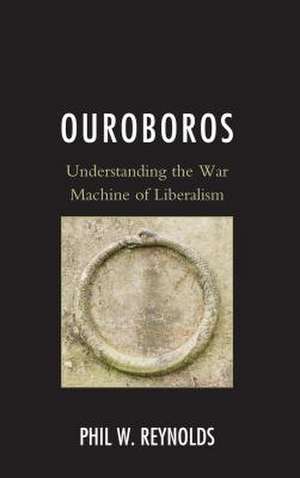
Ouroboros
Autor Phil W. Reynoldsen Limba Engleză Hardback – 9 iul 2019
Preț: 584.91 lei
Preț vechi: 865.03 lei
-32%
Puncte Express: 877
Carte tipărită la comandă
Livrare economică 27 noiembrie-11 decembrie
Livrare prin curier în România Termenul estimat este afișat lângă disponibilitate.
Transport gratuit pentru acest produs Plată online sau ramburs, în funcție de opțiunile comenzii.
Retur gratuit în 14 zile Comandă securizată și suport în română.
Specificații
ISBN-13: 9781498590914
ISBN-10: 1498590918
Pagini: 300
Ilustrații: 14 Graphs
Dimensiuni: 157 x 235 x 22 mm
Greutate: 0.61 kg
Editura: Lexington Books
Locul publicării:New York, United States
ISBN-10: 1498590918
Pagini: 300
Ilustrații: 14 Graphs
Dimensiuni: 157 x 235 x 22 mm
Greutate: 0.61 kg
Editura: Lexington Books
Locul publicării:New York, United States
Cuprins
1. Liberalism, the State, and War
2. Explaining Clausewitzian Power
3. The Security Dispositif as an Ordering Framework
4. The Domestic and the Periphery
5. The Origins of the War Machine
6. How the War Machine Become Permanent
7. Key Components of Clausewitzian War
8. The Problem with Clauswitzian War and the Trinity
9. How the Singularity Is Revealed
10. The Uninhibited Partisan, Terror and Force
11. Algeria and the Ordering of Society
12. Vietnam and the Immediate Threat
13. Afghanistan and Killing a War Machine
14. 9/11 and Comparative Advantage
15. Crux
16. Problems with Preemption
17. Preemption as Method
18. Generating Certainty
PART SIX -CONCLUSIONS
19. Liberalism and the War Machine
20. The Singularity
21. Preemption as Imperative
22. The Ouroboros
2. Explaining Clausewitzian Power
3. The Security Dispositif as an Ordering Framework
4. The Domestic and the Periphery
5. The Origins of the War Machine
6. How the War Machine Become Permanent
7. Key Components of Clausewitzian War
8. The Problem with Clauswitzian War and the Trinity
9. How the Singularity Is Revealed
10. The Uninhibited Partisan, Terror and Force
11. Algeria and the Ordering of Society
12. Vietnam and the Immediate Threat
13. Afghanistan and Killing a War Machine
14. 9/11 and Comparative Advantage
15. Crux
16. Problems with Preemption
17. Preemption as Method
18. Generating Certainty
PART SIX -CONCLUSIONS
19. Liberalism and the War Machine
20. The Singularity
21. Preemption as Imperative
22. The Ouroboros
Recenzii
With Ouroboros: Understanding the War Machine of Liberalism, Phil Reynolds lays bare Liberalism's inherent penchant for war. In a robust and ultimately scathing critique of Liberal strategies of preemption, Reynolds helps us think through this unfolding contradiction. Why does such incongruity arise? What drives this apparent paradox forward? By answering these questions, Reynolds encourages us to see Liberalism as serpentine, twisting and contorting as it swallows its own tail. Ouroboros is an important book that brings clarity and conviction in an age of doublespeak and deception.
"Reynolds has written a thoughtful and challenging work that reinterprets recent US foreign policy. Through his utilization of European critical philosophers, Reynolds provides a fresh lens through which we can make sense of the recent peripheral wars with which the United States and its allies have struggled."
This book stretched my brain into areas I had never considered over the past thirty-five years of studying war. Phil Reynolds, in keeping with the best traditions of the "warrior-scholar" artfully weaves elements of traditional military strategy and philosophy from the 18-19th centuries with contemporary 20-21st century concepts of post-modern political theory, guerrilla warfare, and counter-insurgency doctrine. If you ever imagined Clausewitz dancing with Foucault to a tune piped by Mao and danced by Afghan and Iraq insurgents, you will find it here. It is a book worth studying for those seeking deeper understanding of why great powers intervene in other people's business, and often fail.
Drawing on a wide-array of sources and in-depth case studies of Algeria, Vietnam, Afghanistan, and Iraq, Reynolds argues that many of the conflicts the West faces today are largely due to the rejection of neoliberal ideas by groups on the "periphery" whose visions of the future are rooted in local identities rather than universal truths (as defined by liberalism). Liberalism, he contends, uses war for two reasons: to secure domestic happiness through ordered economic exchanges and to "snuff out" the illiberal. And these are primarily achieved through preemptive and remote wars. Undoubtedly, some will take exception to his thesis. Nevertheless, it deserves its day in court.
"Reynolds has written a thoughtful and challenging work that reinterprets recent US foreign policy. Through his utilization of European critical philosophers, Reynolds provides a fresh lens through which we can make sense of the recent peripheral wars with which the United States and its allies have struggled."
This book stretched my brain into areas I had never considered over the past thirty-five years of studying war. Phil Reynolds, in keeping with the best traditions of the "warrior-scholar" artfully weaves elements of traditional military strategy and philosophy from the 18-19th centuries with contemporary 20-21st century concepts of post-modern political theory, guerrilla warfare, and counter-insurgency doctrine. If you ever imagined Clausewitz dancing with Foucault to a tune piped by Mao and danced by Afghan and Iraq insurgents, you will find it here. It is a book worth studying for those seeking deeper understanding of why great powers intervene in other people's business, and often fail.
Drawing on a wide-array of sources and in-depth case studies of Algeria, Vietnam, Afghanistan, and Iraq, Reynolds argues that many of the conflicts the West faces today are largely due to the rejection of neoliberal ideas by groups on the "periphery" whose visions of the future are rooted in local identities rather than universal truths (as defined by liberalism). Liberalism, he contends, uses war for two reasons: to secure domestic happiness through ordered economic exchanges and to "snuff out" the illiberal. And these are primarily achieved through preemptive and remote wars. Undoubtedly, some will take exception to his thesis. Nevertheless, it deserves its day in court.