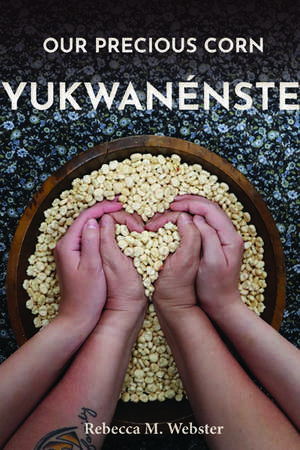
Our Precious Corn: Yukwanénste: Makwa Enewed
Autor Rebecca M. Websteren Limba Engleză Paperback – mai 2023
Preț: 352.98 lei
Puncte Express: 529
Preț estimativ în valută:
62.48€ • 72.58$ • 54.13£
62.48€ • 72.58$ • 54.13£
Carte indisponibilă temporar
Doresc să fiu notificat când acest titlu va fi disponibil:
Se trimite...
Preluare comenzi: 021 569.72.76
Specificații
ISBN-13: 9781938065309
ISBN-10: 1938065301
Pagini: 350
Ilustrații: 11
Dimensiuni: 152 x 229 x 25 mm
Greutate: 0.89 kg
Editura: Michigan State University Press
Colecția Makwa Enewed
Seria Makwa Enewed
ISBN-10: 1938065301
Pagini: 350
Ilustrații: 11
Dimensiuni: 152 x 229 x 25 mm
Greutate: 0.89 kg
Editura: Michigan State University Press
Colecția Makwa Enewed
Seria Makwa Enewed
Notă biografică
Rebecca M. Webster is an enrolled citizen of the Oneida Nation in Wisconsin. She serves on the faculty at the University of Minnesota Duluth in their Department of American Indian Studies. She is a founding member of Ohe∙láku (among the cornstalks), a co-op of ten Oneida families that grow multiple acres of traditional heirloom corn together. She and her husband also own a farmstead on the Oneida Reservation where they primarily grow Haudenosaunee varieties of corn, beans, squash, sunflowers, sunchokes, and tobacco. Their philosophy is that every time an Indigenous person plants a seed, it is an act of resistance, an assertion of sovereignty, and a reclamation of identity. In light of this philosophy, an Oneida faithkeeper named the ten-acre homestead Ukwakhwa: Tsinu Niyukwayayʌthoslu (Our Foods: Where we plant things), a name which also lends itself to the 501(c)(3) nonprofit organization, Ukwakhwa Inc., that Webster formed with her family to help advance their goals of helping share knowledge with the community.
Cuprins
Contents
Preface
Chapter 1. Tsiʔtsyotáshawau (Of Where It Began)
Chapter 2. Kanehelatúksla (To Extend Greetings and Thankfulness)
Chapter 3. Kayanláslaʔkowa (Great Matters)
Chapter 4. Wahutatya·thewéwe (They Arrived)
Chapter 5. Wohotiliwahokénha (They Tangled over Matters)
Chapter 6. Kaliwihyo (Good Message)
Chapter 7. Wayukhinukulhaʔte Okhale Wayukhinató·li· (They Dismissed Our Thinking and They Disrupted Our Towns)
Chapter 8. Wayukwahutsyákwa Okhale Wayukhiwiláhkwa (They Have Taken Our Land Away and They Have Taken Our Children Away)
Chapter 9. Wayukhinikuhláʔkháshyi (They Have Separated Our Minds)
Chapter 10. Ohutsyo·kú· Wahatiha·wíhte (They Took It to under the Earth)
Chapter 11. Ona Waekwatahtaskenhá (Now We Have the Means to Help Ourselves)
Chapter 12. Ohe·láku (Among the Cornstalks)
Chapter 13. Yukwaliwisaʔáhtu (How We Tie Our Matters Together)
Chapter 14. Tsiʔ Nahte Olihwaka·yú· Okhale Oli·wáse (Of What Old Matters and New Matters)
Chapter 15. Ohutu Yukwatkattuhati (We All Are Looking to Our Future)
Appendix. Tsi Twakhunihe (How We Cook Our Foods)
Glossary
Notes
Bibliography
Index
Recenzii
Rebecca Webster knows corn. Her beautiful book, Our Precious Corn: Yukwanénste, is an insightful window into her community's relationship with corn as a relative, not as a commodity. Anyone who is interested in food sovereignty should read this book.
—Patty Loew, PhD member of the Mashkiiziibii–Bad River Band of Lake Superior Ojibwe, journalism professor and inaugural director, Center for Native American and Indigenous Research, Northwestern University
—Patty Loew, PhD member of the Mashkiiziibii–Bad River Band of Lake Superior Ojibwe, journalism professor and inaugural director, Center for Native American and Indigenous Research, Northwestern University
Descriere
For the Oneida people, yukwanénste has two meanings: our corn and our precious. Corn has walked alongside the Oneida and other Haudenosaunee people since creation, playing an integral role in their daily and ceremonial lives throughout their often turbulent history. The relationship between corn and the Oneida has changed over time, but the spirit of this important resource has remained by their side, helping them heal along the way. In Our Precious Corn: Yukwanénste, author Rebecca M. Webster (Kanyʌʔtake·lu), an Oneida woman and Indigenous corn grower, weaves the words of explorers, military officers, and anthropologists, as well as historic and other contemporary Haudenosaunee people, to tell a story about their relationships with corn including hopeful visions for its future.