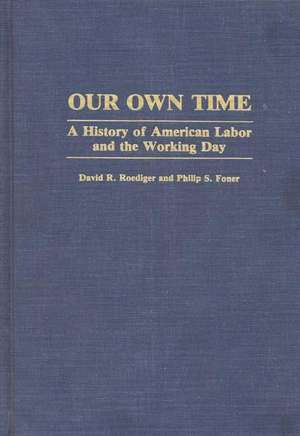
Our Own Time
Autor Philip S. Foner, David R. Roedigeren Limba Engleză Hardback – 27 mar 1989
Beginning with a picture of working hours in colonial America and the early republic, Roediger and Foner then analyze the ideology of the movement for a ten-hour workday in the early nineteenth century. They demonstrate that the ten-hour issue was a key to the dynamism of the Jacksonian labor movement as well as to the unity of male artisans and female factory workers in the 1840s. The authors proceed to examine the subsequent demands for an eight-hour day, which helped to produce the mass labor struggles of the late nineteenth century and established the American Federation of Labor as the dominant force in American trade unionism. Chapters on labor movement defeats following World War I, on the depression years, and on the lack of progress over the last half-century complete the study. "Our Own Time" will be an ideal supplemental text for courses in U.S. labor and economic history.
Preț: 494.22 lei
Preț vechi: 703.75 lei
-30%
Puncte Express: 741
Carte tipărită la comandă
Livrare economică 25 decembrie 26 - 08 ianuarie 27
Livrare prin curier în România Termenul estimat este afișat lângă disponibilitate.
Transport gratuit pentru acest produs Plată online sau ramburs, în funcție de opțiunile comenzii.
Retur gratuit în 14 zile Comandă securizată și suport în română.
Specificații
ISBN-13: 9780313260629
ISBN-10: 0313260621
Pagini: 398
Dimensiuni: 161 x 240 x 26 mm
Greutate: 0.71 kg
Editura: Praeger
ISBN-10: 0313260621
Pagini: 398
Dimensiuni: 161 x 240 x 26 mm
Greutate: 0.71 kg
Editura: Praeger
Descriere
Our Own Time provides the first full account of the movement to shorten the working day in the United States. Combining the narrative and trade union emphasis of traditional labor history with the focus on culture and the labor process characteristic of contemporary labor history, the book offers an illuminating reinterpretation of the history of the U.S. labor movement from the colonial period onward. The authors argue that the length of the working day or week historically has been the central issue raised by the American labor movement during its most vigorous periods of organization.
Beginning with a picture of working hours in colonial America and the early republic, Roediger and Foner then analyze the ideology of the movement for a ten-hour workday in the early nineteenth century. They demonstrate that the ten-hour issue was a key to the dynamism of the Jacksonian labor movement as well as to the unity of male artisans and female factory workers in the 1840s. The authors proceed to examine the subsequent demands for an eight-hour day, which helped to produce the mass labor struggles of the late nineteenth century and established the American Federation of Labor as the dominant force in American trade unionism. Chapters on labor movement defeats following World War I, on the depression years, and on the lack of progress over the last half-century complete the study. Our Own Time will be an ideal supplemental text for courses in U.S. labor and economic history.
Beginning with a picture of working hours in colonial America and the early republic, Roediger and Foner then analyze the ideology of the movement for a ten-hour workday in the early nineteenth century. They demonstrate that the ten-hour issue was a key to the dynamism of the Jacksonian labor movement as well as to the unity of male artisans and female factory workers in the 1840s. The authors proceed to examine the subsequent demands for an eight-hour day, which helped to produce the mass labor struggles of the late nineteenth century and established the American Federation of Labor as the dominant force in American trade unionism. Chapters on labor movement defeats following World War I, on the depression years, and on the lack of progress over the last half-century complete the study. Our Own Time will be an ideal supplemental text for courses in U.S. labor and economic history.
Notă biografică
DAVID R. ROEDIGER teaches labor history at the University of Missouri. He is the coeditor with Franklin Rosemont, of Haymarket Scrapbook and the author of recent articles in History Workshop Journal, Labor History, Journal of Social History, and Labour/Le Travail.
PHILIP S. FONER is Professor Emeritus of History at Lincoln University, Pennsylvania. His numerous books include Organized Labor and the Black Worker, 1619-1973 and the two-volume Women and the American Labor Movement.
PHILIP S. FONER is Professor Emeritus of History at Lincoln University, Pennsylvania. His numerous books include Organized Labor and the Black Worker, 1619-1973 and the two-volume Women and the American Labor Movement.