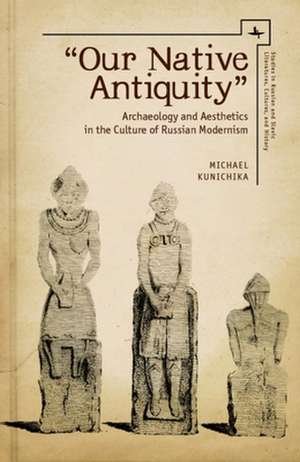
"Our Native Antiquity": Archaeology and Aesthetics in the Culture of Russian Modernism: Studies in Russian and Slavic Literatures, Cultures, and History
Autor Michael Kunichikaen Limba Engleză Paperback – 15 ian 2018
Din seria Studies in Russian and Slavic Literatures, Cultures, and History
- 25%
 Preț: 501.10 lei
 - 22%
 Preț: 158.47 lei
 -
 Preț: 318.35 lei
 - 22%
 Preț: 143.28 lei
 - 21%
 Preț: 126.02 lei
 - 18%
 Preț: 94.59 lei
 - 26%
 Preț: 550.26 lei
 - 17%
 Preț: 143.94 lei
 - 26%
 Preț: 641.38 lei
 - 17%
 Preț: 94.85 lei
 - 22%
 Preț: 103.27 lei
 - 25%
 Preț: 556.76 lei
 - 16%
 Preț: 146.08 lei
 - 23%
 Preț: 854.93 lei
 -
 Preț: 317.79 lei
 -
 Preț: 395.35 lei
 -
 Preț: 388.43 lei
 - 23%
 Preț: 169.77 lei
 -
 Preț: 325.32 lei
 -
 Preț: 243.67 lei
 - 23%
 Preț: 862.00 lei
 - 26%
 Preț: 594.05 lei
 - 25%
 Preț: 510.97 lei
 - 20%
 Preț: 252.64 lei
Preț: 237.61 lei
Puncte Express: 356
Carte disponibilă
Livrare economică 14-28 noiembrie
Livrare express 03-07 noiembrie pentru 34.37 lei
Livrare prin curier în România Termenul estimat este afișat lângă disponibilitate.
Transport gratuit de la 400.00 lei Plată online sau ramburs, în funcție de opțiunile comenzii.
Retur gratuit în 14 zile Comandă securizată și suport în română.
Specificații
ISBN-13: 9781618116642
ISBN-10: 1618116649
Pagini: 348
Dimensiuni: 156 x 234 x 18 mm
Greutate: 0.49 kg
Editura: Academic Studies Press
Colecția Academic Studies Press
Seria Studies in Russian and Slavic Literatures, Cultures, and History
Locul publicării:Boston, MA, United States
ISBN-10: 1618116649
Pagini: 348
Dimensiuni: 156 x 234 x 18 mm
Greutate: 0.49 kg
Editura: Academic Studies Press
Colecția Academic Studies Press
Seria Studies in Russian and Slavic Literatures, Cultures, and History
Locul publicării:Boston, MA, United States
V-ar putea interesa
-
 Queen AnneAnne SomersetPreț: 122.11 lei
 -
 To Hell and BackIan Kershaw-26%Preț: 102.55 lei137.66 lei
 -
 A People of One Book: The Bible and the VictoriansTimothy Larsen-15%Preț: 293.03 lei345.89 lei
 -
 Europe Isn't WorkingLarry ElliottPreț: 80.40 lei
 -
 The Last Great FrenchmanCharles WilliamsPreț: 154.69 lei
 -
 She-WolvesHelen CastorPreț: 95.18 lei
 -
 Russia and the RussiansGeoffrey Hosking-20%Preț: 116.24 lei146.03 lei
 -
 -26%Preț: 68.90 lei93.62 lei
 -
 The Balfour Declaration: The Origins of the Arab-Israeli ConflictJonathan Schneer-26%Preț: 91.52 lei123.05 lei
 -
 Coming Up TrumpsJean Trumpington-33%Preț: 42.92 lei64.44 lei
 -
 -25%Preț: 76.51 lei102.02 lei
 -
 Italian Jewry in the Early Modern Era: Essays in Intellectual HistoryAlessandro Guetta-25%Preț: 602.35 lei801.91 lei
 -
 Russian Monarchy: Representation and RuleRichard Wortman-25%Preț: 604.11 lei803.04 lei
 -
 Belomor: Criminality and Creativity in Stalin’s GulagJulie S. Draskoczy-25%Preț: 556.45 lei741.02 lei
 -
 -25%Preț: 651.76 lei865.06 lei
 -
 -24%Preț: 515.62 lei680.87 lei
 -
 Essays in Russian Social and Economic HistorySteven L. Hoch-18%Preț: 658.03 lei802.47 lei
 -
 -26%Preț: 641.44 lei862.78 lei
 -
 Preț: 361.73 lei
 -
 New Directions in Anglo-Jewish HistoryGeoffrey Alderman-26%Preț: 547.33 lei738.11 lei
Recenzii
"Russian modernism’s aesthetic orientation sought to expand 'in time,' not only 'in space.' Instead of geographically exploring the 'found' traditions of primitive cultures (as in the cases of Picasso or Gauguin), Russian modernists drilled through the layers of time to reach their own native land. In this compelling book, Michael Kunichika persistently returns to nineteenth-century history, poetry, and aesthetics, as well as to the origins of the discipline of archaeology in Russia, as he subtly reads modernist poetry, prose, visual works, and film. Kunichika’s original perspective on the subject—and how he conceptualizes it—will have major implications for our understanding of some of the most significant aesthetic and political developments in Russian modernism and beyond."
""Our Native Antiquity" gives us by far the most detailed, insightful and distinctive picture we have of the instability of 'modernity' within Russian culture ca. 1890-1930, as efforts to recuperate a 'native antiquity' got caught up in a paradoxical web of national ideology, cultural influence from Europe and beyond, and the ironies of historical self-consciousness as such. Highlights include the stunning linkages Michael Kunichika draws between archeology and writers as diverse as Tolstoy, Bunin and Khlebnikov; the illuminating connections established between 'Golden Age' Russian poetry and modernist work (particularly in the reimagining of the Bronze Horseman through the Stone Woman); convincing speculations on the links between the primitivist/archeological explorations of Russian modernists and their European counterparts (like Picasso); and the truly brilliant investigation of Pil'niak's musings on historical continuity in a time of historical catastrophe. Kunichika’s study will take its place among the most important works we have on both Russian modernism and on questions of periodization and form."
"An engrossing, tightly conceptualized study at the intersection of several disciplines: literary, painterly, cinematic aesthetics; archaeology and anthropology; cultural and political history. Michael Kunichika makes a remarkable contribution to interdisciplinary research of modern Russian culture. His book is in the tradition of Hugh Kenner's The Pound Era, with the focus however on the poetry of Russian symbolism, the idiosyncratic futurism of Velimir Khlebnikov, the films of Dziga Vertov and the prose of the ill-fated Boris Pil'niak. His discourse analyses and the stimulating readings of the imagery of the burial mounds and statuary of the Eurasian steppe are exemplary."
"This ambitious book shows powerfully how much modernism indulged a fascination with the deep past alongside its obvious push toward the desired future. Beautifully written and subtly theorized, Kunichika’s work focuses on specific artefacts—the Stone Women, the burial mounds, and the remarkable Scythian skeleton discovered in the 1920s—within a rich context of archaeology, aesthetics, and historical inquiry. These tales of cultural appropriation and enduring fascination with sites and objects offer us new readings of texts both written and cinematic by Bobrov, Khlebnikov, Pil’niak, and Vertov, among others."
"This impressive study addresses Russian modernists’ (ca. 1890–1930) aesthetic concerns in the context of their quest for a strictly “Russian antiquity” removed from European classical roots… The goal of this book is as multifaceted as it is ambitious: “to reveal the inner distinction between the various modes of retrospection” in the work of the Russian modernists and to analyze “the ways in which they formulated their own projects as regards who would be the best inheritor, in spirit and in form, of the past.” Although the author claims to use mainly philological and cultural-historical methodology, this study stands at the intersection of several other disciplines: archaeology, anthropology, art history, and cinema studies."
“Kunichika’s first book is a tour de force.”
“Kunichika’s book willbe of great interest to Slavic scholars from different fields. It makes animportant contribution to the existing scholarship on Russian modernism andoffers a sophisticated model of a well-balanced interdisciplinary study.” —NataliaDame, Slavic and East European Journal
""Our Native Antiquity" gives us by far the most detailed, insightful and distinctive picture we have of the instability of 'modernity' within Russian culture ca. 1890-1930, as efforts to recuperate a 'native antiquity' got caught up in a paradoxical web of national ideology, cultural influence from Europe and beyond, and the ironies of historical self-consciousness as such. Highlights include the stunning linkages Michael Kunichika draws between archeology and writers as diverse as Tolstoy, Bunin and Khlebnikov; the illuminating connections established between 'Golden Age' Russian poetry and modernist work (particularly in the reimagining of the Bronze Horseman through the Stone Woman); convincing speculations on the links between the primitivist/archeological explorations of Russian modernists and their European counterparts (like Picasso); and the truly brilliant investigation of Pil'niak's musings on historical continuity in a time of historical catastrophe. Kunichika’s study will take its place among the most important works we have on both Russian modernism and on questions of periodization and form."
"An engrossing, tightly conceptualized study at the intersection of several disciplines: literary, painterly, cinematic aesthetics; archaeology and anthropology; cultural and political history. Michael Kunichika makes a remarkable contribution to interdisciplinary research of modern Russian culture. His book is in the tradition of Hugh Kenner's The Pound Era, with the focus however on the poetry of Russian symbolism, the idiosyncratic futurism of Velimir Khlebnikov, the films of Dziga Vertov and the prose of the ill-fated Boris Pil'niak. His discourse analyses and the stimulating readings of the imagery of the burial mounds and statuary of the Eurasian steppe are exemplary."
"This ambitious book shows powerfully how much modernism indulged a fascination with the deep past alongside its obvious push toward the desired future. Beautifully written and subtly theorized, Kunichika’s work focuses on specific artefacts—the Stone Women, the burial mounds, and the remarkable Scythian skeleton discovered in the 1920s—within a rich context of archaeology, aesthetics, and historical inquiry. These tales of cultural appropriation and enduring fascination with sites and objects offer us new readings of texts both written and cinematic by Bobrov, Khlebnikov, Pil’niak, and Vertov, among others."
"This impressive study addresses Russian modernists’ (ca. 1890–1930) aesthetic concerns in the context of their quest for a strictly “Russian antiquity” removed from European classical roots… The goal of this book is as multifaceted as it is ambitious: “to reveal the inner distinction between the various modes of retrospection” in the work of the Russian modernists and to analyze “the ways in which they formulated their own projects as regards who would be the best inheritor, in spirit and in form, of the past.” Although the author claims to use mainly philological and cultural-historical methodology, this study stands at the intersection of several other disciplines: archaeology, anthropology, art history, and cinema studies."
“Kunichika’s first book is a tour de force.”
“Kunichika’s book willbe of great interest to Slavic scholars from different fields. It makes animportant contribution to the existing scholarship on Russian modernism andoffers a sophisticated model of a well-balanced interdisciplinary study.” —NataliaDame, Slavic and East European Journal
Cuprins
Acknowledgments 8 Note on Translation and Transliteration 11 Introduction 12 i. Archaic Mirrors 15 ii. Elective Antiquities 19 Chapter One 27 The Archaeology of the Stone Babas and the Modernist Inheritance i. “Rough Hewn Statues” 34 ii. Idols Destroyed, Idols Displaced, 49 and the Steppe Denuded iii. The Modernist Peregrinations of the Stone Babas 57 Chapter Two 62 A Cultural Poetics of the Kurgan i. How to Excavate a Kurgan 62 ii. Gnedich, Iliada 69 iii. Vantage Points, ca. 1850 80 iv. 1876—The Grave Becomes a Cradle: 90 Zabelin contra Chaadaev v. Archaeological Defamiliarization 96 vi. Steppe Archaism and the Stratification of Time 100 Chapter Three 107 Ancient Statues, Ancient Terrors i. Archaic Simplicity 110 ii. Primitive Rudeness 120 iii. “No Ordinary Stone Woman” 128 Chapter Four 139 How a Modernist Artifact Is Made: The “Native Antiquity” of the Stone Babas and the Indigenization of Cubism i. The Stone Baba and the Bronze Horseman 147 ii. Indigenous Cubism 162 Chapter Five 173 Velimir Khlebnikov, Poet of the Stone Babas i. “The Stone Woman” (1919): Modernist Metamorphosis 178 ii. The Steppes of Time: “A Night in a Trench” 190 iii. The Grave of Khlebnikov 201 Chapter Six 204 The Landmarks of Time: Burial Mounds, Eurasian Necropolises, and Modernist Form in Boris Pil’niak’s The Naked Year i. Volga “Pompeiis” 211 ii. Scythianism, 1918 217 iii. Modernist Stratigraphy: Uvek, Site of Time 222 iv. Modernist Topography: “Loop Station Mar” and the Poetics of Adjacency 234 Chapter Seven 243 Areas of Deformation Part One: Dziga Vertov and the Scythian 243 i. Areas of Deformation 247 ii. The Shooting Log 261 iii. The Archaeology of the Superimpositions 271 iv. Archaeology with a Hammer 275 Part Two: Boris Pil’niak’s The Volga Falls 280 to the Caspian Sea and the Courage of Farewell i. All That Was Solid Did Not Melt into Air: 287 Persisting Things ii. The Fluids of History: 291 Archaeology and Antiquarianism iii. The Courage of Farewell: 297 The Return of the Stone Women iv. Coda 307 Bibliography 312 Index 326