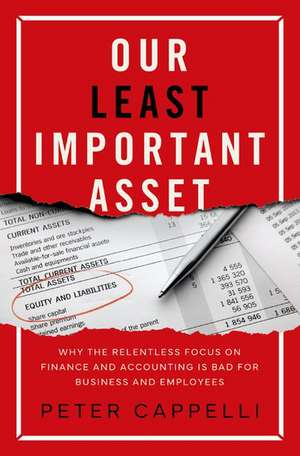
Our Least Important Asset: Why the Relentless Focus on Finance and Accounting is Bad for Business and Employees
Autor Peter Cappellien Limba Engleză Hardback – 18 dec 2023
Observăm o contradicție fundamentală în afacerile moderne: deși discursul oficial pune preț pe oameni, realitatea contabilă îi tratează ca pe o povară financiară ce trebuie redusă constant. În Our Least Important Asset, Peter Cappelli abordează direct problema stagnării salariilor și a insecurității locului de muncă, demonstrând că acestea nu sunt rezultatul unei căutări de eficiență, ci al unor erori sistematice în modul în care contabilitatea financiară evaluează capitalul uman. Considerăm că această perspectivă este esențială pentru a înțelege de ce, în ciuda dovezilor privind productivitatea, companiile continuă să prioritizeze reducerea costurilor per angajare în detrimentul calității.
Remarcăm o analiză tăioasă a modului în care indicatorii de profitabilitate pe termen scurt distorsionează managementul resurselor umane. Pe linia practică a volumului People - The New Asset on the Balance Sheet de J. Divanna, dar cu un focus critic pe viciile de structură ale sistemelor de raportare financiară, Cappelli explică fenomene precum trecerea la vacanțe nelimitate sau utilizarea forței de muncă „închiriate”. Spre deosebire de lucrările sale anterioare, cum ar fi Talent on Demand, unde se concentra pe adaptarea la un mediu de afaceri incert, aici autorul merge la rădăcina problemei: sistemul de arbitraj financiar care forțează executivii să ia decizii contraproductive pentru sănătatea organizației.
Stilul este unul riguros, ancorat în cercetare empirică, dar extrem de relevant pentru realitatea corporativă actuală. Peter Cappelli nu se limitează la critică, ci oferă o radiografie a modului în care subminarea investiției în oameni afectează creativitatea și loialitatea. Este un text care cere o reevaluare a modului în care succesul unei afaceri este măsurat la nivelul bilanțului contabil.
Preț: 185.19 lei
Preț vechi: 219.57 lei
-16%
Carte disponibilă
Livrare economică 23 octombrie-03 noiembrie
Livrare express 09-15 octombrie pentru 65.35 lei
Specificații
ISBN-10: 0197629806
Pagini: 240
Dimensiuni: 165 x 236 x 24 mm
Greutate: 0.48 kg
Editura: Oxford University Press
Colecția OUP USA
Locul publicării:New York, United States
V-ar putea interesa
-
 Weird in a World That's NotJennifer RomoliniPreț: 97.46 lei
 -
 Change at WorkPeter Cappelli-21%Preț: 428.55 lei542.87 lei
 -
 Employment Practices and Business StrategyPeter Cappelli-11%Preț: 377.07 lei424.12 lei
 -
 Working for the StateS. Corby-15%Preț: 642.11 lei755.43 lei
 -
 Me. Pick Me! Marketing Yourself for a JobE. Corinne Corinne ByrdPreț: 140.40 lei
 -
 Talent on DemandPeter CappelliPreț: 237.83 lei
 -
 Lifestyle Selling for WomenPauline O'MalleyPreț: 157.86 lei
 -
 Price and Productivity MeasurementBert M. Balk W. Erwin DiewertPreț: 187.47 lei
 -
 Hacia El Autentico Rol DirectivoRicardo Lpez De AndaPreț: 141.15 lei
 -
 Preț: 134.73 lei
 -
 What You Should Know When Looking for a Job in Today's MarketplaceRichard a. WittmeyerPreț: 93.99 lei
 -
 A Cry for Help!Majid Al SuleimanyPreț: 381.72 lei
 -
 It's Nobody's Business But YoursKillmeyer Barbara KillmeyerPreț: 152.25 lei
 -
 The Guests of Itlldo Place Bed and BreakfastWood-Boissonnea Dana Wood-BoissonneaultPreț: 105.16 lei
 -
 Time to Get Hired!Yusuf Wilson MhrmPreț: 144.29 lei
 -
 -26%Preț: 113.79 lei154.71 lei
 -
 -27%Preț: 163.71 lei223.14 lei
 -
 Preț: 288.53 lei
 -
 Preț: 123.86 lei
 -
 Preț: 118.13 lei
 -
 Preț: 401.08 lei
 -
 Konzept und Berufsbild des Feelgood-ManagementsSophia GesingPreț: 117.93 lei
De ce să citești această carte
Recomandăm această carte liderilor de business și profesioniștilor din resurse umane care simt că strategiile de management sunt blocate în cifre reci. Veți învăța cum să identificați capcanele contabile care sabotează productivitatea și cum să argumentați importanța capitalului uman în termeni care contează pentru investitori. Este un instrument esențial pentru a înțelege de ce modelul actual de management al talentelor eșuează și ce trebuie schimbat pentru succesul pe termen lung.
Despre autor
Peter Cappelli este profesor de management (George W. Taylor Chair) și director al Centrului pentru Resurse Umane la prestigioasa Wharton School, University of Pennsylvania. Recunoscut la nivel global ca unul dintre cei mai influenți gânditori în domeniul managementului, Cappelli a publicat lucrări de referință care analizează evoluția pieței muncii și a relațiilor de angajare. Expertiza sa, acumulată de-a lungul deceniilor de cercetare academică și consultanță, este valorificată frecvent în publicații precum Harvard Business Review, unde contribuie la definirea celor mai bune practici în leadership și strategie de talent.
Descriere
Recenzii
How and why are corporate jobs getting worse and worse over time? Peter Cappelli's latest book answers both these questions: corporations are pushed by accounting demands to squeeze employment costs and to rely on contractors and outsourcing to keep these costs off their books-even at the expense of HR practices supported by decades of research and experience. Our Least Important Asset is an arresting take on the source of our current employment malaise.
Human capital expert Peter Cappelli has written an important new book addressing the fundamental question of why policies that value and build human capital are not only rare in practice but increasingly implemented. His insightful answer: financial accounting measures lead to a lose-lose situation in which companies and their employees suffer. Just as the ESG movement has broadened reporting, so the answer to improved productivity and employee wellbeing must begin in changes in accounting measures.
Peter Cappelli, one of the leading scholars of workforce management, offers a compelling explanation of the decline of human resource practices like careful hiring and performance evaluation and investment in training. Corporate fixation with shareholder value maximization operationalized through financial accounting practices has turned employees from a perceived asset to a liability. Cappelli's probing analysis shows that the popular bromide of convincing corporate leaders 'to do well by doing good' is not sufficient to stem the erosion of work. That makes Our Least Important Asset a must read for those who care about the future of work and workers.
A thought-provoking and important study for managers or faculty and students in business and management programs.
Cappelli's book is based on decades of research and experience in human resource management. He draws on a wealth of empirical evidence and case studies to illustrate his points. Cappelli's book is based on decades of research and experience in human resource management. He draws on a wealth of empirical evidence and case studies to illustrate his points. Highly recommended. All readership levels.