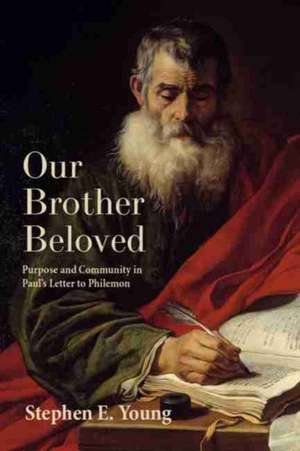
Our Brother Beloved
Autor Stephen E. Youngen Limba Engleză Hardback – 29 aug 2021
Începem analiza acestui volum prin prisma capitolului dedicat Americii antebelice, unde autorul demonstrează cum interpretările eronate ale Epistolei către Filimon au oferit, istoric, o justificare teologică pentru instituția sclaviei. Our Brother Beloved nu este doar o exegeză biblică, ci un studiu interdisciplinar necesar care își propune să deconstruiască mitul sclavului fugar Onisim, returnat de Pavel stăpânului său. Stephen E. Young argumentează că această perspectivă opresivă, care persistă și astăzi în mediul academic, nu aparține textului original, ci este rezultatul unor lecturi influențate de structurile de putere socioculturale.
Ceea ce diferențiază această lucrare este introducerea Teoriei Poziționării, un instrument împrumutat din psihologia socială, pentru a analiza modul în care identitățile cititorilor sunt modelate de text. Recomandăm acest volum pentru rigoarea cu care analizează mecanismele prin care comunitatea creștină timpurie era invitată să îl primească pe Onisim nu ca pe o proprietate, ci ca pe un „frate iubit”. Din punct de vedere metodologic, titlul este comparabil cu Philemon: An Introduction and Study Guide de Dr. Robert Seesengood în ceea ce privește prezentarea dezbaterilor etice, dar este actualizat printr-o abordare psihosocială inovatoare care oferă soluții concrete la lacunele interpretărilor clasice.
Considerăm că Our Brother Beloved reușește să recalibreze discuția despre justiția socială în Noul Testament, oferind o alternativă solidă la lucrări precum cele semnate de Lewis Brogdon. Tonul lui Young este precis și academic, evitând capcanele apologetice și concentrându-se pe modul în care limbajul epistolar construiește o nouă realitate socială. Este o resursă esențială pentru studenții la teologie și cercetătorii interesați de intersecția dintre religie, istorie și drepturile omului.
Preț: 381.45 lei
Carte disponibilă
Livrare economică 02-16 noiembrie
Specificații
ISBN-10: 1481315315
Pagini: 256
Dimensiuni: 152 x 229 x 27 mm
Greutate: 0.5 kg
Editura: Baylor University Press
De ce să citești această carte
Recomandăm această carte cercetătorilor și studenților la teologie care doresc să depășească interpretările tradiționale ale Epistolei către Filimon. Veți câștiga o perspectivă nouă, fundamentată pe psihologia socială, care transformă un text adesea folosit pentru a justifica sclavia într-un manifest pentru eliberare și egalitate. Este un instrument critic pentru oricine analizează legătura dintre textele biblice și dreptatea socială.
Descriere scurtă
The Letter to Philemon has been read by generations of interpreters, including towering figures such as John Chrysostom, as having to do with Paul returning the fugitive slave Onesimus to his master. Hence the letter, at best, was made complicit in the institution of slavery and, at worst, was foundational for the view that slavery was God ordained. This oppressive interpretation still holds sway in the academy and church alike.
In his interdisciplinary study, Stephen E. Young sets a new trajectory for understanding this unassuming epistle. Our Brother Beloved: Purpose and Community in Paul's Letter to Philemon opens with a case study on the use of the Letter to Philemon in the debates surrounding slavery and fugitive slaves in antebellum America. The book then analyzes the major background stories that have been used as keys to interpret the letter, showing that past and present oppressive uses of the Letter to Philemon are due not to the letter's contents but to the persistence of erroneous readings. Young provides a new interpretation that accounts for every element of the Letter to Philemon while also addressing many shortcomings of previous interpretations. In so doing he pioneers the use of Positioning Theory, from the field of social psychology, as an analytical approach, opening up a new avenue for the study of ancient texts.
That texts shape the identity of readers is widely recognized, but biblical scholars tend to disregard the process by which that influence unfolds. Young demonstrates how the Letter to Philemon sought to shape the identity of its readers within their sociocultural context by molding them into a community of deliverance, one that could receive Onesimus no longer as a slave but as a brother and fellow worker in the gospel. Such a fresh reading carries strong implications for the ongoing cause of social justice.