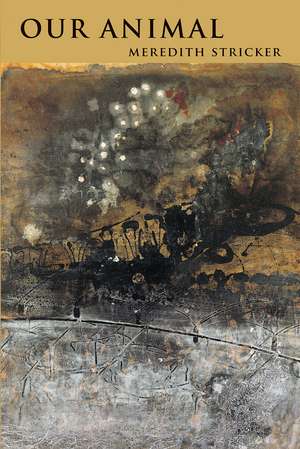
Our Animal
Autor Meredith Strickeren Limba Engleză Paperback – 5 apr 2016
Our Animal hybridizes novel flaking into poetic forms like a gnat swarm, magnetic filings, or migratory flux. It’s a fierce inquiry into Othering, tracking Kafka’s life through his deep identification with animals, especially those hunted or outcast. Graphically complex with metamorphic text layers, the chapters shape-shift in relation to crows, dragonflies, a frog; there are deer, swallows, a goldfinch, humans, a hybrid Beast, wolf, Insekt, a small unidentified animal in its burrow. We are entangled in biography as biology— paradisiacal transfiguration that leaves out no being.
Our Animal is the winner of the 2014 Omnidawn Poetry Open Book Contest, selected by Mary Jo Bang.
Our Animal is the winner of the 2014 Omnidawn Poetry Open Book Contest, selected by Mary Jo Bang.
Preț: 93.87 lei
Preț vechi: 122.30 lei
-23%
Puncte Express: 141
Carte indisponibilă temporar
Doresc să fiu notificat când acest titlu va fi disponibil:
Se trimite...
Specificații
ISBN-13: 9781632430199
ISBN-10: 1632430193
Pagini: 96
Dimensiuni: 152 x 229 x 8 mm
Greutate: 0.14 kg
Ediția:1
Editura: Omnidawn Publishing, Inc.
Colecția Omnidawn
ISBN-10: 1632430193
Pagini: 96
Dimensiuni: 152 x 229 x 8 mm
Greutate: 0.14 kg
Ediția:1
Editura: Omnidawn Publishing, Inc.
Colecția Omnidawn
Notă biografică
Meredith Stricker is the author of six poetry collections, including REWILD, winner of the Tupelo Press Dorset Prize; Our Animal, winner of the Omnidawn Open Book Award; Tenderness Shore, winner of the National Poetry Series Award; and anemochore, winner of the Gloria Anzaldúa Prize and finalist for the Poetry Society of America Four Quartets Award. Her work involves performance, paint, drawing, graphic overlays and hybrid forms of documentary/lyric exploring a sentient world through media ranging from artist books to buildings. As an artist, designer and poet, she co-directs poetics + space, a collaborative that focuses on architecture in Big Sur, along with projects to bring together artists, writers, musicians and experimental forms.
Recenzii
"Our Animal hybridizes novel flaking into poetic forms like a gnat swarm, magnetic filings or migratory flux. It’s a fierce inquiry into Othering, tracking Kafka’s life through his deep identification with animals, especially those hunted or outcast. Graphically complex with metamorphic text layers, the chapters shape-shift in relation to crows, dragonflies, a frog; there are deer, swallows, a goldfinch, humans, a hybrid Beast, wolf, Insekt, a small unidentified animal in its burrow. Drawing on family history in Hungary and Siberia, the phonemes of exile and homeland, the familiar and displaced, Our Animal entangles us in biography as biology—bios writing and re-writing wartime, fragments of history and the nature of translation: interlingual, interspecies—paradisiacal transfiguration that leaves out no being.
The continual back and forth movement of this multi-layered, multi-sourced story of literary kinship over time comes to resemble the pacing of a caged bear. The va-et-vient takes place between Stricker and Kafka, as well as between the two them and us, the readers, animals all. As they pace within the enclosure-like poems, the border between what Kafka wrote and what Stricker is writing dissolves, and as it does, unattributed fragments rise to the surface out of what appears to be the static of the two talking over one another: 'That’s o.k. I show up later anyway' 'a stray dog scuffles behind a dumpster' 'wants earth' 'like a blond wax' 'angel Madonna doll.' There are even flashes here and there of what might be taken for truth. Not the old idea of truth, a polished-to-perfection gem, but a Janus-faced truth that resists the falsity of sound-bite reductive purity and edges closer instead to the convulsive beauty of surrealism. In the chaos of any given moment, on the mirror at the back of the cage we can see ourselves looking first here, then there—'I' 'a' 'wax' 'doll'—as we mime Stricker’s search for some consoling likeness."
The continual back and forth movement of this multi-layered, multi-sourced story of literary kinship over time comes to resemble the pacing of a caged bear. The va-et-vient takes place between Stricker and Kafka, as well as between the two them and us, the readers, animals all. As they pace within the enclosure-like poems, the border between what Kafka wrote and what Stricker is writing dissolves, and as it does, unattributed fragments rise to the surface out of what appears to be the static of the two talking over one another: 'That’s o.k. I show up later anyway' 'a stray dog scuffles behind a dumpster' 'wants earth' 'like a blond wax' 'angel Madonna doll.' There are even flashes here and there of what might be taken for truth. Not the old idea of truth, a polished-to-perfection gem, but a Janus-faced truth that resists the falsity of sound-bite reductive purity and edges closer instead to the convulsive beauty of surrealism. In the chaos of any given moment, on the mirror at the back of the cage we can see ourselves looking first here, then there—'I' 'a' 'wax' 'doll'—as we mime Stricker’s search for some consoling likeness."
"Our Animal haunts the tragic peripheries of World War II, and in doing so touches upon themes central to Jewish culture and literature after the Shoah: G-d, diaspora, trauma, memory, testimony, history, and survival. Though he died between the wars, it makes sense that Kafka (so close tokavka, the Czech for crow) is Stricker’s companion animal through the landscape of 'clotted mud and snow that was wartime,' given his sensibility attuned equally to devastation and transformation, doubt and faith. The brilliance of this book lies in Stricker’s effortless fusion of so many genres—biography, lyric, essay, visual poetry—into a singular idiom while documenting her search for the Soul’s residence after unthinkable disaster. Her ethics is such that the beauty of the writing does not shield us from brutality, instead leading us always 'further into the dark conveyance beyond imagination.'”
"In Our Animal we find ourselves driving at nightfall, radio on, away from Dante’s selva oscura, in the direction of Eden. The poems are the broadcast of every instance and new species passed along the way. Fabulously, among these species, Stricker numbers you and I."
"Meredith Stricker’s chapter-poem is a brilliant mix of lyric, narrative, and epic elements. Sampling, scrambling, overlaying, collaging, and crossing out language from Kafka’s diaries, stories, and aphorisms and Dante’s hell and paradise, Stricker creates a set of meditations in which human, animal, vegetable, and mineral life not only co-exist but converse. What they say in the transition zone the poem creates is spacious and wise, strange but not estranged, and rich in its resonance for our nonhuman moment."