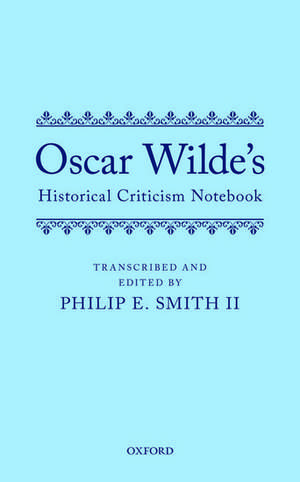
Oscar Wilde's Historical Criticism Notebook
Editat de Philip E. Smith IIen Limba Engleză Hardback – 22 sep 2016
Preț: 823.10 lei
Preț vechi: 1216.13 lei
-32%
Puncte Express: 1235
Carte tipărită la comandă
Livrare economică 10-15 decembrie
Livrare prin curier în România Termenul estimat este afișat lângă disponibilitate.
Transport gratuit pentru acest produs Plată online sau ramburs, în funcție de opțiunile comenzii.
Retur gratuit în 14 zile Comandă securizată și suport în română.
Specificații
ISBN-13: 9780199688012
ISBN-10: 019968801X
Pagini: 290
Dimensiuni: 138 x 222 x 22 mm
Greutate: 0.48 kg
Editura: OUP OXFORD
Colecția OUP Oxford
Locul publicării:Oxford, United Kingdom
ISBN-10: 019968801X
Pagini: 290
Dimensiuni: 138 x 222 x 22 mm
Greutate: 0.48 kg
Editura: OUP OXFORD
Colecția OUP Oxford
Locul publicării:Oxford, United Kingdom
V-ar putea interesa
-
 Still Modernism: Photography, Literature, FilmLouise Hornby-30%Preț: 664.37 lei946.46 lei
 -
 -30%Preț: 946.57 lei1355.37 lei
 -
 The Lights o' London and Other Victorian PlaysEdward Fitzball-19%Preț: 470.97 lei581.45 lei
 -
 DostoevskyJohn Jones-33%Preț: 979.48 lei1456.90 lei
 -
 Hannah More: The First VictorianAnne Stott-28%Preț: 397.06 lei550.29 lei
 -
 -10%Preț: 347.11 lei386.37 lei
 -
 Last Things: Emily Brontë's PoemsJanet Gezari-14%Preț: 290.11 lei337.75 lei
 -
 -18%Preț: 1247.35 lei1521.17 lei
 -
 -18%Preț: 1248.98 lei1523.15 lei
 -
 Preț: 226.18 lei
 -
 Dislocating Race and NationRobert S. LevinePreț: 300.40 lei
 -
 Posting ItCatherine J. GoldenPreț: 220.08 lei
 -
 Dickens and the Broken ScriptureJanet LarsonPreț: 293.01 lei
 -
 Baudelaire's Prose PoemsEdward K KaplanPreț: 206.49 lei
 -
 Dostoevsky: The Author as PsychoanalystGeorge SantayanaPreț: 479.50 lei
 -
 -23%Preț: 734.85 lei954.36 lei
 -
 The Languages of Performance in British RomanticismLilla Maria Crisafulli-23%Preț: 571.10 lei741.68 lei
 -
 National Monuments and Nationalism in 19th Century GermanyHans A. Pohlsander-27%Preț: 645.45 lei884.18 lei
 -
 Wieland-HandbuchJutta Heinz-15%Preț: 803.25 lei945.00 lei
 -
 Passion SpentBent SørensenPreț: 164.46 lei
Recenzii
Such an outstanding example of editing and transcription practice and principles deserves study by any scholar intent on undertaking such a bibliographical and interpretive enterprise. It is to be highly commended for its exemplary attention to detail, its dedicated detective work, its depth of knowledge, and its clear love of the material.
The notebook thus rather surprisingly embeds the "Historical Criticism" essay in the classic mid-Victorian antinomies of faith and rationality ... this large silo of scholarly labour seems here to yield at least one fruitful grain of suggestion ... Wilde burst upon the world as an aesthete ... he was really conducting a dialogue with religion.
First impressions count: this is a beautiful book, in the finest traditions of reference volumes from its press. I had not handled a new volume of this quality in years; it is built to last, and I envisage its handsomely plain binding, heavy paper and sturdy spine gracing the shelves of reference libraries for more than one human lifetime. Its contents merit the bookmaker's pains. ... we have a full and meticulous transcription of a manuscript notebook in which the young Oscar Wilde collected many of the materials he was to use in his important though incomplete early essay 'Historical Criticism'. Smith, an editor of many years' experience and deeply familiar with the Wildean corpus, demonstrates this convincingly in his well judged and concise introduction. ... In sum, Smith has gifted Wildean scholarship with a work of extraordinary quality, and has made available a new primary source along with all the help its potential readers could possibly desire.
Smith's detailed transcription and careful footnoting provide an excellent framework for exploring Wilde's process of critical thought, scholarly research and development of language. There is a fresh perspective here on his raw relationship with the classical historians and philosophers.
The notebook thus rather surprisingly embeds the "Historical Criticism" essay in the classic mid-Victorian antinomies of faith and rationality ... this large silo of scholarly labour seems here to yield at least one fruitful grain of suggestion ... Wilde burst upon the world as an aesthete ... he was really conducting a dialogue with religion.
First impressions count: this is a beautiful book, in the finest traditions of reference volumes from its press. I had not handled a new volume of this quality in years; it is built to last, and I envisage its handsomely plain binding, heavy paper and sturdy spine gracing the shelves of reference libraries for more than one human lifetime. Its contents merit the bookmaker's pains. ... we have a full and meticulous transcription of a manuscript notebook in which the young Oscar Wilde collected many of the materials he was to use in his important though incomplete early essay 'Historical Criticism'. Smith, an editor of many years' experience and deeply familiar with the Wildean corpus, demonstrates this convincingly in his well judged and concise introduction. ... In sum, Smith has gifted Wildean scholarship with a work of extraordinary quality, and has made available a new primary source along with all the help its potential readers could possibly desire.
Smith's detailed transcription and careful footnoting provide an excellent framework for exploring Wilde's process of critical thought, scholarly research and development of language. There is a fresh perspective here on his raw relationship with the classical historians and philosophers.
Notă biografică
Philip E. Smith is Associate Professor Emeritus of English at the University of Pittsburgh, where he taught from 1970-2014. He chaired the department from 1987 to 1995 and won the Chancellor's Distinguished Teaching and Chancellor's Distinguished Service Awards. He received the Association of Departments of English (ADE) Francis Andrew March Award in 1999. With Michael S. Helfand, he co-authored and co-edited Oscar Wilde's Oxford Notebooks: A Portrait of Mind in the Making (Oxford University Press, 1989). He edited Approaches to Teaching the Works of Oscar Wilde (MLA, 2008). He has also written articles and chapters on Wilde, Constance Naden, Robert Heinlein, Ursula Le Guin, Brian Aldiss, August Wilson, John Galsworthy, Charles Olson, and on issues of curriculum, staffing, and teaching in the profession of English studies.
Cuprins
- Acknowledgments
- Introduction
- Historical Criticism Notebook
- Commentary
- Works Consulted
- Appendix
- Index