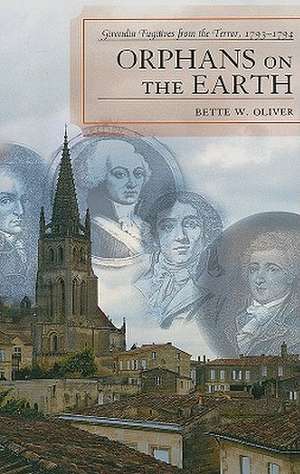
Orphans on the Earth: Girondin Fugitives from the Terror, 1793-94
Autor Bette W. Oliveren Limba Engleză Hardback – 16 iul 2009
Preț: 535.29 lei
Preț vechi: 835.86 lei
-36%
Puncte Express: 803
Preț estimativ în valută:
94.63€ • 110.10$ • 82.32£
94.63€ • 110.10$ • 82.32£
Carte tipărită la comandă
Livrare economică 17 aprilie-01 mai
Specificații
ISBN-13: 9780739127315
ISBN-10: 0739127314
Pagini: 129
Dimensiuni: 163 x 241 x 16 mm
Greutate: 0.39 kg
Editura: Bloomsbury Publishing
Colecția Lexington Books
Locul publicării:New York, United States
ISBN-10: 0739127314
Pagini: 129
Dimensiuni: 163 x 241 x 16 mm
Greutate: 0.39 kg
Editura: Bloomsbury Publishing
Colecția Lexington Books
Locul publicării:New York, United States
Cuprins
Chapter 1 Introduction
Chapter 2 Chapter 1. The Rolands and Their Circle (1791-93)
Chapter 3 Chapter 2. Escape from Paris (Summer 1793)
Chapter 4 Chapter 3. On the Run (Summer 1793)
Chapter 5 Chapter 4. Buzot's Perspective (1791-94)
Chapter 6 Chapter 5. Barbaroux's Account (1791-93)
Chapter 7 Chapter 6. Louvet's Journey (November 1793-April 1974)
Chapter 8 Chapter 7. The Last Days (June-July 1794)
Chapter 9 Conclusion
Chapter 2 Chapter 1. The Rolands and Their Circle (1791-93)
Chapter 3 Chapter 2. Escape from Paris (Summer 1793)
Chapter 4 Chapter 3. On the Run (Summer 1793)
Chapter 5 Chapter 4. Buzot's Perspective (1791-94)
Chapter 6 Chapter 5. Barbaroux's Account (1791-93)
Chapter 7 Chapter 6. Louvet's Journey (November 1793-April 1974)
Chapter 8 Chapter 7. The Last Days (June-July 1794)
Chapter 9 Conclusion
Recenzii
Based largely on the manuscript memoirs and correspondence of François Buzot, Jérôme Pétion, Charles Barbaroux, Jean-Baptiste Louvet, and Madame Roland, Bette Oliver's Orphans on the Earth narrates, from their perspective, the story of these members of the Girondin faction, their expulsion from the Convention, and their flight from Paris. By relating in evocative detail the previously untold account of their harrowing year of pursuit by the Jacobins, this book lays bare the tragic human cost of the French Revolution and allows the reader to experience the daily life of a fugitive during the Terror.
The final chapter of Girondin history deserves to be better known. Oliver's latest book is a solid, sympathetic study of these revolutionary leaders after they lost power. Hers is a very human tale of fascinating people drawn largely from their own words; it is a sad story of devoted men defeated and hunted down by the opponents. This book is a fine assessment of the Girondins in their last days.
The phrase "orphans of the earth" was coined by Francois Buzot, one of twenty-nine Girondin deputies expelled from the National Convention in the summer of 1793 following the successful Jacobin coup and placed under house arrest. Those who chose to remain in the capital were put on trial and would die on the guillotine..Oliver tells it well, movingly at times, and does nothing to hide her sympathy for the fugitives and for those who, like Marie-Therese Bouquey in Saint-Emilion, got caught up in their escape and paid a terrible price for helping them. Petite histoire is may be, a story made for the romantic spirit of the age. But it is not without interest, and it provides a fitting postscript to the political careers of some of the most prominent leaders of the Gironde.
Oliver's prose is highly readable, and her work will have great appeal to the casual reader and nonspecialist scholar..Oliver's work is a welcome contribution to an overlooked aspect of the Terror.
The final chapter of Girondin history deserves to be better known. Oliver's latest book is a solid, sympathetic study of these revolutionary leaders after they lost power. Hers is a very human tale of fascinating people drawn largely from their own words; it is a sad story of devoted men defeated and hunted down by the opponents. This book is a fine assessment of the Girondins in their last days.
The phrase "orphans of the earth" was coined by Francois Buzot, one of twenty-nine Girondin deputies expelled from the National Convention in the summer of 1793 following the successful Jacobin coup and placed under house arrest. Those who chose to remain in the capital were put on trial and would die on the guillotine..Oliver tells it well, movingly at times, and does nothing to hide her sympathy for the fugitives and for those who, like Marie-Therese Bouquey in Saint-Emilion, got caught up in their escape and paid a terrible price for helping them. Petite histoire is may be, a story made for the romantic spirit of the age. But it is not without interest, and it provides a fitting postscript to the political careers of some of the most prominent leaders of the Gironde.
Oliver's prose is highly readable, and her work will have great appeal to the casual reader and nonspecialist scholar..Oliver's work is a welcome contribution to an overlooked aspect of the Terror.