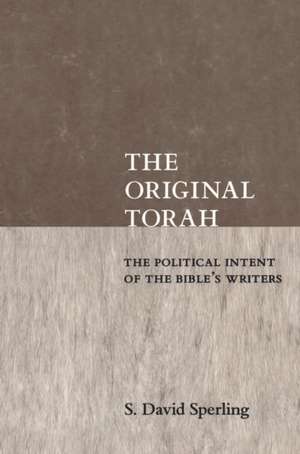
Original Torah
Autor S David Sperlingen Limba Engleză Paperback – feb 2003
Structura lucrării Original Torah este construită pe o metodologie riguroasă de analiză critică, refuzând să accepte textele biblice ca simple cronici istorice. S David Sperling organizează materialul plecând de la o premisă provocatoare: absența dovezilor arheologice pentru evenimentele din Pentateuh nu invalidează textul, ci îi schimbă natura. Autorul utilizează indicatori lingvistici preciși, precum prezența cuvintelor străine sau menționarea unor tehnologii specifice, pentru a ancora cronologic și geografic compoziția fiecărui fragment. Remarcăm modul în care Sperling demonstrează că autorii antici au proiectat agenda politică și religioasă a epocii lor asupra unor figuri ancestrale. De exemplu, acțiunile atribuite lui Avraam sunt interpretate ca precedente deliberate menite să legitimeze deciziile politice ale regelui David. Această perspectivă transformă Tora dintr-un text pur sacru într-un instrument sofisticat de propagandă și guvernare. Stilul este unul academic, dar accesibil, oferind o „cheie de lectură” nouă pentru fundamentul iudaismului și creștinismului. Ca alternativă la The Torah de Michael H. Lubatkin pentru cursurile de studii biblice sau iudaism, lucrarea lui Sperling aduce avantajul unei analize politice mult mai specifice, trecând dincolo de interpretarea pur literară sau morală pentru a explora mecanismele puterii în Israelul antic. Este o lectură esențială pentru cei interesați de intersecția dintre istoriografie, lingvistică și teologie.
Preț: 252.91 lei
Carte tipărită la comandă
Livrare economică 21 noiembrie-05 decembrie
Specificații
ISBN-10: 0814798330
Pagini: 185
Dimensiuni: 151 x 228 x 13 mm
Greutate: 0.26 kg
Editura: NEW YORK UNIVERSITY PRESS
V-ar putea interesa
-
 Heartbreak CityShaun ScottPreț: 169.50 lei
 -
 Spirit Whales and Sloth TalesDavid B. WilliamsPreț: 140.56 lei
 -
 Nice Is Not EnoughC J PascoePreț: 157.48 lei
 -
 How Hip Hop Became Hit PopAmy CoddingtonPreț: 272.38 lei
 -
 After One Hundred WintersMargaret D. JacobsPreț: 115.88 lei
 -
 Full Light and Perfect ShadowDavid F MartinPreț: 195.99 lei
 -
 The Czech Manuscripts – Forgery, Translation, and National MythDavid L. CooperPreț: 495.25 lei
 -
 Preț: 246.84 lei
 -
 Religious Appeals in Power PoliticsPeter S. HennePreț: 211.62 lei
 -
 Textual CacophonyDaniel JohnsonPreț: 120.46 lei
 -
 The House of Hemp and ButterKevin C. O'ConnorPreț: 240.81 lei
 -
 In the Nation's ServicePhilip TaubmanPreț: 130.55 lei
 -
 Students of the CovenantS. David SperlingPreț: 161.17 lei
 -
 Your Yoga BusinessAva TaylorPreț: 286.57 lei
 -
 Adapted Physical Activity Across the Life SpanCarol Leitschuh-23%Preț: 716.18 lei930.11 lei
 -
 The Overload System for StrengthChristian ThibaudeauPreț: 211.84 lei
 -
 Yarn Cake AmigurumiJacki DonhouPreț: 108.24 lei
 -
 Barbara Earl ThomasCarolyn Swan NeedellPreț: 138.58 lei
De ce să citești această carte
Recomandăm această carte cititorilor care doresc să înțeleagă originile reale ale Bibliei dincolo de mitologie. S David Sperling oferă o perspectivă fascinantă asupra modului în care textele sacre au fost modelate de mize politice concrete. Cititorul câștigă o metodă nouă de a decoda alegoriile biblice, înțelegând cum figuri precum Avraam sau Iacov au servit drept modele pentru legitimarea regilor istorici ai Israelului.
Descriere scurtă
Recenzii
Theological Studies "Likely to be the standard work on this subject for years to come, and to contribute to one of the most important debates in the history of the Jewish people, on the very nature of Israel and the Covenant."
James R. Russell, Harvard University "An excellent and provocative read . . . challenges the reader to rethink previously held suppositions concerning biblical texts."
Carl S. Ehrlich, York University