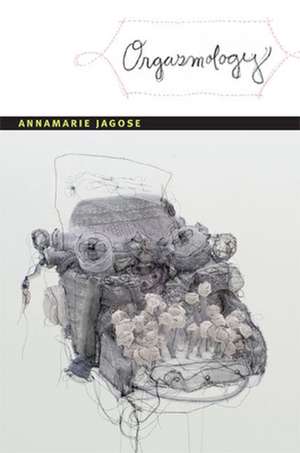
Orgasmology: Next Wave: New Directions in Women's Studies
Autor Annamarie Jagoseen Limba Engleză Hardback – 23 dec 2012
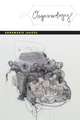
Annamarie Jagose, o figură centrală în studiile LGBT și autoarea unor lucrări fundamentale precum Queer Theory, își propune în noul său volum o analiză curajoasă a unui subiect paradoxal: deși sexualitatea este hiper-prezentă în mediul academic, actul fizic al orgasmului a rămas surprinzător de puțin explorat sub aspect material și psihic. Remarcăm aici o tranziție de la interesul autoarei pentru vizibilitatea lesbiană din Inconsequence – Lesbian Representation and the Logic of Sexual Sequence către o examinare a practicilor erotice concrete care definesc subiectivitatea modernă.
Descoperim în Orgasmology o istorie culturală fascinantă care urmărește „cariera” orgasmului de-a lungul secolului XX. Cine a studiat perspectivele sociologice din Orgasmic Bodies va aprecia aici rigoarea cu care Jagose deconstruiește normele sexuale, aducând în plus o dimensiune critică asupra modului în care știința și cultura populară au modelat așteptările noastre intime. Cartea este organizată tematic, pornind de la obsesia anilor '20 pentru orgasmul simultan ca indicator al „normalității” conjugale, trecând prin practicile controversate de recondiționare comportamentală din deceniile '60-'70 și ajungând la reprezentările vizuale contemporane, de la imagistica medicală la pornografie.
Reținem modul în care autoarea tratează „plăcerile contrafăcute” nu ca pe o simplă decepție, ci ca pe o formă de manifestare a libertății de alegere în spațiul queer. Spre deosebire de abordările pur istorice, Orgasmology ne provoacă să regândim concepte precum etica, intimitatea și modernitatea, demonstrând că, deși credem că știm totul despre acest subiect, orgasmul mai are încă multe să ne învețe despre noi înșine.






Preț: 635.34 lei
Preț vechi: 747.46 lei
-15%
Carte tipărită la comandă
Livrare economică 19 noiembrie-03 decembrie
Specificații
ISBN-10: 0822353776
Pagini: 251
Ilustrații: 10 illustrations
Dimensiuni: 160 x 241 x 23 mm
Greutate: 0.52 kg
Editura: Duke University Press
Seria Next Wave: New Directions in Women's Studies
De ce să citești această carte
Pentru cititorii interesați de sociologie, studii de gen și istoria mentalităților, această carte oferă o perspectivă academică proaspătă asupra intimității. Veți câștiga o înțelegere profundă a modului în care plăcerea a fost reglementată și interpretată politic în ultimul secol. Este o recomandare excelentă pentru cei care doresc să depășească clișeele despre sex și să exploreze mecanismele puterii ascunse în cele mai private momente.
Despre autor
Annamarie Jagose, născută în 1965, este o renumită cercetătoare în domeniul studiilor LGBT și scriitoare de beletristică. Cu o carieră academică solidă, ea s-a impus ca o voce autoritară în teoria queer, publicând lucrări de referință care analizează identitatea sexuală și reprezentarea socială. Printre titlurile sale notabile se numără Queer Theory și The Routledge Queer Studies Reader, volume care au ajutat la definirea acestui domeniu interdisciplinar. În prezent, contribuțiile sale continuă să influențeze direcțiile noi în studiile de gen și teoria feministă contemporană.
Descriere scurtă
Cuprins
Recenzii
"Orgasmology disrupts queer doxa through a renewed emphasis on the materiality of sexual practice. Neither gay nor straight, queer nor normative, male nor female, orgasm shows up everywhere; its lability allows Annamarie Jagose to roam freely across a wide range of critical discourses, scenes, and textual objects. Sentence by sentence, this book is extremely rewardingfunny, finely observed, and smart in all the right places."Heather Love, author of Feeling Backward: Loss and the Politics of Queer History
"Just when they told you queer theory was dead, along comes a book that shows, yet again, what all the excitement wasand still isabout. Annamarie Jagose's patient, systematic demonstration that orgasm is the deconstruction of sex may seem at first to be pretty standard stuff, but the picture it discloses of the rise of twentieth-century sexuality, and of heterosexuality in particular, is so lucid and so surprising that you wonder why we never could see it in such eloquent detail before. You finish this book feeling ten times smarter than when you started it."David M. Halperin, author of How To Be Gay
Altogether, I did learn more about orgasms. As a piece of cultural criticism, it is scholarly and carefully wrought. Jagoses book is mainly a study in representation following her earlier projects. I would have liked this to have been clearer in the books title, because I kept reading hoping to find more sociological material on the orgasm The academic project of queerness has been relentlessly coupled to postmodern indecipherability, excess and non-signification, as a strategy of linguistic freedom. The strength of Jagoses book lies not in the repetition of this romantic position but rather in its careful trace of the human orgasm in social, medical and representational history. Seeing orgasms trace in this way is quite handy. - Sally R. Munt, Times Higher Education, 11th April 2013
"[W]hile thinking too hard about achieving orgasm in the bedroom (...or kitchen...or office...or elsewhere) may foreclose its possibility, Jagose shows the opposite effect occurs in critical inquiry." - Marcie Bianco, Lambda Literary Review "Orgasmology disrupts queer doxa through a renewed emphasis on the materiality of sexual practice. Neither gay nor straight, queer nor normative, male nor female, orgasm shows up everywhere; its lability allows Annamarie Jagose to roam freely across a wide range of critical discourses, scenes, and textual objects. Sentence by sentence, this book is extremely rewarding - funny, finely observed, and smart in all the right places." - Heather Love, author of Feeling Backward: Loss and the Politics of Queer History "Just when they told you queer theory was dead, along comes a book that shows, yet again, what all the excitement was - and still is - about. Annamarie Jagose's patient, systematic demonstration that orgasm is the deconstruction of sex may seem at first to be pretty standard stuff, but the picture it discloses of the rise of twentieth-century sexuality, and of heterosexuality in particular, is so lucid and so surprising that you wonder why we never could see it in such eloquent detail before. You finish this book feeling ten times smarter than when you started it." - David M. Halperin, author of How To Be Gay "Altogether, I did learn more about orgasms. As a piece of cultural criticism, it is scholarly and carefully wrought. Jagose's book is mainly a study in representation following her earlier projects. I would have liked this to have been clearer in the book's title, because I kept reading hoping to find more sociological material on the orgasm... The academic project of queerness has been relentlessly coupled to postmodern indecipherability, excess and non-signification, as a strategy of linguistic freedom. The strength of Jagose's book lies not in the repetition of this romantic position but rather in its careful trace of the human orgasm in social, medical and representational history. 'Seeing' orgasm's trace in this way is quite handy." - Sally R. Munt, Times Higher Education, 11th April 2013