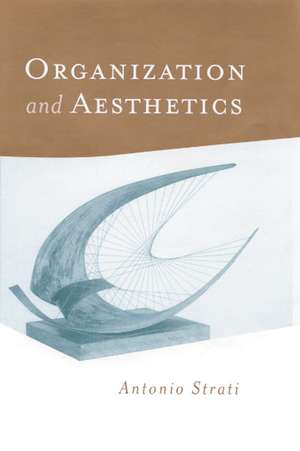
Organization and Aesthetics
Autor Antonio Stratien Limba Engleză Paperback – 1999
The book highlights the role of emotion in organizations, the importance of symbol, the subjective influence of culture and the processes of learning and cognition. These phenomena are related to the aesthetic rather than to purify rational, demanding new modes of inquiry that allow us richer insight into the dynamics of organizational life.
Organization and Aesthetics provides a powerful new lens through which the daily, ever-chaning complexity of organizations can be better understood by students, researchers and mangers.
Preț: 472.54 lei
Preț vechi: 555.93 lei
-15%
Puncte Express: 709
Preț estimativ în valută:
83.56€ • 95.82$ • 72.22£
83.56€ • 95.82$ • 72.22£
Carte tipărită la comandă
Livrare economică 27 aprilie-11 mai
Specificații
ISBN-13: 9780761952398
ISBN-10: 076195239X
Pagini: 228
Dimensiuni: 156 x 234 x 13 mm
Greutate: 0.35 kg
Ediția:1
Editura: SAGE Publications
Locul publicării:London, United Kingdom
ISBN-10: 076195239X
Pagini: 228
Dimensiuni: 156 x 234 x 13 mm
Greutate: 0.35 kg
Ediția:1
Editura: SAGE Publications
Locul publicării:London, United Kingdom
V-ar putea interesa
-
 The Practice of Organizational Diagnosis: Theory and MethodsClayton Alderfer-21%Preț: 526.68 lei668.13 lei
 -
 Working Life: Renewing Labour Process AnalysisPaul Thompson-11%Preț: 419.40 lei471.24 lei
 -
 Where in the World Is My Team?Terence BrakePreț: 232.77 lei
 -
 Making Sense of the Organization, Volume 2Karl E. WeickPreț: 309.88 lei
 -
 Understanding Organizational CultureMats Alvesson-8%Preț: 422.45 lei459.18 lei
 -
 Political Behavior in OrganizationsAndrew J. DuBrin-44%Preț: 476.10 lei849.75 lei
 -
 Organizational Culture in Action: A Cultural Analysis WorkbookGerald W. Driskill-18%Preț: 972.27 lei1185.69 lei
 -
 Key Concepts in Organization TheoryAnn L. CunliffePreț: 368.72 lei
 -
 Understanding Gender and OrganizationsMats Alvesson-15%Preț: 496.08 lei583.63 lei
 -
 Organizing & OrganizationsStephen Fineman-23%Preț: 542.29 lei704.27 lei
 -
 Understanding Identity and OrganizationsAndrea WhittlePreț: 425.92 lei
 -
 Key Concepts in Critical Management StudiesMark TadajewskiPreț: 343.56 lei
Cuprins
Organizational Aesthetics, Experience and Plausibility
Aesthetic Knowledge of Organizational Action
The Elusiveness of Organizational Aesthetics
The Beautiful in Organizational Life
Artefacts, Form and Aesthetic Categories
Conclusions
Aesthetic Knowledge of Organizational Action
The Elusiveness of Organizational Aesthetics
The Beautiful in Organizational Life
Artefacts, Form and Aesthetic Categories
Conclusions
Descriere
This book shows how aesthetic understanding of organizations can extend our knowledge and sharpen our insights into many processes that shape organizational action. Organizational life is pervaded by aesthetics, yet conventional organizational analysis has been dominated by a `scientific', logico-rational tradition that ignores the aesthetic dimension.
The book highlights the role of emotion in organizations, the importance of symbol, the subjective influence of culture and the processes of learning and cognition. These phenomena are related to the aesthetic rather than to purify rational, demanding new modes of inquiry that allow us richer insight into the dynamics of organizational life.
The book highlights the role of emotion in organizations, the importance of symbol, the subjective influence of culture and the processes of learning and cognition. These phenomena are related to the aesthetic rather than to purify rational, demanding new modes of inquiry that allow us richer insight into the dynamics of organizational life.