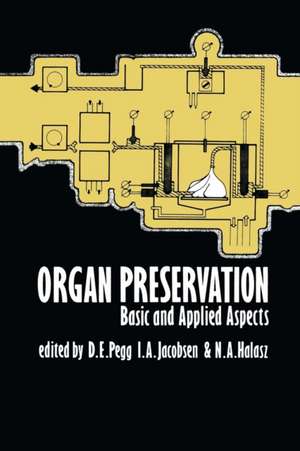
Organ Preservation
Editat de D. R. Peggen Limba Engleză Paperback – 17 feb 2012
Preț: 366.54 lei
Preț vechi: 385.84 lei
-5%
Puncte Express: 550
Carte tipărită la comandă
Livrare economică 08-22 decembrie
Livrare prin curier în România Termenul estimat este afișat lângă disponibilitate.
Transport gratuit de la 400.00 lei Plată online sau ramburs, în funcție de opțiunile comenzii.
Retur gratuit în 14 zile Comandă securizată și suport în română.
Specificații
ISBN-13: 9789401162692
ISBN-10: 9401162697
Pagini: 456
Ilustrații: XXI, 433 p.
Dimensiuni: 155 x 235 x 25 mm
Greutate: 0.69 kg
Ediția:Softcover reprint of the original 1st ed. 1982
Editura: Springer
Locul publicării:Dordrecht, Netherlands
ISBN-10: 9401162697
Pagini: 456
Ilustrații: XXI, 433 p.
Dimensiuni: 155 x 235 x 25 mm
Greutate: 0.69 kg
Ediția:Softcover reprint of the original 1st ed. 1982
Editura: Springer
Locul publicării:Dordrecht, Netherlands
V-ar putea interesa
-
 -5%Preț: 762.69 lei802.83 lei
 -
 MCQs in Applied Basic SciencesK. Mokbel-5%Preț: 346.58 lei364.81 lei
 -
 -5%Preț: 392.62 lei413.29 lei
 -
 Endoscopic Surgery of the Potential Anatomical SpacesAttilio Maria Farinon-5%Preț: 744.00 lei783.16 lei
 -
 SurgeryHarold Ellis-5%Preț: 362.06 lei381.12 lei
 -
 Surgical Management of Congestive Heart FailureJames C Fang-5%Preț: 1472.08 lei1549.56 lei
 -
 Thyroidectomy: with Harmonic FOCUS®Ann-Katrin Güler-5%Preț: 350.89 lei369.36 lei
 -
 Tonsillectomy with Harmonic TechnologyHoward K. Herman-5%Preț: 318.57 lei335.33 lei
 -
 Laparoscopic Gastric BandingKarl Miller-5%Preț: 259.10 lei272.73 lei
 -
 TransplantationschirurgieR. Pichlmayr-5%Preț: 802.46 lei844.70 lei
 -
 Management of Thyroid CancerK. Alok Pathak-5%Preț: 387.18 lei407.56 lei
 -
 Pelvic Floor Disorders: Surgical ApproachAchille Lucio Gaspari-5%Preț: 1075.33 lei1131.93 lei
 -
 Multimodal Treatment of Recurrent Pelvic Colorectal CancerGiovanni Maria Romano-5%Preț: 743.00 lei782.11 lei
 -
 -5%Preț: 1169.54 lei1231.10 lei
 -
 Atlas of Digestive Endoscopic ResectionPinghong Zhou-5%Preț: 760.52 lei800.54 lei
 -
 Current Concepts in Parenteral NutritionJ. M. Greep-5%Preț: 361.45 lei380.47 lei
 -
 A history of surgeryD. De Moulin-5%Preț: 728.24 lei766.57 lei
 -
 -5%Preț: 361.94 lei380.99 lei
 -
 Tutorial TherapyD. Bovill-5%Preț: 351.07 lei369.55 lei
Public țintă
ResearchCuprins
I. Basic Reviews.- 1 Energetics and mitochondria.- 2 Membrane functions.- 3 Biological significance and therapeutic potential of prostacyclin.- 4 A free radical approach to tissue injury.- 5 Endothelial cell function and organ preservation ex vivo.- 6 The principles of organ storage procedures.- II. Effects of Ischaemia and Anoxia.- 7 Recovery of renal function in the rat after warm ischaemia: functional and morphological changes..- 8 The dynamics of regional blood flow after ischaemic trauma of the rat kidney.- 9 Renal function impairment in swelling with and without anoxia.- 10 Prostacyclin and the ischaemic kidney.- 11 Kidney blood flow and microcirculatory changes after autologous kidney transplantation.- III. Biochemical and Pharmacological Aspects of Hypothermia.- 12 Future prospects in organ preservation.- 13 Tissue pH changes in renal preservation.- 14 Study of human kidneys prior to transplantation by phosphorus nuclear magnetic resonance.- 15 Effects of hypothermia on anabolic and catabolic processes and on oxygen consumption in perfused rat livers.- 16 Mechanism of loss of mitochondrial functions during hypothermic storage of kidneys.- 17 Depletion of CoA in dog kidneys during hypothermic perfusion.- 18 Renal viability testing during preservation by metabolic parameters.- 19 Hibernatory animals as a model for hypothermic organ preservation.- 20 Pharmacological factors in organ preservation.- 21 Effect of chlorpromazine on the contractile function and metabolic status of continuously perfused and ischaemic hearts.- IV. Preservation by Initial Perfusion and Hypothermia.- 22 Flush preservation.- 23 The effect of cooling rate in flush preservation of rabbit kidneys.- 24 Washout of red blood cells from kidneys damaged by warm ischaemia.- 25 Comparative evaluationof a new low ionic strength, hyperkalaemic flush solution.- 26 Hypothermic preservation of the rat pancreas.- 27 Deuterium oxide (D2O) for organ preservation.- 28 Retrograde oxygen persufflation - a technique for preservation of ischaemically damaged organs.- V. Preservation by Continuous Perfusion.- 29 Kidney preservation by continuous perfusion.- 30 Continuous perfusion and transplantation of rat kidneys.- 31 Cold storage and machine preservation of kidney: studies with the isolated rat kidney.- 32 Light microscopy findings in intermediate term kidney preservation.- 33 Five-day preservation of canine kidneys using a preservation machine.- 34 Lysosomal enzyme release during successful 5-, 7- and 8-day canine kidney storage.- 35 Aerobic and anaerobic perfusion of canine kidneys with a new perfusate.- 36 The use of oncotic support agents in perfusion preservation.- 37 Intermediate ex-vivo and in-vivo perfusion to prolong hypothermic kidney preservation up to 6 days.- 38 Is normothermic preservation an alternative to hypothermic preservation?.- 39 Measurement of tissue P02 during kidney perfusion with Fluosol®-43.- 40 Liver preservation in the rat.- 41 The effect of donor pretreatment on tubular function of the preserved canine allograft.- 42 Xenobanking.- VI. Preservation of Cadaver Kidneys.- 43 Factors influencing primary function in kidney transplants from brain-dead donors.- 44 Can immediate function of a cadaver renal transplant be predicted?.- 45 Factors of consequence for graft survival: a statistical analysis.- 46 Early and long-term function of cadaveric kidneys preserved by ice storage after flushing with Collins’ solution.- 47 The effect of dopamine administered to kidney graft recipients.- VII. General Discussion.- 48 Pretreatment.- 49 Initial perfusion.-50 Hypothermic preservation.- 51 Experimental models.- VIII. Cryopreservation.- 52 Perfusion of canine kidneys with dimethyl sulphoxide; techniques and toxicity.- 53 Prevention of toxicity from high concentrations of cryo-protective agents.- 54 Kidney preservation with Me2SO- and sucrose-containing solutions.- 55 Investigation into subzero non-freezing storage of rabbit kidney.- 56 Survival of hepatocytes upon thawing from - 196°C: functional assessment after transplantation.- 57 The effect of cryoprotectant concentration on freezing damage in kidney slices.- 58 The mechanism of cryoinjury in glycerol-treated rabbit kidneys.- 59 Rabbit kidney function in vitro following cooling to -20°C with glycerol or dimethyl sulphoxide.- 60 Prospects for organ preservation by vitrification.- 61 General discussion of cryopreservation.