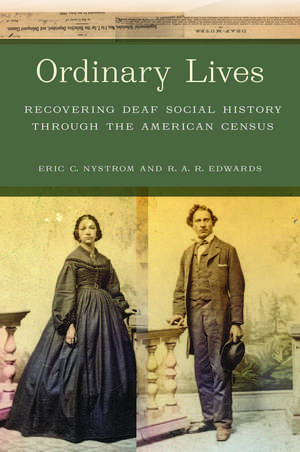
Ordinary Lives
Autor Eric C Nystrom, R A R Edwardsen Limba Engleză Paperback – 29 feb 2024
Employing the methods of social history, such as the use of digital history techniques and often-ignored sources like census records, Eric C. Nystrom and R. A. R. Edwards recover the lived experiences of everyday deaf people in late nineteenth century America. Ordinary Lives captures the stories of deaf women and men, both Black and white, describing their family lives, networks of support, educational experiences, and successes and hardships. In this pioneering “deaf social history,” Edwards and Nystrom reconstruct the biographies of a wider range of deaf individuals to tell a richer, more nuanced, and more inclusive history of the larger American deaf community.
Preț: 241.31 lei
Puncte Express: 362
Preț estimativ în valută:
42.72€ • 49.75$ • 37.11£
42.72€ • 49.75$ • 37.11£
Carte disponibilă
Livrare economică 03-17 februarie
Livrare express 17-23 ianuarie pentru 29.90 lei
Preluare comenzi: 021 569.72.76
Specificații
ISBN-13: 9781625347633
ISBN-10: 1625347634
Pagini: 272
Ilustrații: 11 illus., 1 chart, 13 tables
Dimensiuni: 150 x 218 x 23 mm
Greutate: 0.48 kg
Editura: University of Massachusetts Press
ISBN-10: 1625347634
Pagini: 272
Ilustrații: 11 illus., 1 chart, 13 tables
Dimensiuni: 150 x 218 x 23 mm
Greutate: 0.48 kg
Editura: University of Massachusetts Press
Notă biografică
ERIC C. NYSTROM is associate professor of history at Arizona State University.
R. A. R. EDWARDS is professor of history at Rochester Institute of Technology and author of Words Made Flesh: Nineteenth-Century Deaf Education and the Growth of Deaf Culture.
R. A. R. EDWARDS is professor of history at Rochester Institute of Technology and author of Words Made Flesh: Nineteenth-Century Deaf Education and the Growth of Deaf Culture.
Cuprins
List of Illustrations
Acknowledgments Introduction
1. Deaf History, Cultural History, and Social History
2. Deafness and the Census
3. Population
4. Lydia Macomber’s Network
5. Becoming a National Community
6. Race
7. Geography
8. The Deaf Vineyard in 1880
9. Institutions and Work
10. Joseph DeHart
Conclusion and Future Directions
Appendix: Queries
Notes
Index of Names
Index
Acknowledgments Introduction
1. Deaf History, Cultural History, and Social History
2. Deafness and the Census
3. Population
4. Lydia Macomber’s Network
5. Becoming a National Community
6. Race
7. Geography
8. The Deaf Vineyard in 1880
9. Institutions and Work
10. Joseph DeHart
Conclusion and Future Directions
Appendix: Queries
Notes
Index of Names
Index
Recenzii
“These data trends launch fascinating questions about deaf history for scholars to interrogate more deeply at the local, regional, and national scales. . . This work is particularly useful to graduate students or scholars exploring the potentials of digital humanities. Those in Disability Studies and Deaf Studies may likewise find the book’s claims about national and regional trends compelling.”—Nicole Lee Schroeder, American Historical Review
“This is a fascinating book, both in the stories it tells and the future publications by other researchers that it should inspire. The authors are to be commended for their achievement.”—Martin Atherton, H-Disability
“Ordinary Lives makes important contributions to deaf history, and it will encourage new areas of research across multiple disciplines.”—Octavian Robinson, associate professor of deaf studies at Gallaudet University
“Nystrom and Edwards are the first scholars to explicitly widen the historiographical practices of deaf history to include social history.”—H-Dirksen L. Bauman, coeditor of Deaf Gain: Raising the Stakes for Human Diversity
“This is a fascinating book, both in the stories it tells and the future publications by other researchers that it should inspire. The authors are to be commended for their achievement.”—Martin Atherton, H-Disability
“Ordinary Lives makes important contributions to deaf history, and it will encourage new areas of research across multiple disciplines.”—Octavian Robinson, associate professor of deaf studies at Gallaudet University
“Nystrom and Edwards are the first scholars to explicitly widen the historiographical practices of deaf history to include social history.”—H-Dirksen L. Bauman, coeditor of Deaf Gain: Raising the Stakes for Human Diversity