Cantitate/Preț
Produs

Orchestras: A Model for Social and Organizational Development

Autor Ralph J. Bathurst, David F Gilling, Sasha J. Rasmussen
en Limba Engleză Hardback – 5 noi 2019
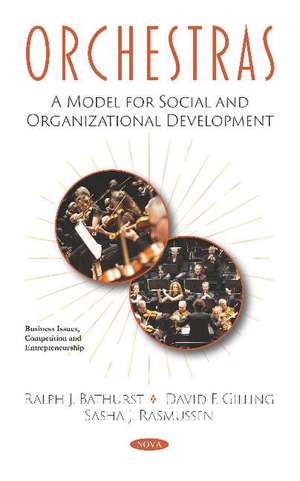
The symphony orchestra as an organizational form models how 21st century societies and business enterprises could operate. The onset of the digital age, sometimes called the fourth industrial revolution, has brought with it unprecedented challenges to organizing and leading. With so few exemplars available to show us the way, we have been all too ready to embrace digitization in our communication strategies, structural arrangements and educational processes without thinking through and resolving the deleterious effects that these technologies have on human beings, both at work and play. The rise of social media sites, which keep people connected across geographical and temporal boundaries, have paradoxically created isolated and lonely human beings. In some cases, lone actors have taken out their personal angst on others through the murderous use of military-style weapons, live-streaming their terror to their globalized audiences. In the face of this seemingly unstoppable tide of growing discarnate communities and workplaces, the symphony orchestra asks to pause and explore embodied ways of operating. This book demonstrates that people can form vibrant communities by learning how an orchestra performs. We discuss the engine room of the orchestra: the string musicians' keen sense of timing and being together with each other and the rest of the ensemble. Equally, the woodwind players help us understand tuning and how to work with variable intervals in order to achieve consistent intonation across the cohort. Orchestral musicians listen intently to each other, and the conductor plays an important role in achieving cohesion. This relationship between the conductor and the musicians demonstrates ways of leading that attend to the dynamic environment, which characterizes orchestral music-making. The symphony orchestra presents a model for social and organizational development that goes beyond standardization and its resulting approximation, which in music terms is called 'equal temperament'. Organizations can achieve the much-promised excellence and efficiency when all staff understand the non-standard variations in music intervals that characterize orchestral performance. The orchestra models the relational elements that underpin organizing: ways of reconfiguring society beyond the political and social divides that trouble communities across the globe.
Citește tot Restrânge

Preț: 89825 lei

Preț vechi: 120889 lei
-26%

Puncte Express: 1347

Cartea se retipărește

Doresc să fiu notificat când acest titlu va fi disponibil:

Specificații

ISBN-13: 9781536163452
ISBN-10: 1536163457
Pagini: 220
Dimensiuni: 152 x 229 x 19 mm
Greutate: 0.44 kg
Editura: Nova Science Publishers Inc
Colecția Nova Science Publishers Inc
Locul publicării:United States

Cuprins

  • Preface
    • Foreword
    • Introduction
    • These Revolutionary Times
    • A Brief History of the Orchestra
    • Strings: The Engine Room
    • Woodwind: Getting in Tune
    • Conductors: Silent Leadership
    • Conductor Carlos Kleiber and the Concertgebouw Orchestra
    • Orchestrating Organizations
    • The Orchestra in a Traumatized City: The CSO 105
    • Orchestras Global and Local: West-Eastern Divan, and Orpheus
    • Finding Dionysus
    • References.
  •