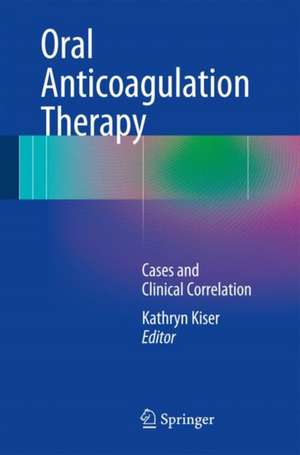
Oral Anticoagulation Therapy: Cases and Clinical Correlation
Editat de Kathryn Kiseren Limba Engleză Paperback – 23 iun 2017
Observăm că volumul Oral Anticoagulation Therapy, editat de Kathryn Kiser, adoptă un format practic de tip „paperback”, fiind organizat riguros pe secțiuni ce prioritizează aplicabilitatea clinică imediată. Structura nu este una didactică liniară, ci se bazează pe o serie de cazuri clinice care ghidează cititorul prin puncte cheie de decizie, facilitând accesul la informații complexe despre anticoagulantele orale directe (DOAC) fără a suprasolicita profesionistul. Ne-a atras atenția faptul că fiecare prezentare de caz include întrebări esențiale și discuții fundamentate pe dovezi, oferind o corelație directă între teorie și practica medicală.
Cartea este structurată în patru părți principale, începând cu riscul de stratificare în fibrilația atrială (scorurile CHA2DS2VASc și HAS-BLED) și progresând spre managementul complex al pacienților cu comorbidități severe. Cuprinsul indică o acoperire exhaustivă a nișelor critice: de la pacienți vârstnici sau cu disfuncții renale variabile, până la cei cu stenoze valvulare sau necesități de trecere de la terapia cu warfarină. Acolo unde Novel Insights on Oral Anticoagulants in Clinical Practice de Jagdish Hiremath oferă o privire de ansamblu asupra istoricului și dezvoltării farmacologice, acest volum aprofundează managementul decizional în situații de urgență sau complicații hemoragice. În comparație cu Anticoagulation Management de Anne Rose, care se concentrează pe rolul farmacistului în diverse setări de îngrijire, lucrarea de față este orientată clinic spre cardiolog, oferind scenarii specifice pentru selecția agentului optim în funcție de profilul individual al pacientului.
Preț: 912.39 lei
Preț vechi: 960.41 lei
-5%
Carte tipărită la comandă
Livrare economică 19-25 noiembrie
Specificații
ISBN-10: 3319546414
Pagini: 313
Ilustrații: X, 313 p. 6 illus., 2 illus. in color.
Dimensiuni: 155 x 235 x 18 mm
Greutate: 0.54 kg
Ediția:1st ed. 2017
Editura: Springer International Publishing
Colecția Springer
Locul publicării:Cham, Switzerland
V-ar putea interesa
-
 The Expert Guide to Beating Heart DiseaseHarlan M Krumholz-5%Preț: 107.93 lei113.61 lei
 -
 -5%Preț: 621.12 lei653.81 lei
 -
 -5%Preț: 1767.99 lei1861.04 lei
 -
 Biotechnology in Personal CareRaj Lad-18%Preț: 1642.33 lei2002.84 lei
 -
 Atrial FibrillationPeter Kowey-5%Preț: 1116.72 lei1175.49 lei
 -
 Cardiovascular Outcomes: Collaborative, Path-Based ApproachesSuzanne Blancett-5%Preț: 686.88 lei723.03 lei
 -
 Hypertension ManagementAspen Health & Administration Developmen-5%Preț: 716.57 lei754.29 lei
 -
 Coronary Artery Disease & Related Conditions MgmtHealth and Administration Development Gr-5%Preț: 723.17 lei761.23 lei
 -
 Treatment of Advanced Heart DiseaseKenneth L. Baughman-5%Preț: 2737.97 lei2882.07 lei
 -
 Atlas of Vascular DiseaseMark Creager-5%Preț: 1465.27 lei1542.39 lei
 -
 The H Factor SolutionJames BralyPreț: 182.74 lei
 -
 Molecular Mechanisms of Cardiac Hypertrophy and FailureRichard A. Walsh-18%Preț: 4947.60 lei6033.66 lei
 -
 Erectile Dysfunction in Hypertension and Cardiovascular DiseaseMargus Viigimaa-5%Preț: 369.33 lei388.77 lei
 -
 -5%Preț: 373.61 lei393.27 lei
 -
 -5%Preț: 378.39 lei398.30 lei
 -
 -5%Preț: 390.65 lei411.21 lei
 -
 Der Sekundenherztod mit besonderer Berücksichtigung des HerzkammerflimmernsHeinrich Ewald Hering-5%Preț: 375.21 lei394.96 lei
 -
 -5%Preț: 375.90 lei395.68 lei
 -
 -5%Preț: 379.76 lei399.76 lei
 -
 Klinische HerzdiagnostikPierre Schrumpf-Pierron-5%Preț: 378.19 lei398.09 lei
De ce să citești această carte
Suntem de părere că această lucrare este esențială pentru cardiologi și rezidenți deoarece transformă ghidurile teoretice în soluții practice. Cititorul câștigă abilitatea de a naviga rapid prin scenarii de risc, precum interacțiunile medicamentoase neinvestigate sau ajustarea dozelor în insuficiența renală. Este un instrument clinic precis care elimină ambiguitatea în selectarea anticoagulantului potrivit pentru pacienții cu profil complex.
Despre autor
Kathryn Kiser, editorul acestui volum publicat de Springer, este un specialist recunoscut în domeniul farmacoterapiei cardiovasculare. Expertiza sa se reflectă în selecția riguroasă a cazurilor clinice care compun lucrarea, punând accent pe siguranța pacientului și pe optimizarea rezultatelor terapeutice în utilizarea anticoagulantelor de nouă generație. Activitatea sa editorială vizează traducerea datelor clinice complexe în protocoale de lucru accesibile și eficiente pentru practicienii din cardiologie și medicină internă.
Cuprins
Table of Contents Part I Introduction
1
Part II Atrial Fibrillation
2: CHA2DS2VASc and HAS-BLED risk stratification tools
3: Male with priority of ischemic stroke reduction
4: Choosing an anticoagulant in an elderly patient
5: Patient with prior history of gastrointestinal hemorrhage
6: Patients with a history of intracranial hemorrhage
7: Concerns with anticoagulant adherence
8: Oral Anticoagulants in stable moderate Chronic Kidney Disease
9: Oral Anticoagulants in severe renal dysfunction
10: Oral Anticoagulants in patients with variable renal function
11: Patient with concomitant stable Coronary Artery Disease
12: Patient with concomitant acute venous thromboembolism
13: Patient with concomitant Mitral Valve Stenosis
14: Patient with concomitant Aortic Valve Stenosis
Part III Warfarin management
15: Best practices for switching from stable warfarin
16: Patient-centered strategies for improving warfarin management
Part IV Venous Thromboembolism (VTE)
17: Provoked versus unprovoked VTE
18: VTE prophylaxis in hip and knee replacement surgery
19: VTE prophylaxis in the intensive care unit
20: VTE and recent drug eluting stent placement
21: Acute VTE in a patient with moderate chronic kidney disease
22: Oral anticoagulation and duration in recurrent VTE
23: Pulmonary embolism (PE) with thrombolytic therapy
Part V Acute Coronary Syndrome (ACS)
24: Patient on oral anticoagulant presenting with ACS
25: Oral anticoagulant therapy post-percutaneous coronary intervention
26: ST-segment elevation myocardial infarction (lytic candidate) on oral anticoagulant
27: ACS with bypass surgery
Part VI Drug Interactions
28: Anticoagulant drug-drug interactions with CYP 3A4 inhibitors
29: Significance of P-glycoprotein (P-gp) drug-drug interactions
30: Considerations with pharmacodynamics drug-drug interactions
31: Management of direct oral anticoagulants with mixed P-gp/3A4 drug-drug interactions
32: Pharmacokinetic drug-drug interactions with warfarin
Part VII Special Populations
33: Chronic Pain Management with anticoagulation
34: Anticoagulation management in atrial fibrillation catheter ablation
35: Anticoagulation management considerations for mechanical valves
36: Management of antiphospholipid antibody syndrome (APS)
37: VTE and Pregnancy
38: VTE in active Malignancy
39: Anticoagulation management in patients undergoing gastric bypass procedures
40: Patient presenting with minor bleeding
41: Patient presenting with major, life-threatening bleeding
42: Overdose of dabigatran
Recenzii
Notă biografică
Katie Kiser, Pharm.D., BCACP received her Bachelor of Science in Biology from King University in Bristol, Tennessee and her Doctor of Pharmacy from the University of North Carolina School of Pharmacy in Chapel Hill, North Carolina. She completed her postgraduate year-one residency with emphasis in ambulatory care at Moses Cone Health System in Greensboro, North Carolina and her postgraduate year-tworesidency in ambulatory care at the University of North Carolina Hospitals in Chapel Hill, North Carolina. Dr. Kiser is faculty at South College School of Pharmacy in Knoxville, Tennessee and previously taught at the University of Maryland School of Pharmacy in Baltimore, Maryland.
Dr. Kiser has over 10 years of clinical and teaching experience in anticoagulation management and is a Board of Pharmaceutical Specialties certified Ambulatory Care Pharmacist. Dr. Kiser has practiced primarily in the outpatient clinical setting and served as the Director of the UHC Antithrombosis Clinic in Baltimore, Maryland from 2010 – 2014. Her current clinical practice is at NHC HealthCare in Farragut, Tennessee where she serves as a consultant pharmacist and specializes in oral anticoagulant management in a diverse rehabilitation and long term care population.
Dr. Kiser is an Associate Editor and co-founder of iForumRx.org which is an interactive web-based community designed to inform ambulatory care clinicians about high-quality, practice-changing evidence. Dr. Kiser is highly involved with the American College of Clinical Pharmacy and has served in local and national leadership positions She has written chapters in a leading pharmacy textbook and has participated in clinical research and written many peer-reviewed articles on anticoagulation, health literacy, the scholarship of teaching, and other topics.
Textul de pe ultima copertă
This case-based title reviews anticoagulation management strategies available for a wide variety of clinical scenarios. Designed to aid providers of direct patient care on complex clinical decisions regarding appropriate evidence-based therapy options, patient and agent related variables to consider, as well as expert opinion on the topic.
Oral Anticoagulation Therapy: Cases and Clinical Correlation will provide clinicians and trainees with clear clinical cases, commentary, and resources to develop their knowledge base, problem-solving skills, and ability to practically apply new knowledge to a variety of clinical situations. Resources provided in cases include valuable figures, tables, and key points designed for the reader to be able to utilize at the point of care.
Caracteristici
Descriere
Given the amount and complexity of information surrounding the the target specific oral anticoagulants a lengthy didactic educational format has the potential to be overwhelming to the reader and difficult to translate and apply to direct patient care. The proposed book will educate clinicians utilizing a series of clinical cases to simultaneously develop the readers’ knowledge base, problem-solving skills, and practically apply their new knowledge to a variety of clinical situations. These will be short focused case presentations that provide critical information and pose questions to the reader at key points in the decision making process. The cases will be relevant to what clinicians will encounter not only on a daily basis, but also reflective of scenarios that clinicians will not encounter regularly, but that they will have to act upon (e.g. a bleeding patient, patient scheduled for elective or emergent procedure, patient with changing renal function, patient on drugs that have a plausible yet unstudied drug interaction with a target specific oral anticoagulant etc). Included in the case studies will be evidence-based discussions (with appropriate references) that provide immediate feedback on the different treatment alternatives that were offered. The case studies will be designed to instruct the reader how to select and effectively utilize the most appropriate agent for a given clinical scenario. They will focus on key features of the target specific oral anticoagulants, what they have in common, how they are unique from each other, as well as illustrating the clinical decision process one should take when selecting an agent or managing a patient already receiving one of the target specific oral agents.