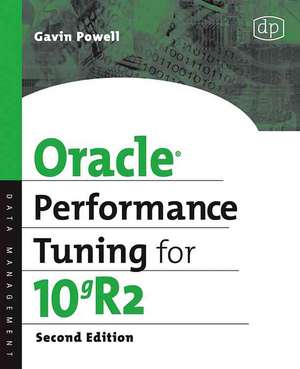
Oracle Performance Tuning for 10gR2
Autor Gavin Jt Powellen Limba Engleză Paperback – sep 2006
Gavin Powell shows that the central theme of Oracle10gR2 Performance Tuning is four-fold: denormalize data models to fit applications; tune SQL code according to both the data model and the application in relation to scalability; create a well-proportioned physical architecture at the time of initial Oracle installation; and most important, mix skill sets to obtain the best results.
* Fully updated for version 10gR2 and provides all necessary transition material from version 9i
* Includes all three aspects of Oracle database tuning: data model tuning, SQL & PL/SQL code tuning, physical plus configuration tuning
* Contains experienced guidance and real-world examples using large datasets Emphasizes development as opposed to operating system perspective
Preț: 593.16 lei
Preț vechi: 741.46 lei
-20%
Puncte Express: 890
Carte disponibilă
Livrare economică 07-21 noiembrie
Livrare prin curier în România Termenul estimat este afișat lângă disponibilitate.
Transport gratuit pentru acest produs Plată online sau ramburs, în funcție de opțiunile comenzii.
Retur gratuit în 14 zile Comandă securizată și suport în română.
Specificații
ISBN-13: 9781555583453
ISBN-10: 1555583458
Pagini: 960
Dimensiuni: 192 x 234 x 37 mm
Greutate: 1.61 kg
Ediția:2nd edition
Editura: ELSEVIER SCIENCE
ISBN-10: 1555583458
Pagini: 960
Dimensiuni: 192 x 234 x 37 mm
Greutate: 1.61 kg
Ediția:2nd edition
Editura: ELSEVIER SCIENCE
Public țintă
Developers, Database Administrators, Consultants and Corporate professionalsCuprins
Preface
Introduction
Part I. Data Model Tuning
Chapter 1. The Relational Database Model
Chapter 2. Tuning the Relational Database Model
Chapter 3. Different Forms of the Relational Database Model
Chapter 4. A Brief History of Data Modeling
Part II. SQL Code Tuning
Chapter 5. What is SQL?
Chapter 6. Basic Concepts of Efficient SQL
Chapter 7. Advanced Concepts of Efficient SQL
Chapter 8. Common Sense Indexing
Chapter 9. Oracle SQL Optimization and Statistics
Chapter 10. How Oracle SQL Optimization Works
Chapter 11. Overriding Optimizer Behavior Using Hints
Chapter 12. How to Find Problem Queries
Chapter 13. Automated SQL Tuning
Part III. Physical and Configuration Tuning
Chapter 14. Installing Oracle and Creating a Database
Chapter 15. Tuning Oracle Database File Structures
Chapter 16. Object Tuning
Chapter 17. Low Level Physical Tuning
Chapter 18. Hardware Resource Usage Tuning
Chapter 19. Tuning Network Usage
Chapter 20. Oracle Partitioning and Parallelism
Chapter 21. Ratios: Possible Symptoms of Problems
Chapter 22. Wait Events
Chapter 23. Latches
Chapter 24. Tools and Utilities
Part IV. Tuning Everything at Once
Chapter 25. The Wait Event Interface
Chapter 26. The Database Control
Chapter 27. Tuning With STATSPACK
Appendices
Appendix A. Sample Databases
Appendix B. Sample Scripts (script changes)
Appendix C. Sources of Information (accreditations)Appendix D. SQL Tuning in Oracle Enterprise Manager
(might delete this one, depending on how much I remove from part III, which is 9i)
Introduction
Part I. Data Model Tuning
Chapter 1. The Relational Database Model
Chapter 2. Tuning the Relational Database Model
Chapter 3. Different Forms of the Relational Database Model
Chapter 4. A Brief History of Data Modeling
Part II. SQL Code Tuning
Chapter 5. What is SQL?
Chapter 6. Basic Concepts of Efficient SQL
Chapter 7. Advanced Concepts of Efficient SQL
Chapter 8. Common Sense Indexing
Chapter 9. Oracle SQL Optimization and Statistics
Chapter 10. How Oracle SQL Optimization Works
Chapter 11. Overriding Optimizer Behavior Using Hints
Chapter 12. How to Find Problem Queries
Chapter 13. Automated SQL Tuning
Part III. Physical and Configuration Tuning
Chapter 14. Installing Oracle and Creating a Database
Chapter 15. Tuning Oracle Database File Structures
Chapter 16. Object Tuning
Chapter 17. Low Level Physical Tuning
Chapter 18. Hardware Resource Usage Tuning
Chapter 19. Tuning Network Usage
Chapter 20. Oracle Partitioning and Parallelism
Chapter 21. Ratios: Possible Symptoms of Problems
Chapter 22. Wait Events
Chapter 23. Latches
Chapter 24. Tools and Utilities
Part IV. Tuning Everything at Once
Chapter 25. The Wait Event Interface
Chapter 26. The Database Control
Chapter 27. Tuning With STATSPACK
Appendices
Appendix A. Sample Databases
Appendix B. Sample Scripts (script changes)
Appendix C. Sources of Information (accreditations)Appendix D. SQL Tuning in Oracle Enterprise Manager
(might delete this one, depending on how much I remove from part III, which is 9i)