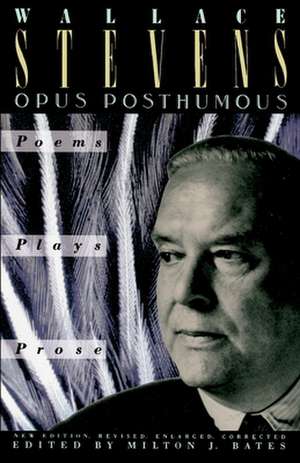
Opus Posthumous
Autor Wallace Stevensen Limba Engleză Paperback – 1990
Preț: 119.20 lei
Puncte Express: 179
Carte disponibilă
Livrare economică 02-16 noiembrie
Livrare prin curier în România Termenul estimat este afișat lângă disponibilitate.
Transport gratuit de la 400.00 lei Plată online sau ramburs, în funcție de opțiunile comenzii.
Retur gratuit în 14 zile Comandă securizată și suport în română.
Specificații
ISBN-13: 9780679725343
ISBN-10: 0679725342
Pagini: 354
Dimensiuni: 140 x 216 x 21 mm
Greutate: 0.44 kg
Ediția:Revised, Enlarg.
Editura: Knopf Doubleday Publishing Group
ISBN-10: 0679725342
Pagini: 354
Dimensiuni: 140 x 216 x 21 mm
Greutate: 0.44 kg
Ediția:Revised, Enlarg.
Editura: Knopf Doubleday Publishing Group
V-ar putea interesa
-
 Dancing Wu Li Masters, TheGary ZukavPreț: 109.87 lei
 -
 MarkingsDag HammarskjoldPreț: 97.84 lei
 -
 Preț: 93.76 lei
 -
 Same LifeMaureen N. McLanePreț: 79.86 lei
 -
 Selected PoemsWallace Stevens-20%Preț: 96.34 lei120.46 lei
 -
 Wallace StevensRobert ButtelPreț: 354.72 lei
 -
 A Little, AloudAngela Macmillan-17%Preț: 101.08 lei122.51 lei
 -
 Preț: 484.07 lei
 -
 Preț: 223.89 lei
 -
 But Who's Counting?Zelda Leah GatuskinPreț: 74.29 lei
 -
 The Collected Poems of Wallace Stevens (Pulitzer Prize Winner)Wallace StevensPreț: 119.81 lei
 -
 Cultural StudiesChris Barker-12%Preț: 468.55 lei532.44 lei
 -
 Poems to FriendsVenantius Fortunatus-18%Preț: 113.35 lei137.83 lei
 -
 A Village LifeLouise GluckPreț: 69.57 lei
 -
 A Light Song of LightKei MillerPreț: 69.02 lei
 -
 What's Become of Cultural Studies?Graeme Turner-15%Preț: 591.92 lei696.37 lei
 -
 HarmHillary GravendykPreț: 84.47 lei
Notă biografică
Wallace Stevens was born in Reading, Pennsylvania, on October 2, 1879, and died in Hartford, Connecticut, on August 2, 1955. Although he had contributed to the Harvard Advocate while in college, he began to gain general recognition only when Harriet Monroe included four of his poems in a sepcial 1914 wartime issue of Poetry. Harmonium, his first volume of poems, was published in 1923, and was followed by Ideas of Order (1936), The Man with the Blue Guitar (1937), Parts of a World (1942), Transport to Summer (1947), The Auroras of Autumn (1950), The Necessary Angel (a volume of essays, 1951), The Collected Poems of Wallace Stevens (1954), and Opus Posthumous (first published in 1957, edited by Samuel Frued Morse; a new, revised, and corrected edition by Milton J. Bates, 1989). Mr. Stevens was awarded the Bollingen Prize in Poetry of the Yale University Library for 1949. In 1951 he won the National Book Award in Poetry for The Auroras of Autumn, in 1955 he won it a second time for The Collected Poems of Wallace Stevens, which was also awarded the Pulitzer Prize in Poetry in 1955. From 1916 on, he was associated with the Hartford Accident and Indemnity Company, of which he became vice president in 1934.
Textul de pe ultima copertă
This book has been edited to correct the previous editions errors and to incorporate material that has come to light since original publication. A third of the poems and essays in this edition are new to the volume.