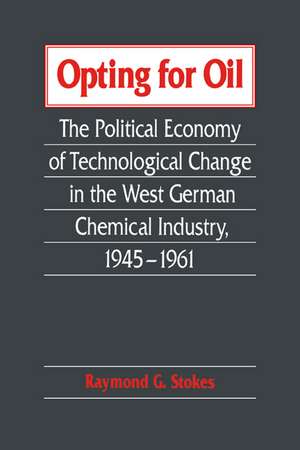
Opting for Oil
Autor Raymond G. Stokesen Limba Engleză Hardback – 11 iun 2015
Preț: 530.76 lei
Preț vechi: 596.36 lei
-11%
Puncte Express: 796
Carte tipărită la comandă
Livrare economică 19 noiembrie-03 decembrie
Livrare prin curier în România Termenul estimat este afișat lângă disponibilitate.
Transport gratuit pentru acest produs Plată online sau ramburs, în funcție de opțiunile comenzii.
Retur gratuit în 14 zile Comandă securizată și suport în română.
Specificații
ISBN-13: 9780521451246
ISBN-10: 0521451248
Pagini: 274
Dimensiuni: 161 x 240 x 19 mm
Greutate: 0.58 kg
Ediția:New.
Editura: Cambridge University Press
Locul publicării:New York, United States
ISBN-10: 0521451248
Pagini: 274
Dimensiuni: 161 x 240 x 19 mm
Greutate: 0.58 kg
Ediția:New.
Editura: Cambridge University Press
Locul publicării:New York, United States
Cuprins
Introduction; Part I. Background: 1. Politics and technological excellence: organic chemicals, 1860–1945: 2. Western German chemicals in flux, 1945–55; Part II. Bargaining from Strength: The Political Economy Of Technological Change, 1945–55: 3. A new agenda, 1949–55: Cold War, changing energy patterns and the development of West German chemical technology; 4. Rejoining the international community: international cooperation and technology transfer, 1951–5; Part III. Alternative Paths to Plenty: Case Studies from the mid-1950s: 5. Fifty-fifty with the petroleum multinationals: BASF, Shell, and Rheinische Olefinwerke; 6. Fifty-fifty with the petroleum multinationals: Bayer, British Petroleum, and Erdölchemie; 7. Going it alone: Hoechst; 8. State's interest and technological change: Hüls and cold-rubber technology; 9. End game strategies: the German coal industry and the Fischer–Tropsch process; Part IV. Consolidating the New Regime, 1957–61: 10. Petrochemicals triumphant, 1957–61; 11. Conclusion; Index.
Recenzii
'… finely crafted … fine achievement in scholarly analysis.' Nature
Descriere
An analysis of how the West German chemical industry regained and then retained a competitive position in world markets from 1945–61.