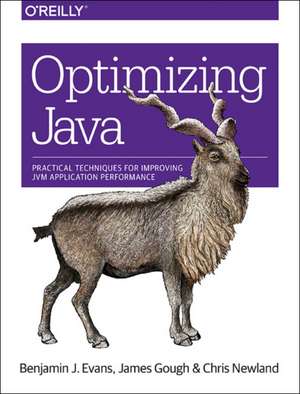
Optimizing Java
Autor Benjamin J. Evans, James Gough, Chris Newlanden Limba Engleză Paperback – 26 apr 2018
Autorii Benjamin J. Evans, James Gough și Chris Newland aduc în acest volum o vastă experiență practică acumulată în optimizarea sistemelor critice, oferind o perspectivă tehnică riguroasă asupra ecosistemului Java. Ne-a atras atenția refuzul lor de a oferi „rețete magice”, alegând în schimb să trateze optimizarea ca pe o disciplină experimentală, fundamentată pe date măsurabile. Subliniem faptul că volumul nu se limitează la teoria internă a mașinii virtuale, ci plasează performanța în contextul modern al infrastructurilor cloud.
Credem că valoarea adăugată a acestei lucrări rezidă în modul în care explică interacțiunea dintre codul Java și hardware-ul contemporan. Autorii analizează în detaliu cum arhitectura procesorului și sistemul de operare influențează execuția, oferind tehnici concrete pentru ambalarea, desfășurarea și depanarea aplicațiilor în medii native cloud. Complementar lui Java Performance de Scott Oaks, care se concentrează pe mecanismele interne ale JVM și versiunile LTS, acest volum acoperă zona critică a observabilității în sistemele distribuite și impactul virtualizării asupra performanței.
Structura este una progresivă, de la fundamentele hardware la tehnici avansate de concurență. În loc să livreze algoritmi gata făcuți, Optimizing Java învață cititorul cum să definească obiective de performanță și cum să utilizeze instrumente de profilare pentru a atinge acele ținte fără a cădea în capcana microbenchmarking-ului eronat. Este o resursă tehnică ce transformă intuiția în metodologie, esențială pentru inginerii care gestionează sisteme cu trafic ridicat unde fiecare milisecundă contează.
Preț: 389.70 lei
Preț vechi: 487.12 lei
-20%
Carte tipărită la comandă
Livrare economică 23 noiembrie-07 decembrie
Specificații
ISBN-10: 1492025798
Pagini: 400
Dimensiuni: 178 x 233 x 23 mm
Greutate: 0.68 kg
Ediția:1
Editura: O'Reilly
V-ar putea interesa
-
 Thinking in JavaBruce Eckel-20%Preț: 406.17 lei507.71 lei
 -
 -20%Preț: 365.08 lei456.35 lei
 -
 -20%Preț: 291.24 lei364.05 lei
 -
 Effective JavaJoshua Bloch-20%Preț: 322.10 lei402.63 lei
 -
 Clean Code: A Handbook of Agile Software CraftsmanshipRobert Martin-20%Preț: 366.47 lei458.09 lei
 -
 Preț: 42.38 lei
 -
 Java Concurrency in PracticeBrian Goetz-20%Preț: 294.27 lei367.84 lei
 -
 -20%Preț: 316.22 lei395.27 lei
 -
 Real-World Java: Helping You Navigate the Java Eco systemJeanne Boyarsky-20%Preț: 320.06 lei400.08 lei
 -
 Java Essentials for DummiesDoug Lowe-20%Preț: 78.97 lei98.70 lei
 -
 -20%Preț: 306.30 lei382.88 lei
 -
 The Enterprise Big Data LakeAlex Gorelik-20%Preț: 378.05 lei472.57 lei
 -
 Reactive Programming with RxJavaBen Christiansen-20%Preț: 235.02 lei293.77 lei
 -
 Identity and Data Security for Web DevelopmentJonathan Leblanc-20%Preț: 236.63 lei295.78 lei
 -
 Designing Web APIsBrenda Jin-20%Preț: 217.70 lei272.13 lei
 -
 Database InternalsAlex Petrov-20%Preț: 326.38 lei407.98 lei
 -
 Microservices: Up and RunningRonnie Mitra-20%Preț: 278.55 lei348.20 lei
 -
 -36%Preț: 204.62 lei317.67 lei
 -
 The Well-Grounded Java DeveloperBenjamin Evans-20%Preț: 379.31 lei474.14 lei
 -
 Troubleshooting Java, Second EditionLaurentiu Spilca-20%Preț: 407.57 lei509.47 lei
 -
 Benchmarking, Measuring, and OptimizingWeiwei Lin-20%Preț: 816.16 lei1020.20 lei
De ce să citești această carte
Recomandăm această carte inginerilor Java de nivel intermediar și avansat care doresc să elimine presupunerile din procesul de tuning. Cititorul câștigă o metodologie riguroasă de analiză a performanței, învățând să utilizeze corect instrumentele de monitorizare și să optimizeze aplicațiile pentru medii cloud native. Este un ghid practic pentru cei care vor să înțeleagă cu adevărat cum rulează codul lor pe hardware-ul modern.
Despre autor
Benjamin J. Evans, James Gough și Chris Newland sunt figuri proeminente în comunitatea Java, recunoscuți pentru contribuțiile lor la dezvoltarea ecosistemului și pentru expertiza în sisteme de înaltă performanță. Benjamin Evans este Java Champion și co-fondator al jClarity, o companie specializată în instrumente de performanță (achiziționată de Microsoft). James Gough este un arhitect software cu experiență vastă în sisteme bancare, iar Chris Newland este creatorul proiectului JITWatch, un instrument esențial pentru vizualizarea deciziilor de compilare ale mașinii virtuale Java.
Notă biografică
Ben Evans is the Co-founder and Technology Fellow of jClarity, a startup which delivers performance tools to help development & ops teams. He helps to organise the London Java Community, and represents them on the Java Community Process Executive Committee where he works to define new standards for the Java ecosystem. He is a Java Champion; JavaOne Rockstar; co-author of "The Well-Grounded Java Developer” and a regular public speaker on the Java platform, performance, concurrency, and related topics.
James (Jim) Gough is a Java developer and author. Jim first became interested in Java during his degree program at the University of Warwick, and after graduating he became a member of the London Java Community. Community has remained central to Jim's contributions, which include working on the design and testing of JSR-310 and serving on the Java Community Process Executive Committee for several years. Jim is a regular conference speaker and is currently focused on building customer facing technology at Morgan Stanley. He spent four years teaching Java and C++ in various countries around the world.
Chris Newland has been working with Java since 1999 when he started his career using the language to implement intelligent agent systems. He is now a senior developer and team lead at ADVFN using Java to process stock market data in real time. Chris is the inventor of JITWatch (https://github.com/AdoptOpenJDK/jitwatch), an open-source visualiser for understanding the Just-In-Time (JIT) compilation decisions made by the HotSpot JVM. He is a keen JavaFX supporter and runs a community OpenJFX build server at https://chriswhocodes.com. Follow him on Twitter@chriswhocodes