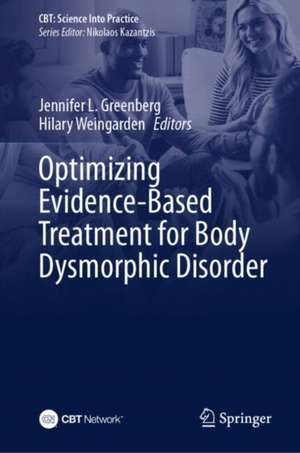
Optimizing Evidence-Based Treatment for Body Dysmorphic Disorder: CBT: Science Into Practice
Editat de Jennifer L. Greenberg, Hilary Weingardenen Limba Engleză Hardback – 2 dec 2024
Subliniem contribuția esențială a editorilor Jennifer L. Greenberg și Hilary Weingarden, care reunesc în acest volum expertiza clinică necesară abordării tulburării dismorfice corporale (BDD), o patologie marcată de o suferință psihologică profundă și o rată alarmantă a morbidității. Putem afirma că această lucrare, publicată în prestigioasa serie CBT: Science Into Practice, reprezintă un ghid metodologic indispensabil pentru practicienii care se confruntă cu o afecțiune adesea subdiagnosticată, în ciuda impactului său devastator asupra funcționării sociale și profesionale. Notăm cu interes structura riguroasă a volumului, care ghidează cititorul de la criteriile de diagnostic și evaluare, până la intervențiile complexe de tip cognitiv-comportamental. Primele capitole stabilesc cadrul clinic și diagnosticul diferențial, în timp ce secțiunile centrale aprofundează modelul CBT și managementul farmacologic. Un element de noutate absolută este Capitolul 8, dedicat tratamentelor nerecomandate, oferind medicului o busolă etică și clinică în evitarea intervențiilor ineficiente. Acolo unde Body Dysmorphic Disorder de David Veale oferă o privire de ansamblu asupra cadrului de tratament, acest volum aprofundează optimizarea protocoalelor pentru populații specifice, incluzând variante precum dismorfia musculară și BDD-by-proxy. Progresia materialului este logică, adresând succesiv barierele de tratament, rolul familiei în cazul adolescenților și perspectivele cross-culturale. Integrarea studiilor de caz permite o înțelegere nuanțată a pacienților care prezintă un nivel scăzut de introspecție sau rezistență la schimbare. Optimizing Evidence-Based Treatment for Body Dysmorphic Disorder nu este doar un manual teoretic, ci un instrument de lucru care transformă datele științifice în pași clinici concreți, esențiali pentru îmbunătățirea calității vieții pacienților.






Preț: 1103.75 lei
Preț vechi: 1161.85 lei
-5%
Carte disponibilă
Livrare economică 19 octombrie-02 noiembrie
Specificații
ISBN-10: 3031653386
Pagini: 240
Ilustrații: Approx. 310 p.
Dimensiuni: 160 x 241 x 18 mm
Greutate: 0.57 kg
Ediția:2024
Editura: Springer
Colecția CBT: Science Into Practice
Seria CBT: Science Into Practice
Locul publicării:Cham, Switzerland
V-ar putea interesa
-
 Body Dysmorphic DisorderFugen Neziroglu-5%Preț: 170.10 lei179.04 lei
 -
 Cognitive-Behavioral Treatment of Borderline Personality DisorderMarsha M. Linehan-15%Preț: 561.12 lei660.14 lei
 -
 Cognitive Behavioral Group TherapyIngrid Sochting-23%Preț: 608.92 lei790.81 lei
 -
 -5%Preț: 413.48 lei435.24 lei
 -
 Cognitive-Behavioral Treatment of PerfectionismSarah J. Egan-5%Preț: 313.76 lei330.28 lei
 -
 -5%Preț: 314.45 lei331.00 lei
 -
 -5%Preț: 857.79 lei902.93 lei
 -
 Treating Eating Disorders with DBT: The MED-DBT ProtocolAnita Federici-5%Preț: 329.83 lei347.19 lei
 -
 -25%Preț: 69.94 lei93.58 lei
 -
 -25%Preț: 69.71 lei93.27 lei
 -
 -27%Preț: 51.00 lei70.16 lei
 -
 -5%Preț: 424.60 lei446.94 lei
 -
 Cognitive Behavior Therapy and Eating DisordersChristopher G. Fairburn-5%Preț: 427.75 lei450.26 lei
 -
 Appearance Anxiety: A Guide to Understanding Body Dysmorphic Disorder for Young People, Families and ProfessionalsBDD and Related Disorders Service The National and Specialist OCD-21%Preț: 105.74 lei134.19 lei
 -
 CBT to Support Adults with ADHD: A Therapist's GuideAntonia Dittner-26%Preț: 213.66 lei288.79 lei
 -
 Letting Go of Perfect: A Gay Man’s Guide to Healing from Body DysmorphiaDaniel O’Shaughnessy-20%Preț: 108.96 lei136.24 lei
 -
 -19%Preț: 126.25 lei155.92 lei
 -
 Trauma-Informed and Embodied Approaches to Body Dysmorphic DisorderNicole Schnackenberg-29%Preț: 203.77 lei288.22 lei
 -
 -19%Preț: 120.65 lei148.38 lei
De ce să citești această carte
Această resursă se adresează psihologilor clinicieni și psihiatrilor care doresc să stăpânească protocoalele de ultimă oră pentru BDD. Cititorul câștigă o înțelegere profundă a tehnicilor CBT specifice și a managementului riscului de suicid, frecvent în această patologie. Este o lectură necesară pentru a diferenția corect BDD de alte tulburări și pentru a implementa strategii terapeutice validate, evitând intervențiile estetice sau dermatologice care pot agrava simptomatologia.
Despre autor
Dr. Jennifer L. Greenberg și Dr. Hilary Weingarden sunt experți recunoscuți în psihologia clinică, cu o activitate susținută în cadrul unor instituții academice și clinice de prestigiu afiliate domeniului sănătății mintale. Jennifer L. Greenberg are o vastă experiență în cercetarea și tratamentul tulburărilor de imagine corporală, publicând numeroase articole despre eficacitatea terapiei cognitiv-comportamentale. Hilary Weingarden se specializează în mecanismele psihologice ale BDD și în dezvoltarea intervențiilor digitale și clinice pentru această populație. Ambii editori sunt afiliați seriei CBT: Science Into Practice, contribuind la traducerea cercetării empirice în protocoale de tratament aplicabile imediat în cabinet.
Descriere scurtă
Cuprins
Notă biografică
Hilary Weingarden, PhD, is a psychologist in the Center for OCD and Related Disorders at Massachusetts General Hospital (MGH), Assistant Director of the MGH Psychiatry Center for Digital Mental Health, and Assistant Professor of Psychology (Psychiatry) at Harvard Medical School. Dr. Weingarden is a licensed psychologist with expertise in evidence-based treatments for OCD, body dysmorphic disorder (BDD), and related disorders. She also conducts clinical research funded by the National Institute of Mental Health and Harvard Medical School, focused on the harmful role of shame in BDD and obsessive compulsive related disorders (OCRDs) and on leveraging technology to enhance the assessment and treatment of BDD and OCRDs. She has published widely on BDD and OCRDs and has been invited to speak nationally and internationally, as well as to media outlets, about BDD, OCRDs, and body image. Dr. Weingarden serves on the grant review committee for the International OCD Foundation and editorial board for the Journal of Obsessive Compulsive Related Disorders.